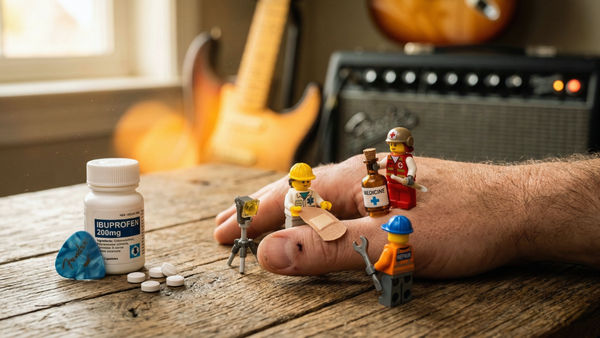
3 Arthritis 'Reset' Moves to Do Before You Pick Up the Guitar


Two Minutes That Change How Your Hands Feel for the Next Hour
This is more than another generic warm up, this is waking your hands up so they actually listen.
Have you ever sat down to play, picked up the guitar and noticed your hands feel... tight. Stiff. Like they haven't quite woken up yet. And you haven't even started playing.
So what do you do? Im guessing if you like me you normally push through. You grip a chord. You try to make your fingers cooperate. And it takes five, ten, sometimes fifteen minutes before they start feeling even remotely fluid.
By that point, you've already created tension trying to force stiff hands to do things they weren't ready for. And the rest of your session carries that pattern forward.
Here's what we often don't realize: that morning stiffness, that locked-up feeling it's not permanent damage. It's your nervous system being protective.
And it responds by tightening everything up as a protective mechanism.
But here's the thing: you can shift that pattern. You can tell your nervous system, "Hey, we're okay. You can relax. We're going to move gently.
And when you do that, when you give your hands a two-minute 'reset' before you play and respect that they need it, well then they respond differently. They loosen. They cooperate. They remember they can move.
This week, I'm going to show you three simple moves that address the specific stiffness patterns arthritis creates. These moves are the foundation of what I call The Comfort System an approach to resetting the body before we ever touch the strings.
Not generic stretches. Not complicated routines. Just three deliberate resets that wake your hands up, calm your nervous system down, and give you a fighting chance at comfortable playing from the first chord."
Why "Warming Up" Isn't Enough for Arthritic Hands
Alright, let's talk about why the standard warm-up advice doesn't quite work when you're dealing with arthritis.
Most warm-up routines are designed for healthy, flexible joints. They assume your baseline is neutral. they assume that your hands are ready to go, they just need a little "activation."
But with arthritis, your baseline isn't neutral. It's protective.
Your nervous system has learned: "These joints have inflammation. These joints have changed structurally. Movement might hurt. Better lock everything down until we're sure it's safe."
So you wake up with stiff hands. Not because your joints are fused or because you've lost all mobility, but because your nervous system has preemptively tightened everything as a precaution.
And here's the problem with jumping straight into standard warm-ups: if you start moving stiff joints without first telling your nervous system it's safe to relax, you're just fighting resistance.
You're trying to stretch tight tissue. You're trying to bend joints that are being actively braced by protective muscle tension.
And thats why it often feels hard and frustrating and sometimes painful.
That's why you need a reset first.
A reset isn't about stretching or strengthening. It's about signaling safety to your nervous system so it stops bracing and allows your hands to move the way they're designed to.
When that happens, when your nervous system gets the message that movement is okay, the stiffness starts to release. No not completely. And no, not magically. But enough that you can actually play without fighting your body from the first chord.
The 3 Reset Moves (2 Minutes Total)
These aren't stretches in the traditional sense. They're neurological resets that address the specific patterns arthritis creates.
You can do them sitting at your desk, in your car, on the couch anywhere really. You don't need your guitar. You don't need special equipment.
Just two minutes and your hands.
Reset Move #1: The Hand Soak (Warm Water Alternative)
If you have access to warm water:
Run your hands under warm (not hot) water for 30-60 seconds. Let the warmth penetrate. Gently open and close your fingers under the water. Rotate your wrists slowly.
Why this works:
Warmth increases blood flow to stiff joints and signals safety to your nervous system. The combination of heat + gentle movement tells your body: "We're not in danger. We can relax."
If you don't have access to water:
Rub your hands together vigorously for 20-30 seconds until they feel warm. Then gently squeeze each hand with the opposite hand, applying gentle pressure to the palm and back of the hand. This creates friction, increases circulation, and mimics the soothing effect of warm water.
Key detail:
Don't skip this step just because it seems too simple.
Many guitarists with arthritis I've worked with report that this one move just warming the hands first changes their entire playing session. This is about signalling to your brain it's ok for the hands to relax, simple but very effective.
Reset Move #2: The Gentle Fist-to-Fan (Joint Mobilization)
How to do it:
- Start with your hands open, fingers gently extended (not forced straight).
- Slowly curl your fingers into a soft fist. Not tight. Not gripping. Just a gentle curl.
- Hold for 2 seconds.
- Slowly open your hand, spreading your fingers wide like a fan.
- Hold for 2 seconds.
- Repeat 5-8 times per hand.
Why this works:
This move takes each finger joint through its full available range without force or pressure. It's exploratory, not aggressive.
You're not trying to achieve maximum closure or maximum extension. You're just showing your nervous system: "Look, we can move through this range. It's safe. There's no threat here."
And as you repeat the movement, your nervous system starts to believe it. The protective bracing eases. The joints feel less locked.
Key detail:
Focus on smooth, controlled movement. If a joint feels particularly stiff, don't force it. Just move to the edge of comfortable range and hold there for a breath. That's the reset. Not the stretch.
Reset Move #3: The Thumb-to-Finger Touch (Fine Motor Wake-Up)
How to do it:
- Touch the tip of your thumb to the tip of your index finger. Hold for 1 second.
- Release and touch your thumb to your middle finger. Hold.
- Continue to ring finger, then pinky.
- Reverse the sequence: pinky, ring, middle, index.
- Repeat the full sequence 3-4 times per hand.
Why this works:
This move activates the small intrinsic muscles of your hand and wakes up the neurological pathways that control fine motor coordination.
When you have arthritis, these pathways can get "sleepy", not because they're damaged, but because your nervous system has been avoiding activating them to prevent potential discomfort.
This gentle, precise movement pattern tells your brain: "We're about to need these pathways. Time to wake them up."
And by the time you pick up the guitar, your fingers are ready to respond. They're not starting from zero. They're starting from awake.
Key detail:
Make actual contact between thumb and fingertip. Don't just approximate it. The tactile feedback: the sensation of touch, is part of what wakes the system up.
Why These 3 Moves (And Not Others)
Look, there are a hundred different stretches and exercises you could do. So why these three?
Because these three address the specific patterns arthritis creates:
Move #1 (Warm Water/Hand Rub) addresses the physiological stiffness.
Arthritis often comes with reduced circulation and tissue stiffness, especially in the morning or after periods of inactivity. Warmth increases blood flow and tissue pliability.
Move #2 (Fist-to-Fan) addresses the protective bracing pattern.
Your nervous system locks your joints in mid-range to avoid potential pain. This move gently explores full range without triggering the threat response.
Move #3 (Thumb-to-Finger) addresses the fine motor coordination.
Arthritis disrupts the precise control needed for fretting and fingerpicking. This move reactivates those neural pathways before you ask them to do complex work.
Together, they form a complete reset:
Physiology (warmth) → Range of motion (joint mobilization) → Motor control (fine coordination)
And it takes two minutes. Not twenty. Not ten. Two.
That's the difference between starting your practice session fighting your hands and starting it with your hands ready to cooperate.
When to Do the Reset
Here's the practical question: when do you actually do this?
Best time: Right before you pick up the guitar.
Literally. Do these three moves, then immediately sit down and play. Don't wait ten minutes. Don't do other things first. The reset is most effective when it's immediately followed by the activity you're preparing for.
Also helpful:
- First thing in the morning if you wake up with stiff hands
- After sitting at a desk for hours before an evening practice session
- In the car before walking into a lesson or jam session
- Anytime your hands feel locked up and you need to reset the baseline
Pro tip:
If you're practicing for more than 20 minutes, do a quick mini-reset halfway through. Just the fist-to-fan move (10 reps) and the thumb-to-finger touches (2 rounds). Takes 30 seconds and keeps your hands from tightening back up.
What This Actually Changes
So what happens when you make this a habit? When you do the reset before every playing session for two weeks?
Here's what I've seen with players who commit to it:
Playing sessions start easier. You're not spending the first 10-15 minutes trying to get your hands to cooperate. They're ready from the first chord.
Grip pressure naturally lightens. When your nervous system isn't in protective mode, you don't unconsciously over-grip. Your hands relax. Your technique improves.
Playing time increases. When you start from a place of ease instead of stiffness, you can play longer before fatigue sets in.
Recovery improves. When you're not fighting protective tension the whole session, your hands don't feel as beaten up afterward.
And here's the weirdest part: the reset gets faster over time.
At first, it might take the full two minutes for your hands to feel ready. But after a couple weeks of consistent practice, your nervous system learns the pattern. It starts anticipating the reset. And your hands wake up faster.
Some players report that after a month, just doing the hand rub alone is enough to trigger the full relaxation response. Because their nervous system has learned: "Oh, we're doing the reset thing. Time to let go."
That's neuroplasticity. That's your body learning a new pattern.
The Thing Nobody Tells You About Arthritis Stiffness
Alright, here's something most people don't understand about arthritis:
The stiffness you feel isn't always the arthritis itself. Often, it's your nervous system's response to the arthritis.
Yes, there are structural changes in your joints. Yes, there's inflammation. Yes, there's real physiological stuff happening.
But a huge portion of the stiffness, especially the kind that eases up once you start moving, is your nervous system being protective.
It's tightening muscles around the affected joints. It's reducing available range of motion. It's making movement feel harder than it needs to be.
Not to hurt you. But to protect you from potential harm.
But here's the thing: you can work with that protective response.
You can show your nervous system that gentle, controlled movement is safe.
That opening and closing your hand isn't dangerous.
That warming the tissues and exploring range doesn't lead to pain.
And when you do that consistently, when you establish a pattern where movement is followed by safety, not threat then your nervous system starts to relax its grip.
The stiffness eases. The range increases. The playing feels less like forcing and more like flowing.
That's what the reset does. It's a conversation with your nervous system, not a battle with your joints.
Try This: The 7-Day Reset Challenge
Here's a simple experiment to see if this works for you:
For the next 7 days, do the 3 reset moves before every playing session. No exceptions.
Even if your hands feel fine. Even if you're in a hurry. Even if it seems unnecessary.
Just do the two minutes. Warm water or hand rub. Fist-to-fan. Thumb-to-finger.
Track three things:
- How long does it take for your hands to feel fluid? (Compare day 1 to day 7)
- How does your grip feel during the first song? (Tight? Relaxed?)
- How do your hands feel the next morning? (More stiff? Less stiff? Same?)
At the end of 7 days, ask yourself:
- Did the reset make a difference?
- Did your hands wake up faster as the week went on?
- Is two minutes worth the benefit you're getting?
Most players I've worked with are shocked at how much difference this makes. Not because it's some "miracle cure." But because it addresses the actual pattern that's creating the stiffness.
And once you know that pattern can shift, everything else gets easier.
When the Reset Isn't Enough
Look, I'm not going to BS you that three reset moves will solve everything about your hand stiffness when playing or that it's going to "fix" or :cure: anything.
God knows theres enough people on the internet, and I'm sure you've encountered them trying to tell you they have the "magic fix."
If you're dealing with significant arthritis, these moves will help. But they're part of a bigger picture, not the whole solution.
You also need:
- Proper guitar setup (low action, light strings). See my post on Easiest Guitars to Play with Arthritis here
- Smart technique (minimal grip pressure, efficient movement)
- Regular breaks during practice
- Post-playing recovery routine
The reset is your entry point. It gets your hands ready. But everything else still matters.
And if you're experiencing persistent pain that doesn't ease with movement, or if your range of motion is significantly restricted, check in with a healthcare provider.
These resets work best for the protective stiffness pattern, that is the nervous system bracing that's separate from the structural changes. They won't reverse joint damage. They won't eliminate inflammation.
But they will give you better access to whatever mobility you do have. And for most players with arthritis, that's the difference between playing comfortably and not playing at all.
F.P.
Founder, Gentle Octaves

F.P. O’Connor
F.P. O'Connor is a Musician and Movement Specialist whose work is informed by extensive training in Manual Osteopathy, Psychology, and Strength Coaching.
He is the founder of Gentle Octaves, helping adult players develop practical, science-based systems for ease, control, and long-term playing confidence.
FAQ
Q: How is this different from a regular warm-up routine?
These moves calm joint protection before you ask for strength or dexterity.
Most warm-ups assume your baseline is neutral and just need activation. Arthritis changes that baseline. The nervous system often pre-emptively braces joints to avoid pain.
These reset moves reduce that guarding first, so movement happens with less resistance.
Q: Do I need arthritis to benefit from these reset moves?
No they help anyone dealing with stiffness or age-related hand tension.
Even without a diagnosis, repetitive playing, stress, or cold weather can trigger joint guarding. Reset moves improve circulation and signal safety, which benefits most adult players.
If your hands feel “rusty” at the start of practice, use the reset.
Q: How long should the full reset take?
About 5-10 minutes total.
The goal isn’t fatigue or stretching to end range. It’s short, gentle input that tells the nervous system it’s safe to reduce tension. More isn’t better here.
You should finish feeling ready, not worked.
Q: Can I do these reset moves multiple times in one session?
Yes especially during longer practice sessions.
Joint guarding can creep back in under sustained load. A quick mid-session reset (30–60 seconds) often prevents the hands from tightening again and extends comfortable playing time.
If grip pressure starts climbing, pause and reset.
Q: What if I feel clicking, popping, or mild discomfort during a reset?
That’s feedback not something to push through.
Clicking or discomfort usually means tissues are adjusting or a range is too aggressive for today. Slow down, reduce range, and stop before pain. Reset is about reducing threat, not challenging joints. If pain increases, scale it back immediately.
Q: Is warm water necessary, or can I skip that step?
Warm water helps, but it’s not mandatory.
Heat increases circulation and tissue pliability, making joints more receptive. If warm water isn’t available, hand rubbing creates friction and achieves a similar effect, just less intensely.
Q: Will these reset moves replace technical or strength practice?
No they prepare your body to benefit from it.
Reset clears unnecessary tension so technique and strength work can be performed with less strain. Skipping reset often leads to reinforcing compensations instead of building usable skill.
Q: Where do these resets fit in Release → Reset → Rebuild™?
They are the entry point to Reset.
Release reduces accumulated tension. Reset restores usable movement. Rebuild adds strength and control. Skipping Reset is why relief often doesn’t last.
Sources & Science
- Brosseau L, Yonge KA, Robinson V, Marchand S, Judd M, Wells G, Tugwell P. Thermotherapy for treatment of osteoarthritis. Cochrane Database Syst Rev. (2003) PMCID: https://pubmed.ncbi.nlm.nih.gov/14584019/
- Butler, D. S., & Moseley, G. L. (2013). Explain pain (2nd ed.). Noigroup Publications.
- Vlaeyen, J. W., & Linton, S. J. (2000). Fear-avoidance and its consequences in chronic musculoskeletal pain. Pain, 85(3), 317-332. https://pubmed.ncbi.nlm.nih.gov/10781906/
Read More
Easiest Guitar to Play with Arthritis: Finding the Best Guitars for Comfortable Playing
You don't adapt your hands to fit the guitar. You find the guitar that fits your hands. What actually matters for arthritic hands.
The 10-Minute Warm-Up & Cool-Down That Protects Your Playing Years
After you've done your reset moves, follow them with this warm-up routine for maximum comfort and sustainability.