A Supportive Playing Sequence for Guitarists Over 40

Most guitar plans skip this crucial middle step. Yours won’t.
If you play guitar long enough, your body will eventually give you a few gentle reminders that you need to take care of it.
Sometimes it's mild hand pain. Sometimes it's a shoulder screaming "stop."
Sometimes it's just this nagging sense that playing doesn't feel as good as it used to like something's off but you can't quite name it.
So maybe you listened. Maybe you started stretching your hands before and after playing. Maybe you took some breaks. Maybe you rested for a few weeks hoping it would just go away.
And for a little while, maybe it helped.
But then you came back to playing and... yeah...maybe the he pain came back too. Maybe not as sharp. Maybe not as immediate. But it's there. Still lingering. Still limiting you.
And you start thinking: "Why does my hand still hurt even after all the stretches?"
And you start wondering:
“Why do my hands still feel off even after all the stretches?”
Here’s the answer most players never hear:
You’ve probably been following an incomplete plan.
That’s not your fault. Most advice for guitarists focuses on isolated symptoms, not the whole system.
You’re given stretches without ever looking at why certain areas tightened up in the first place.You’re told to rest, but not shown how to return to playing with more awareness, control, or confidence.
And especially after 40, your body often needs more than random stretches or hopeful time off.
It needs rhythm.
It needs clarity.
It needs a smarter, more structured approach.
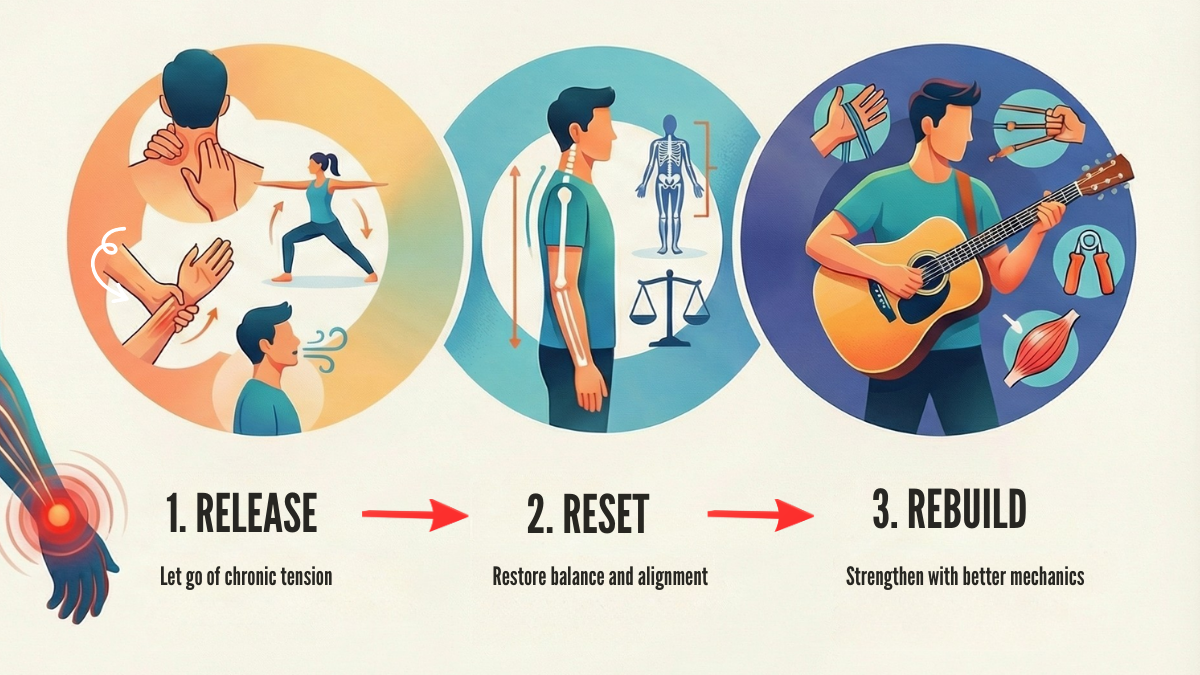
In this post, I’m going to walk you through the three-phase framework I use with players to help them understand and reorganize how they move and play:
Release → Reset → Rebuild™
This isn’t abstract theory.
It’s a practical sequence and the order matters.
Why Most Recovery Plans Don’t Stick
Ask most adult guitarists dealing with discomfort and you'll hear some version of this:
"I've tried rest. I've tried gadgets. I've tried stretches. Nothing lasts."
And I believe them because they usually only reach out to me when nothing else has worked. And usually it's because most plans only target the symptom, not the system.
Where Most Guitar Pain Advice Misses
- Stretching isolated areas without identifying where compensation is coming from
- Chasing tightness instead of understanding load and movement patterns
- Treating hands as the problem, when they’re often just the end of the chain
When you don’t address the upstream pattern, relief is temporary no matter how often you stretch.
Stretching without addressing compensation patterns.
You stretch your wrist, but you never look at why your wrist got tight in the first place. Maybe it's because your shoulder's stiff and your wrist's been picking up the slack. So you stretch and stretch and stretch, but the compensation pattern stays the same. The tension just comes back.
Strengthening without resetting posture or breath.
You try to build strength on top of dysfunction. But you can't strengthen your way out of poor mechanics. If your posture's collapsed or your breathing's shallow or your nervous system's stuck in protective mode, all that strength just reinforces the problem.
Ignoring nerve mobility or fear-based movement.
Discomfort changes how you move. You start bracing, protecting, avoiding certain positions. Your nervous system learns to be afraid. And even after the tissue heals, those protective patterns stick around. So the pain persists not because of damage, but because of the way you're moving or not moving.
As I explain in Keep Playing persistent pain often reflects motor pattern issues, not muscle tightness alone.
Your body's adapted. It's found workarounds. It's compensating. And until you address those underlying patterns, the pain will keep coming back no matter how much you stretch or rest.
Real recovery isn't about pushing harder. It's about sequencing smarter.
You have to release first. Then reset. Then rebuild. In that order. Skip a step and you're just building on a shaky foundation.
Phase 1: Release - Don't Stretch, Soften
This is where we start. Always.
And here's the thing: release is not the same as stretching.
Stretching is aggressive. It's forcing tissue to lengthen. It's pulling and pushing and trying to make something happen.
Release is gentle. It's invitation. It's permission. It's creating space for the nervous system to let go.
Most players who've been in pain for a while are stuck in fight-or-flight mode. Their body thinks it needs to brace, to protect, to guard against threat. And that shows up as chronic tension.
Tight shoulders. Clenched hands. Shallow breathing. Constant vigilance.
You can't stretch your way out of that. You have to ease the nervous system out of protective mode. You have to tell your body, in ways it can understand, that it's safe to soften.
What Release Actually Looks Like
Gentle fascial glides.
Slow, easy movements that encourage tissue to slide and glide instead of sticking. No force. Just encouragement.
Like gently rocking a tight door open instead of kicking it down.
Breath-led mobility.
Using your breath to soften tissue from the inside out. Inhale and feel your ribcage expand. Exhale and let tension drain.
Your breath is one of the most powerful tools you have for regulating your nervous system. Use it.
Observing tension, not forcing release.
Notice where you're tight. Don't immediately try to fix it. Just be with it. Breathe into it. Sometimes awareness alone is enough to start the release process.
Your body knows how to let go. You just have to give it permission.
Try This Right Now
Before your next practice session, do this simple release sequence:
- Shake your arms like you're drying rain off them. Let them be loose and floppy. 30 seconds.
- Exhale for 6 seconds, pause for 2, then inhale for 4. Repeat three times. Feel your nervous system downshift.
- Gently roll your shoulders up, back, down. Not forcing. Just moving. Letting things settle.
That's it. You're not trying to accomplish anything. You're just creating space. Softening. Releasing.
Release first because focus grows roots in loosened ground.
You can't build on top of chronic tension. You have to let go first. Then you can start rebuilding.
I have another post on a A 5-Minute Pre-Play Ritual that can be a great way to release prior to every session.
Phase 2: Reset - Rewire Before You Rebuild
Alright, so this is the phase most recovery plans completely skip.
And it's the most important one.
Because here's the thing: if your nervous system still runs the old protective script, the pain will return. Even if the stretch felt "good."
You can release all the tension in the world. You can rest for weeks.
You can stretch until you're limber as a yoga instructor. But if your body's still moving with the same faulty patterns, if it's still compensating in the same ways, the pain comes back.
Reset is where we rewire those patterns. Where we teach your body a different way of moving. Where we give your nervous system new information so it doesn't default back to the old protective strategies.
What Reset Includes
Breath and scapular rhythm.
Your shoulder blade needs to move in a coordinated way with your arm. If it's stuck or lazy, everything downstream has to compensate.
So we teach it to glide again. We reconnect the rhythm.
Nerve glides (like median and ulnar, 2 big culprits for a lot of playing related pain ).
Nerves need to slide through tissue. When they get stuck or compressed, you get pain, numbness, tingling. So we gently mobilize them.
Not stretching. Just encouraging movement.
Mirror-based awareness and coordination.
Sometimes you need to see what you're doing to understand how you're moving. Watching yourself in a mirror or filming yourself playing can be incredibly revealing.
You think you're doing one thing, but the video shows you're doing something completely different.
The Compensation Chain (Why Your Wrist Hurts When the Problem's in Your Shoulder)
I had a reader message me once. She'd been stretching her wrist for months. Nothing helped. And she was frustrated because she was doing everything "right."
She was looking for a solution but as she was about 8000 miles away asked if there was any thing she could do herself to figure out what was going on.
I had her complete some self checks, the same checks to what I have used with guitarists and refined over the years but adapted for anyone to be able to complete and understand.
I detail these self checks in Keep Playing, theres a lot you can easily learn about your own restrictions, your own movement patterns, and your own patterns when you know what to observe.
She came back after doing the self-checks and said something clicked.
Her wrist wasn’t the problem.
She realized her right shoulder wasn’t moving well, her scapula was essentially locked up. Years of computer work, constant mouse use with her dominant hand, and a collapsed seated posture had slowly taken away that movement.
So when she played guitar, her wrist had been doing work her shoulder should have been doing all along.
Once she addressed the shoulder and restored that missing movement, the compensation pattern unraveled and the wrist discomfort finally had room to settle.
She was thrilled that she was able to finally understand her own body and how movement is connected.
Now she could identify these patterns herself, and thats a skill she will use, not just in her guitar related discomfort, but across many situations she encounters in the future where her movement may be affecting her or contributing to discomfort.
She messaged me about a year after she had bought the book and said she was having low back tightness she suspected form sitting at the desk job most the day.
But she self identified how tight hamstrings were contributing and limiting the movement of her hips and she was working on releasing them.
I love those emails, they make me happy to see such a simple system have a big impact in peoples music and in their lives just form understanding more about how their body moves.
Your body's wired to adapt
If your shoulder blade isn't moving right, your elbow and wrist will pick up the slack. They'll work harder, grip tighter, carry tension they were never meant to.
That's how compensation works. It's clever until it hurts.
So yes, sometimes your wrist discomfort isn't just about your wrist. It's about the shoulder that stopped gliding, or the neck that locked up, or the breath that got shallow when things got stressful.
Reset is where we find those upstream problems and address them directly. Where we untangle the compensation chains. Where we teach your body to move the way it's designed to instead of the way it's adapted to.
A Quick Reset Practice
Before your next practice session, after you've done your release work, try this:
- Stand or sit tall. Feel your sit bones grounded.
- Shrug your shoulders up toward your ears, then slowly let them melt down your back. Notice if one side feels tighter or less coordinated than the other.
- Reach one arm forward, then slowly draw your shoulder blade back and down. Feel the glide. Repeat five times each side.
- Gently tilt your head to one side, then trace your fingers down the opposite arm. This is a basic nerve glide. You're encouraging the nerves to slide. Not stretching. Just moving. Repeat on both sides.
Do this for two minutes. That's all.
You're not trying to fix everything. You're just rewiring. Teaching your body there's another way. Giving your nervous system new information.
Phase 3: Rebuild: From Movement to Music
Now we rebuild strength. But not just any strength.
Strength with control. Strength with endurance. Strength with creativity in mind.
This phase is where we gradually reintroduce playing movements with better mechanics. Where we build functional capacity that translates directly to your guitar playing.
But here's the key: we rebuild slowly. Progressively. Respecting tissue tolerance. Giving your body time to adapt without overwhelming it.
What Rebuild Includes
Resistance band drills.
Light resistance work that builds strength in the small stabilizers. Not heavy lifting. Just gentle, controlled loading that teaches coordination and endurance.
Posture-aware playing.
Integrating everything you've learned in the release and reset phases into actual playing. Maintaining alignment and awareness while you're making music, not just during exercises.
Nervous-system loading (not overload).
Gradually increasing the challenge in a way that builds capacity without triggering protective responses. This is the difference between good stress (which makes you stronger) and bad stress (which breaks you down).
What You're Really Building Here Is Trust
Not just physical strength. Not just endurance.
Trust.
Trust in your movement. Trust in your technique. Trust in your body's ability to play without pain.
Because pain changes you psychologically as much as physically. You start second-guessing yourself. Holding back. Moving tentatively. Bracing against what might happen.
Rebuild is where you reclaim confidence. Where you prove to yourself, through consistent, progressive practice, that you can play. That your body is capable. That the pain doesn't have to control you anymore.
A Simple Rebuild Practice
Once you've been doing release and reset work consistently for a couple weeks, start adding this:
- Pick one song or exercise you know well.
- Play it for 5 minutes at 70% intensity. Not full pressure. Not maximum effort. Just comfortable engagement.
- Notice: Where does fatigue show up first? Where do you start compensating?
- Rest for 2 minutes. Shake out your hands. Breathe. Reset your posture.
- Play for another 5 minutes, maintaining awareness of those fatigue points.
That's it. You're not trying to play as long or as hard as you used to. You're building back gradually, intelligently, with awareness and control.
Over time, you increase the duration, the intensity, the complexity. But always progressively. Always respecting what your body's ready for.
It’s Not About Playing Without Discomfort: It’s About Discomfort No Longer Controlling How You Play
Let's reframe the goal here.
Because I think a lot of players get stuck chasing complete discomfort or pain elimination. Zero pain. Perfect comfort. And then anything less than that feels like failure.
But that's not realistic. Especially after 40. Especially if you've been dealing with chronic issues.
The real goal isn't to move perfectly. It's to move freely.
Not to completely "get rid" of all discomfort, but to stop shaping your playing, your practice, your day around it. To stop letting it dominate how often you choose to pick up your instrument.
You release to feel. To reconnect with your body. To understand what's happening instead of just reacting.
You reset to move. To retrain patterns. To give your nervous system new options.
You rebuild to play. To trust. To reclaim the joy and expression and creativity that brought you to music in the first place.
Discomfort might still show up sometimes. That's okay. But when it does, you'll have tools. You'll understand what's happening. You'll know how to adjust, how to adapt, how to work with it instead of against it.
That's what we're building here.
You release to feel.
You reset to move.
You rebuild to play.
Your Invitation
Option 1: Start Free
Download the free guide: Play Without Pain
You'll learn:
- The 7 pillars of guitar posture that actually matter
- How to warm up properly (release work built into your practice)
- Daily hand stretches to prevent tension and overuse
- Fretting and strumming technique that protects your joints
- A repeatable, pain-free practice routine for consistent progress
- Warning signs to look out for before pain becomes injury
Option 2: Go Complete
Get the full system: Keep Playing The Release → Reset → Rebuild™ Method for Lifelong Guitar Playing
This is the complete handbook with the entire Release → Reset → Rebuild™ framework:
- Phase-by-phase exercises with clear progressions
- Troubleshooting for specific patterns
- Nervous system regulation practices
- Long-term maintenance strategies
Start your recovery with the guide built for guitarists over 40.
No fluff. No gimmicks. Just the sequence that actually works.
You release to feel. You reset to move. You rebuild to play.
F.P
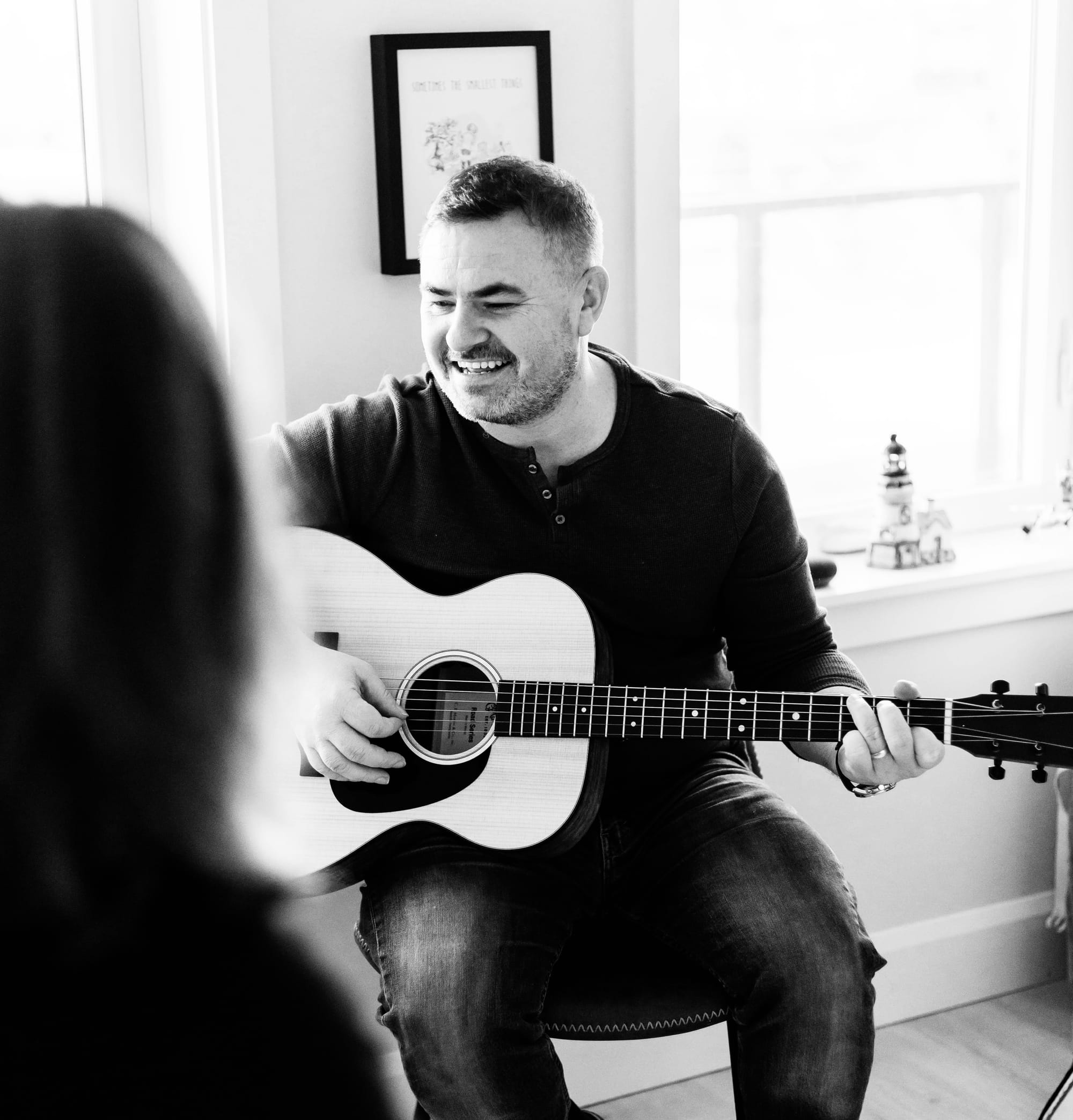
F.P. O’Connor
F.P. O'Connor is a Musician and Movement Specialist whose work is informed by extensive training in Manual Osteopathy, Psychology, and Strength Coaching.
He is the founder of Gentle Octaves, helping adult players develop practical, science-based systems for ease, control, and long-term playing confidence.
FAQ: The Release → Reset → Rebuild™ Recovery System
Q: Why do stretches help temporarily but the pain always comes back?
Because stretching reduces tension but doesn’t change the movement patterns or nervous system habits that created it.
Stretching can feel good in the moment: it increases sensation and short-term mobility. But if your body keeps returning to the same compensations (gripping, hunching, bracing), the tension simply re-accumulates.
That’s why this system is sequential:
- Release calms excessive tension
- Reset changes how you move
- Rebuild makes the change last
Skip any step and you’re chasing symptoms, not causes. If relief lasts minutes or hours but not days, something upstream hasn’t changed yet.
Q: How long should I stay in each phase before moving on?
Each phase has a minimum window, but progression depends more on response than the calendar.
A general guideline:
- Release: 1–2 weeks minimum
- Reset: 2–4 weeks (while continuing release work)
- Rebuild: ongoing, with load added gradually
That said, bodies don’t run on schedules. Some people need longer in Release to calm things down; others move faster. The goal isn’t speed it’s stability. Timelines vary between individuals. Move forward when symptoms settle, not when impatience kicks in.
Q: Can I skip the Reset phase and go straight from Release to Rebuild?
You can but the results rarely last.
Reset is where the real change happens. It’s where you re-educate posture, coordination, breath, and movement sequencing.
If you skip this phase, you’re strengthening a body that still moves poorly — which usually means the same overload patterns come back under load.
If pain returns once strength increases, the reset step was probably rushed or skipped.
Q: What if I’ve been in pain for years — is it too late for this to work?
No. Long-standing pain can improve, but it requires patience and consistency.
Chronic pain doesn’t mean damage is permanent: it often means your nervous system has learned protective patterns that no longer serve you. The body adapts both ways. With the right inputs, it can unlearn just as reliably as it learned the problem.
Progress with chronic pain is measured in steadiness, not speed.
Q: Do I need special tools or equipment for this system?
No as most of the work uses awareness, movement quality, and consistency.
You might use simple tools later (like a resistance band), but the foundation is how you move, breathe, and load your body. The system is deliberately low-tech so it’s sustainable especially for busy adults.
If a routine needs lots of gear, it usually doesn’t last!
Q: How is this different from “rest until it feels better”?
Rest reduces symptoms temporarily; this system restores capacity.
Pure rest often leads to deconditioning, stiffness, and fear of movement.
RRR reduces unnecessary load while keeping the body engaged, so you return to playing with more resilience, not less.
If rest alone worked, the pain wouldn’t keep returning.
Q: Can I still play guitar while using this system?
Usually yes but sometimes with adjusted volume, duration, and awareness.
For many players, completely stopping increases stiffness and anxiety. Short, mindful playing sessions often help maintain confidence and coordination as long as symptoms aren’t escalating.Individual tolerance varies of course.
Sharp or worsening pain is a stop sign. Mild, stable sensations usually aren’t.
Q: How does this system apply if my pain is nerve-related?
The same sequence applies, but the emphasis shifts toward posture and space rather than strength.
Nerve irritation responds best to reducing compression (Release), restoring movement pathways (Reset), and maintaining alignment (Rebuild).
Forcing strength without space usually aggravates nerve symptoms. If symptoms change with posture, space matters more than force.
However this should not be a substitute for a proper nerve assessment and you should see a physician if that is an issue for you.
Q: What’s the biggest mistake people make when using recovery systems?
Rushing to “fix” instead of letting the body adapt.
Most people want to skip to the part that feels productive: heavy exercises, long sessions, intensity. But recovery works best when it’s boring, repeatable, and boring again. If you’re trying to speed this up, you’re probably slowing it down.
Q: How do I know if the system is actually working?
You’ll notice changes in ease, confidence, and recovery not just pain levels.
Early signs of progress include:
- less warm-up time needed
- fewer flare-ups
- better tolerance to playing
- improved awareness of tension
Pain reduction often follows these shifts, not the other way around.
Look for stability first. Comfort comes next.
Sources & Science
Journal of Orthopaedic & Sports Physical TherapyPublished Online:October 31, 2018Volume48Issue11Pages833-836 https://www.jospt.org/doi/10.2519/jospt.2018.0614
Kisner, C. and Colby, L.A. (2012) Therapeutic Exercise: Foundations and Techniques. F.A. Davis Company, Philadelphia.
Lv Y, Yin Y. A Review of the Application of Myofascial Release Therapy in the Treatment of Diseases. J Multidiscip Healthc. 2024 Sep 26;17:4507-4517. doi: 10.2147/JMDH.S481706. PMID: 39351042; PMCID: PMC11441305. https://pmc.ncbi.nlm.nih.gov/articles/PMC11441305/
O'Connor, F.P. (2025). Keep Playing: The Release → Reset → Rebuild™ Method for Lifelong Guitar Playing
Pawlukiewicz M, Kochan M, Niewiadomy P, Szuścik-Niewiadomy K, Taradaj J, Król P, Kuszewski MT. Fascial Manipulation Method Is Effective in the Treatment of Myofascial Pain, but the Treatment Protocol Matters: A Randomised Control Trial-Preliminary Report. J Clin Med. 2022 Aug 4;11(15):4546. doi: 10.3390/jcm11154546. PMID: 35956161; PMCID: PMC9369771. https://pmc.ncbi.nlm.nih.gov/articles/PMC9369771/