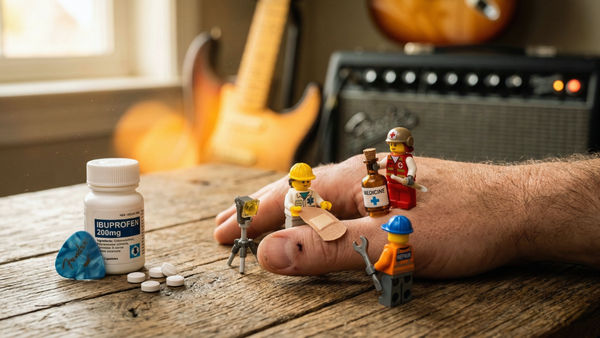
Forearm Pain Playing Guitar: What’s Actually Causing It


Before you blame your forearm, check your shoulder.
Reach your strumming arm across your chest right now, not a stretch, just a reach.
See how far it gets before something pulls tight across the back of the shoulder. If it stops short, or if there’s a dull drag across the rear deltoid, that’s relevant.
That restriction doesn’t stay put when you pick up a guitar. It travels.
Most forearm pain in guitarists gets treated like a local problem. Overused muscles. Too much wrist flexion. Press lighter, rest more, stretch the forearm. And look, that advice isn’t entirely wrong but it’s looking at the wrong end of the problem.
The forearm is usually the last thing to break down, not the first thing to go wrong.
What is forearm pain from playing guitar?
Forearm pain from playing guitar is usually tension or inflammation in the muscles and tendons that control your fingers and wrist. It develops when the forearm works harder than it should, often because restricted mobility higher up the body forces it to compensate.
The Forearm Is Doing Someone Else’s Job
Here’s what I see clinically, over and over: a guitarist comes in with forearm pain. They’ve tried resting, they’ve tried stretching, they’ve maybe tried a different strap height. The forearm itself isn’t structurally damaged. It’s just exhausted.
When I check their shoulder rotation and thoracic mobility, that’s where things get interesting.
The upper back and shoulder are supposed to contribute to every reaching, fretting, and strumming motion you make. When thoracic extension is restricted — when the mid-back is stiff and compressed the shoulder loses range.
When the shoulder can’t rotate freely, the arm can’t position itself cleanly over the fretboard. So the forearm pronates harder. The wrist compensates with more flexion. The grip tightens slightly to compensate for the instability higher up.
Nobody tells the forearm to do this. The body just does it, because the body is remarkably good at finding a way. The problem is that “a way” and “the right way” aren’t the same thing, and eventually the forearm tells you about it.
The forearm isn’t the criminal here. It’s covering for someone who isn’t pulling their weight.
Where To Actually Look First
Ok so the shoulder rotation test above is the quickest screen. But there’s more to it.
Thoracic mobility.
Sit upright and try to rotate your torso slowly, no forcing, to look over your right shoulder, then your left. Most people find one side noticeably stiffer. The stiff side is usually the side of the playing arm that’s struggling. A locked mid-back means the shoulder sits in a slightly forward and compressed position before you’ve even picked up the guitar.
Shoulder blade position.
Stand or sit normally and notice whether your shoulders are rounding forward. Not posture-police stuff just awareness. If the shoulder blades are protracted and the chest is collapsed, the whole shoulder girdle is working from a compressed start position. Every chord shape asks more of the forearm and wrist from that point forward.
Grip force.
This one is the symptom, not the cause, but it’s worth naming: most players grip harder than they realise when they’re tired or tense. The grip compensates for instability. You don’t grip harder because you’re a tense person. You grip harder because something upstream isn’t stable, and the hand is trying to create the stability it can’t find elsewhere.
Why “Just Relax Your Forearm” Doesn’t Work
I’ve heard this advice given to players hundreds of times. Relax the forearm. Don’t grip so hard. Lighten up on the fretting hand.
It’s not bad advice. The problem is that it treats the forearm like it’s making an independent decision to be tense. It isn’t. It’s responding to what’s happening above it.
Telling a compensating forearm to relax is a bit like telling someone to stop limping without looking at what’s happening in their hip. The limp is information. The forearm tension is information. When you address what’s driving it (restricted thoracic mobility, a shoulder that can’t rotate cleanly, a shoulder girdle that’s lost its baseline position), the forearm often settles without you doing anything directly to it.
Free 15-page Guitar Comfort Guide
Play with less tension. Keep the music moving.
A short, practical guide to help your body feel more prepared before you pick up the guitar.
- Warm up properly in five minutes
- Find a playing position that feels supported
- Learn the seven pillars of playing posture
No spam. No daily sales sequence. Just practical guidance for keeping music in your life. Unsubscribe at any time.
That’s the observation that rarely makes it into guitar injury articles. They look at the painful structure and stop there. The kinetic chain keeps going.
What You Can Do Today
This isn’t a corrective exercise protocol. It’s a starting point.
Check the shoulder first the cross-body reach from the top of this post. If you feel restriction, that’s relevant information.
Sit tall before you play, but not rigidly. Let the chest lift slightly, the shoulder blades settle back. You’re not performing posture. You’re giving the shoulder room to move.
Play shorter sessions with more deliberate resets. Every 20 minutes, put the guitar down, roll the shoulders back gently, reach each arm across the chest, take three slow breaths.
And if the forearm pain has been persistent and the shoulder mobility screen shows clear restriction, that’s worth getting looked at properly. Myofascial tension that’s been building for a while doesn’t always respond to self-care alone.
If this pattern sounds familiar, the chapter on shoulder rotation and forearm tension in Keep Playing walks through exactly this the Four Anchors framework and how restricted shoulder rotation shows up as downstream forearm load.
You can find it here.
Keep Playing: The Release → Reset → Rebuild™ Method for Lifelong Guitar Playing

F.P. O'Connor
Manual Osteopath · Guitarist · Movement Nerd
Fergus is a manual osteopath and guitarist who spent nearly two decades watching players quietly give up because nobody gave them a straight answer about why their body was protesting.
→ Download the free Pain-Free Guitar GuideF.A.Q
Why does my forearm hurt after playing guitar?
Forearm pain after playing usually means the forearm flexors and extensors have been working harder than they should.
This can come from technique issues like excess wrist flexion or grip force, but it’s frequently driven by restricted mobility further up the kinetic chain particularly in the shoulder and thoracic spine forcing the forearm to compensate on every chord.
Is forearm pain from guitar playing serious?
Most forearm pain in guitarists is muscular tension or early-stage repetitive strain, not a structural injury. That said, persistent pain that doesn’t settle with rest, or pain that’s sharp and localised to the elbow, is worth having assessed. Lateral epicondylitis and medial epicondylitis are both possible in guitarists and respond better to early intervention than prolonged ignoring.
Should I stop playing guitar if my forearm hurts?
Not necessarily, but playing through sharp or escalating pain isn’t useful. Shorter sessions, deliberate position resets, and addressing the upstream cause is usually a better strategy than full rest which tends to decondition the forearm without fixing what was loading it in the first place.
What’s the difference between forearm pain and tendonitis in guitarists?
General forearm pain is often muscular tension in the forearm flexors or extensors that settles with rest and position work. Tendonitis (inflammation of the tendons at the elbow or wrist) tends to be more localised, more persistent, and often presents with pain on specific loaded movements. If stretching the forearm reproduces a sharp pain at the elbow, that’s worth getting properly assessed rather than self-managing.
How long does guitar forearm pain take to heal?
Muscular tension can settle in days with modified practice and upstream work. Genuine tendinopathy or repetitive strain takes longer, weeks to months depending on severity and whether the root cause has been addressed.
The most common reason forearm pain keeps coming back is that the shoulder and thoracic mobility driving it were never looked at.