Playing Through: What Pain Taught Me About Actually Listening
Sometimes what you lose in speed, you gain in soul.

When Your Hands Won't Let You Show Off Anymore, You Finally Learn to Play
I used to play fast.
Not because I had something to say. But because I could. Because speed felt like proof. Like competence. Like if I could rip through a solo or nail that tricky passage at tempo, then I was a real musician.
And for a while, I got away with it. My hands cooperated. My fingers flew. I could impress people at open mics or in my living room, and that felt good. That felt like Im a real guitarist now.
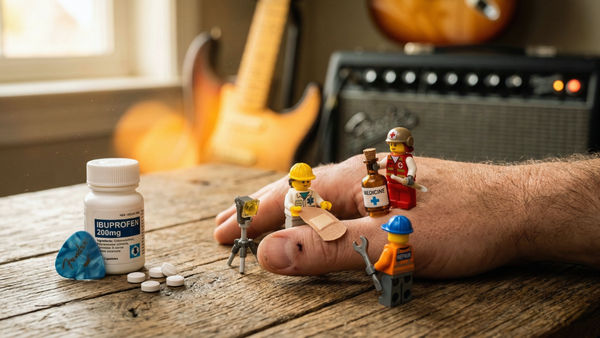
Then my hands started giving me little reminders.
Not dramatic ones at first. Just stiffness in the morning. A little ache after a long session. The kind of thing you ignore because you're not ready to slow down and hey "I'm still youngish these hands have years left in them!"
Maybe I jut wasn't ready to admit that maybe my body was starting to change. That maybe I could no longer play the same way I used to.
But the body doesn't care if you're ready. It just keeps sending signals until you finally listen.
And when I did when I finally had to I realized something I hadn't expected:
The pain wasn't the end of my playing. It was the beginning of actually understanding what playing meant and trusting my own body.
I'm going to share what happened when I stopped fighting my limitations and started listening to them.
How slowing down forced me to discover tone, phrasing, and emotional depth I didn't even know existed.
And why sometimes, losing what you thought made you "good" is the only way to become the musician you were supposed to be.
The Day Speed Stopped Being an Option
I remember the moment clearly. I was playing "Blackbird" by Paul Mc Cartney. It's one of this songs I always wanted to play but it seems too complex.
It took me a while but I stuck with it and eventually I could it play it quickly, effortlessly. And because I was such a stickler, I had to play it the "exact same way" and hit every single note.
Of course that was nonsense, I realize now how it sounds is more important than is it perfect . (Plus he's a lefty so I really was being true to there OG I should be switch hands and thats no going to end well)
Anyway it became one of those songs for me where your fingers know the path so well you don't even have to think.
Except this time, my hands wouldn't cooperate.
They felt tight. Sluggish. Like they were moving through molasses. And every time I tried to push through, tried to force them back to the tempo I wanted, they'd seize up.
Not dramatically. Just enough to make it clear: we're not doing this anymore.
And I was angry. I mean, genuinely p***ed. Because it felt like betrayal.
Like my body had decided, without consulting me, that I was done playing the way I'd always played.
I took a break. Put the guitar down. Walked away. Its just today and I'll give it a day to rest, obviously my hands are tired.
But when I came back the next day I still struggled with the tempo and my fingers weren't cooperating. And it continued the more I tired to play and match the speed and tempo the more my fingers wouldn't cooperate.
"Is there something wrong with me?" I thought. this used to be easy now I cant get through it. After more frustration I stepped away, left the guitar there and went for a walk.
When I came something shifted. I don't know if it was exhaustion or resignation or just finally running out of fight.
But instead of trying to force my way through at full speed, I slowed down.
Way down.
And that's when I heard it.
The space between the notes.
The way one tone moved into another. The way a phrase could breathe if you let it. The way a single note, held just a beat longer, could carry more weight than ten notes played in rapid succession.
I'd been playing for years. But I'd never really listened.
Because I'd been too busy trying to prove something. Trying to match the album version note for note, trying to match the exact timing. But never actually noticing what was played and how I played it and what is really sounded like.
What Happens When You Can't Hide Behind Technique Anymore
Here's the thing about playing with speed: it's impressive. But it's also a really convenient way to avoid vulnerability.
When you're playing fast, people notice the technique. The dexterity. The skill. They don't necessarily notice what you're feeling or what you're trying to say because the flash distracts from everything else.
But when you slow down when you can't hide behind the shred anymore you're exposed.
Every note matters. Every hesitation is audible. Every choice you make is right there in the open for people to hear.
And that's terrifying at first.
Because what if you slow down and there's nothing there? What if all you had was speed, and now that it's gone, you're just... well ...average?
But here's what I learned, and I mean really learned, not just understood intellectually:
Slowing down doesn't reveal that you have less to offer. It reveals what was there all along, buried under the noise.
When I stopped trying to play fast, I started noticing:
Tone. How the same note sounds completely different depending on where you fret it. How you strike the string. How long you let it ring. I'd always known this in theory. But I'd never really explored it because I was too busy moving to the next note.
Phrasing. How a musical idea breathes. Where the natural pauses are. How pulling back on one phrase makes the next one land harder. I'd been playing sentences without punctuation for years. Just a constant stream of notes with no shape. No arc.
This is what the pros know... knowing when to let the music breathe because sometimes the silence says more than the note just played.
Dynamics. The difference between loud and soft. Between attack and release. Between tension and resolution. These weren't just technical concepts anymore. They were emotional tools. Ways to communicate something real.
And the weirdest part? People responded to it more.
Not because I was playing better in some objective sense. But because I was playing more honestly. With more presence. With more care.
I wasn't performing at them anymore. I was sharing something with them.
And that shift that change from proving to sharing was subtle but it was noticed by me and by them.
The Uncomfortable Truth About Limitations
Ok so I'm not going to romanticize this. If you've read my posts before you probably know though I often discuss the subtle, the unseen, or the mindset of playing better Im not going to tell you this is this is "the way".
Because well because I think honesty is important not just in your music or your playing but in how you actually live your life or teach or sell or work.
I'm not going to sit here and tell you that "pain is a gift" or that limitations are some "beautiful blessing in disguise.
Because they're not. They're frustrating. They're humbling. They're unfair. Some people get the long skinny fingers and the musical ear. Some people get early arthritis or chunky fingers that cant seem to make a barre chord properly.
Limitations force you to let go of things you weren't ready to let go of.
But here's the uncomfortable truth I've had to sit with:
Sometimes the thing that feels like loss is actually clearing space for something better.
When I couldn't play fast anymore, I was grieving. I genuinely felt like I'd lost a part of my identity and like I was less of a musician than I used to be.
That the good ol' days were behind me and now I was just a middle aged Dad with a guitar in his office every night lamenting how good I used to be.
But what was actually happening was this:
I was being forced to let go of a version of musicianship that was never serving me anyway. A version built on comparison and performance and external validation. A version where the goal was to impress rather than to connect.
And once that fell away once I couldn't sustain it anymore I had to figure out what was left.
Turns out, a lot actually.
I started playing music I actually loved instead of music that sounded impressive. I started focusing on feel instead of execution. I started trusting my ear instead of my ego.
And yeah, honestly some days I still miss the speed. I miss the flash. I miss feeling technically proficient in ways that were obvious to everyone watching.
But most days? Most days I'm grateful.
Because I'm a better musician now than I was when my hands worked perfectly. Not in spite of the limitations. Because of them.
They kind of kicked me hard and when I got back up I went down a different road and maybe I never would have walked that road without the forceful kick to my ego.
What I Learned When I Finally Shut Up and Listened
Here's what changed when I stopped fighting my body and started working with it:
I Stopped Chasing Other People's Versions of "Good"
For years, I'd been measuring myself against professional Musicians, YouTube shredders and conservatory players: basically people who could do things I couldn't. And I always came up short.
But when I slowed down, I realized: I'm not trying to be them. I'm trying to be me.
And me looks different. Sounds different. Plays different.
And that's not a limitation. That's just reality.
I Started Paying Attention to What Actually Moved Me
I'd been playing songs because they were hard. Because they were impressive. Because other people said they were great.
But when I couldn't hide behind technique anymore, I had to ask: what do I actually want to play? What moves me? What do I care about?
And the answer surprised me. Because it actually wasn't the flashy stuff. It wasn't the showpieces.
It was the quiet stuff. The simple stuff. The stuff that made me feel something.
I Learned That Space Is as Important as Sound
This one's huge. And I never would have learned it if I hadn't been forced to slow down.
When you're playing fast, there's no space. It's just a constant stream of notes. But when you slow down, you realize: the silence between the notes is what gives them meaning.
The pause before a chord resolves. The breath before a phrase starts again. The moment of stillness that makes the next sound hit harder. Just listen to how Jeff Buckley delivers Hallelujah, to me still the single best example of letting the music breathe.
That's not wasted time. That's structure. That's storytelling. That's music right there.
I Found Out I Could Say More With Less
Turns out, you don't need ten notes to communicate an idea. Sometimes one note, played with intention, says everything.
The Part Nobody Tells You About Slowing Down
Here's what I wish someone had told me when I was first dealing with physical discomfort and trying to figure out how to keep playing:
Slowing down doesn't mean you're done. It means you're recalibrating.
And recalibration isn't glamorous. It's not linear. It doesn't feel like progress for a long time because you're letting go of old markers of competence and you haven't found the new ones yet.
You're in this weird in-between space where you can't do what you used to do, but you don't yet know what you can do instead.
And that space is pretty uncomfortable because it's disorienting. It makes you question whether you should just quit altogether.
But if you stay in it if and you keep showing up, keep exploring, keep listening something eventually shifts.
You stop measuring yourself against your old abilities and start discovering new ones.
And during the process maybe you stop grieving what you lost and start to notice what's actually emerging.
Maybe you start asking:what can I do within these parameters that I couldn't do before?
That shift from resistance to curiosity opens up everything.
Try This: The Single-Note Practice
Alright, here's something you can do today that will change how you approach playing. I call it the single-note practice, and it's brutally simple.
Pick one note. Any note. Doesn't matter which one. Just pick one you can reach comfortably.
Set a timer for 5 minutes.
Play that note, over and over, exploring every possible variation:
- Play it soft. Play it loud.
- Play it with your fingertip. Play it with your nail.
- Let it ring. Dampen it immediately.
- Bend it slightly. Let it settle.
- Strike it hard. Caress it gently.
- Play it near the bridge. Play it near the neck.
- Close your eyes. Feel the vibration in your hand.
Your job is not to make it sound good. Your job is to pay attention.
To notice: How many different sounds can I get from this one note?
Here's what usually happens: you realize you've been treating notes like interchangeable units. Like they're all the same as long as you hit them at the right time.
But they're not. Every note has texture and character and possibility.
When you slow down enough to notice that, your playing changes. Not because you're doing anything technically different. But because you're finally present.
After your 5 minutes, jot down one observation:
- "I never noticed how much warmer it sounds near the neck."
- "Playing softer made me listen harder."
- "I was holding my breath the whole time."
Do this once a week for a month. Watch what happens to your playing.
When Letting Go Feels Like Giving Up
I'm not going to pretend this is easy. I'm not going to tell you that embracing limitations is some smooth, enlightened process where you gracefully accept your new reality and move on.
Because it's not.
There are days when it feels like giving up. When slowing down feels like admitting defeat. When focusing on tone instead of speed feels like consolation prize.
And on those days, I remind myself:
I'm not giving up. I'm showing up differently.
I'm not less of a musician because I can't do what I used to do. I'm a different musician. One who's learned things I never would have learned if my hands had kept cooperating.
I learned patience. I learned presence. I learned that music isn't about proving anything to anyone. It's about communicating something real.
And yeah, some days I still miss the flash. I still miss feeling technically impressive.
But most days? Most days I'm more interested in playing something that moves me than playing something that impresses someone else.
And that shift that recalibration from external validation to internal truth is worth more than any technique I've lost.
What Pain Actually Taught Me
So here's what I learned. Not the cleaned-up, inspirational-poster version. The real version:
Pain taught me that I'd been hiding.
Hiding behind speed. Hiding behind complexity. Hiding behind the idea that if I played fast enough, no one would notice I didn't actually have anything to say.
Pain taught me that musicianship isn't about how many notes you can play. It's about how much you can say with the ones you choose to play.
Pain taught me that limitations aren't the end of creativity, they are actually the beginning of a different kind of creativity.
Pain taught me that the musicians whose playing moves me aren't usually the ones with the most technical facility. They're the ones who play with the most honesty.
And most importantly:
Pain taught me that listening to your body isn't weakness. It's the most practical form of wisdom there is.
Because your body is trying to tell you something and if you ignore it long enough, it'll stop asking and start demanding.
But if you listen and if you actually pay attention it'll show you a different path. One that's slower, maybe. More deliberate. More honest.
But also deeper. Richer. More real.
What you lose in speed, you might gain in soul. And soul doesn't fade with age.
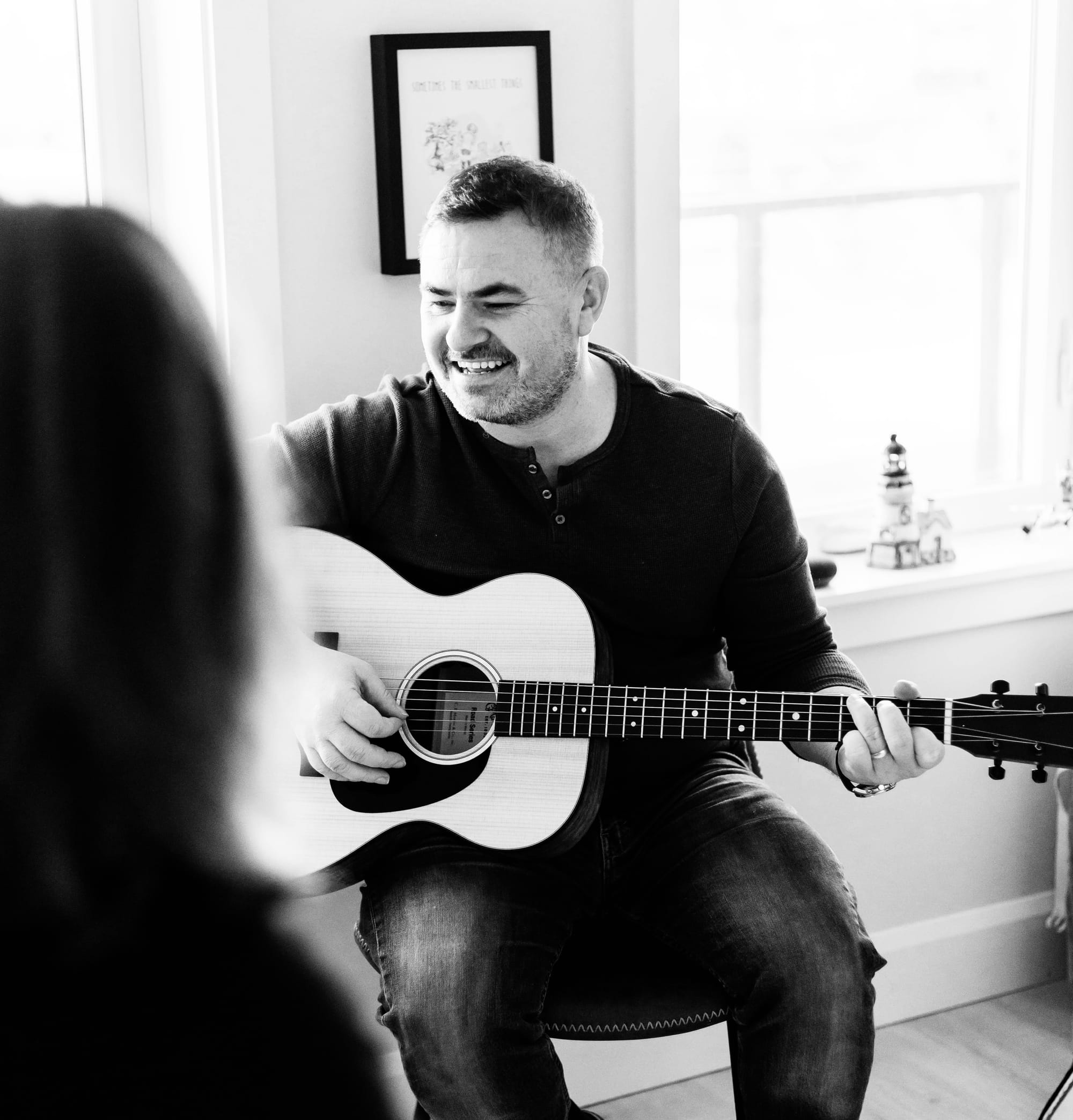
F.P. O’Connor
F.P. O'Connor is a Musician and Movement Specialist whose work is informed by extensive training in Manual Osteopathy, Psychology, and Strength Coaching.
He is the founder of Gentle Octaves, helping adult players develop practical, science-based systems for ease, control, and long-term playing confidence.
👋 About the Creator
I'm F.P. O'Connor, a Musician and Movement Specialist with training in Manual Osteopathy, Psychology, Personal Training, and Coaching.
I founded Gentle Octaves as a place where science, movement, and musicianship meet, helping adults rediscover (or finally begin) their musical journey with freedom and confidence.
This work comes from over 15 years of experience mixed with playing, teaching, and plenty of lived trial-and-error.
Explore more at:
Play better. Move freely. Create for life.
FAQ
Q: Can slowing down actually make me a better player?
A: Many musicians find that slowing down helps them discover tone, phrasing, and dynamics they'd been rushing past for years. It's not about becoming technically better in a speed sense—it's about developing deeper musical awareness and control.
Q: What if I feel like I'm giving up by not playing as fast?
A: Slowing down isn't giving up—it's recalibrating. You're not becoming less of a musician; you're becoming a different one. Many players discover strengths they didn't know they had when speed is no longer the primary goal.
Q: How do I know if pain is telling me to stop completely or just adapt?
A: This is something you should discuss with a qualified healthcare provider. Pain is your body's signal system, and it's important to understand what's behind it. Many guitarists find they can continue playing comfortably with adjustments to posture, technique, and practice habits, but everyone's situation is different.
Sources & Science
- Bangert, M., & Altenmüller, E. O. (2003). Mapping perception to action in piano practice: A longitudinal DC-EEG study. BMC Neuroscience, 4, 26. https://doi.org/10.1186/1471-2202-4-26
- Altenmüller, E., & Jabusch, H. C. (2010). Focal dystonia in musicians: Phenomenology, pathophysiology, triggering factors, and treatment. Medical Problems of Performing Artists, 25(1), 3-9.
- Palmer, C. (1997). Music performance. Annual Review of Psychology, 48, 115-138. https://doi.org/10.1146/annurev.psych.48.1.115
Read More
The 10-Minute Warm-Up & Cool-Down That Protects Your Playing Years
Most guitarists skip the warm-up. Then wonder why their hands hurt three songs in. Here's the simple routine that supports comfortable playing and recovery.
It's Not Too Late: Reclaim Your Musical Joy
What if the doubt just means you still care? How to return to music even with age, stiffness, or years away from the instrument.
Why Your Thumb Hurts When You Play Guitar (And What to Do About It)
Your thumb is filing a complaint. Let's fix that.