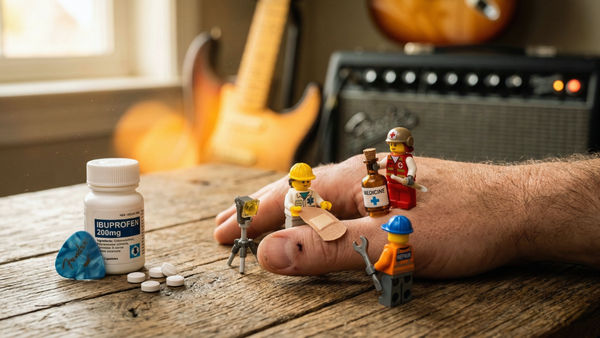
Performance Psychology for Adult Guitarists: Beyond Technique: How Tension, Stress, and Mindset Affect Your Playing Body
Why your nervous system shapes your technique, and more importantly, how to retrain it. Because performance psychology for adult guitarists isn't about achieving "perfection", it's about learning to be present with yourself, your instrument, and whatever's happening in the moment.


Your Hands Remember What Your Mind Tries to Forget
Here's a moment I've seen and personally experienced a thousand times: alone, practicing, everything's flowing. Hands are loose, breathing is easy, playing sounds like its you. Then someone walks into the room, or you hit record, or you just imagine playing for someone else and everything changes.
Suddenly shoulders creep up towards the ears. The jaw sets. The fingers, which were fluid thirty seconds ago, are now gripping like they're trying to strangle the neck.
The music that was alive becomes mechanical, careful, small.
What the heck is that?? We know what we're doing wrong. We can feel it happening. We just can't seem to stop it.
If that sounds familiar, I need you to understand something: this isn't a technique problem. It's not that you need to practice more scales or drill chord changes more efficiently.
This is your nervous system doing exactly what it's designed to do: protecting you from perceived threat. The problem is, it's flagged "being heard" as dangerous.
This article is going to explain why your nervous system shapes your technique, and more importantly, how to retrain it.
Because performance psychology for adult guitarists isn't about achieving some mythical state of "perfection", it's about learning to be present with yourself, your instrument, and whatever's happening in the moment.
It's not about not having any nervousness or fear. It'sabout being able to play well and perform even with the fear, and eventually maybe even recognizing the role of the fear in your performance.
That's what freedom actually sounds like.
If you want to address the physical tension in your playing first start here: The Guitarists Comfort System: Release-Reset-Reuild
The Hidden Link Between Mind and Muscle
Why Mental Stress Shows Up as Physical Tightness
Let me explain something that changed how I understood both psychology and manual therapy: psychophysiological tension. That's the fancy term for how mental load triggers muscular bracing.
Your mind worries, your body responds by tensing up "just in case," and suddenly you're carrying tension that has nothing to do with the physical demands of playing guitar.
I used to see this constantly. Someone would come in with chronic neck and shoulder pain. We'd work on it, release the tissue, get everything moving better. They'd feel great. Then two weeks later they'd be back, same pattern, same tightness.
And when we'd dig into it, it wasn't their posture or their ergonomics, it was their job stress, their relationship stress, their financial anxiety.
Their shoulders were holding their schedule, not their guitar.
Your body doesn't differentiate between "I'm worried about money" and "I'm being chased by a predator."
Stress is stress to your nervous system. And stress triggers the same protective response: muscles tighten, breathing becomes shallow, your system goes into a low-grade state of "ready for threat."
Now add in the specific stress of performance, of being evaluated, of potentially failing, of being exposed and that protective response intensifies.
Your amygdala (the threat-detection part of your brain) signals danger. Your vagus nerve (which regulates your nervous system state) shifts you into sympathetic activation.
And your muscle tone increases across your entire body, but especially in your neck, shoulders, and hands.
This is why you can play something perfectly at home and then fall apart in front of people. It's not that you suddenly forgot how to play.
It's that your nervous system state changed, and muscle tone follows nervous system state.
The Mind-Body Connection Every Guitarist Feels but Can't Name
I've got a background in both osteopathy and psychology, and honestly, that combination has taught me more about helping musicians than either discipline alone.
Because you can't separate them.
The body affects the mind, the mind affects the body, and they're both constantly feeding back into each other in this loop that's either working for you or against you.
When you're anxious, your breathing gets shallow and rapid. When your breathing is shallow and rapid, your body interprets that as evidence that there's something to be anxious about. See the loop? It feeds itself.
This isn't new and more and more approaches are beginning to recognize how one affects the other and vice versa.
But this applies just as much in your guitar playing and musical performance as it does in your everyday health.
When you're gripping the guitar neck too tightly, that physical tension sends signals back to your brain that reinforce the sense that this is difficult, that you need to hold on tight, that you're not safe to let go. And that mental state makes you grip tighter. Loop again.
Breaking these loops is what this whole article is about. But first, you need to understand the specific mental triggers that create physical tension in guitar players. Because you can't change what you don't recognize.
Common Mental Triggers That Create Physical Tension
1. Perfectionism & Overcontrol
This is probably the biggest one I see, especially with adult learners. The more you try to "play it right," the tighter you grip.
You're so focused on not making a mistake that you're essentially trying to force your way through every note. And force creates tension. Tension reduces fluidity.
Reduced fluidity increases mistakes. And mistakes reinforce the belief that you need to try harder, grip tighter, control more.
It's exhausting. And it doesn't work.
Here's what I've learned, both from my own playing and from working with clients: precision doesn't come from effort. It comes from relaxation.
Your fingers are more accurate when they're loose than when they're tense. Your brain makes better decisions when it's calm than when it's stressed.
But perfectionists don't trust that. They think if they just focus harder, try more, care more intensely, they'll get it right. What actually happens is they strangle the music out of the instrument and wonder why it doesn't sound alive.
If this is you, and be honest with yourself , the work isn't learning to play better. It's learning to tolerate imperfection. To let notes ring out messy and still be okay.
To value expression over execution. That's terrifying for a perfectionist. And it's also the only way forward.
2. Fear of Judgment
Adult learners carry a particular weight much more than kids: self-consciousness. A kid picks up a guitar and makes noise and nobody thinks twice about it.
An adult picks up a guitar and immediately feels like they should already be good at it, like starting late is somehow shameful, like being heard while still learning is a form of exposure.
I work primarily with people over forty, and the number one thing that holds them back isn't lack of talent or even lack of time: it's actually fear of judgment.
Fear of what their partner will think. Fear of what their kids will think. Fear of what some imaginary audience is evaluating them against.
And that fear shows up in the body as tension. Your shoulders lift to protect your vulnerable throat and chest. Your breathing becomes shallow so you don't take up too much space. Your playing becomes small and careful because being loud and wrong feels riskier than being quiet and controlled.
Here's the truth underneath all of it: nobody is thinking about your playing as much as you are.
Nobody is evaluating you as harshly as you're evaluating yourself.
And the people who matter, the ones who actually care about you, they just want to hear you try. They want to see you doing something that brings you alive.
But your nervous system doesn't know that. It just knows "being heard = potential rejection = danger." So it tenses up to protect you.
And now your hands can't do what your mind wants them to do because they're too busy defending you from a threat that doesn't actually exist.
3. Overthinking Movement
This one's subtle but it affects a lot of people, especially those of us who are analytical by nature.
You start thinking too much about the mechanics of playing: where your fingers should be, what angle your wrist should sit at, whether you're holding the pick correctly, if your posture is optimal.
All of that is useful information when you're learning. It helps set you up for success.
I literally wrote a book that covers all these details and breaks down the step by step approach to address each one to reduce tension in your playing.
Keep Playing: The Release → Reset → Rebuild™ Method for Lifelong Guitar Playing
But once you're actually playing, that analytical focus blocks flow.
It keeps you in your prefrontal cortex (the thinking part of your brain) instead of allowing your cerebellum and motor cortex (the doing parts) to take over.
Think about it: when you're playing something you know really well, something you've played a hundred times, you're not thinking about it.
Your hands just know. That's flow. That's when playing feels easy and natural and like an extension of yourself.
But the second you start analyzing: "Am I holding this chord right? Is my thumb in the correct position?" you've pulled yourself out of flow and back into effortful control. And effort creates tension.
I've noticed this particularly with clients who are naturally detail-oriented. They want to understand everything, optimize everything, get it exactly right.
And that desire for precision actually makes them less precise because they can't get out of their own way long enough to let their body do what it already knows how to do.
4. Unprocessed Stress & Fatigue
And then......there's everything else you're carrying. The work stress. The relationship stuff. The financial pressure. The aging parent. The health concern. The general accumulated weight of being an adult with responsibilities and problems that don't have easy solutions.
You sit down to play guitar as if you can just leave all of that at the door. But your body is still carrying it. Your nervous system is still in the state it was in before you picked up the guitar.
And if that state was stressed, overwhelmed, or exhausted, that's the state you're trying to play from.
This shows up in posture that collapses before you even start. In breathing that's already shallow and held. In micro-tremors in your hands because your system is running on adrenaline and caffeine instead of rest and nourishment.
In an inability to focus because your mind is still spinning through everything else that needs your attention.
I had a client once, this was years ago, who came in complaining about chronic tension in his hands and forearms.
We worked on his technique, his setup, his posture. Nothing really changed. Finally I asked him what was going on in his life outside of guitar. Turned out he was going through a brutal divorce, dealing with custody issues, and barely sleeping.
His hands weren't the problem. His life stress was the problem, and his hands were just where it was showing up. We didn't fix it with technique work.
We addressed his nervous system state and worked on how to consciously shift out of stress mode before trying to play.
He also realized he needed to open up and address the challenges and speak with a psychologist. That was a big step for him as he was never a fan of talking it out.
I could see every month he came back how his playing was getting freer and he started wanting to work on songs and writing songs to help him through this period of his life.
The chronic hand and forearm stress kind of just went away. He still stretched and did warm ups we had worked on but he admitted by stopping and realizing the impact stress was having he became better aware of how to addresses it.
The Body Doesn't Lie: Reading Your Physical Cues
Somatic Awareness as Early Warning System
Your body is constantly giving you information. The problem is most people either don't notice it or they notice it too late, after tension has already built up into pain.
Somatic awareness is just the fancy term for paying attention to what your body is telling you in real time. And for guitar players, this is one of the most valuable skills you can develop.
Because if you can catch tension early, like in the first 30 seconds of playing instead of after 30 minutes, you can release it before it becomes a problem.
Here are the physical tells I teach people to watch for:
Jaw setting: Your jaw is one of the first places stress shows up. If you're clenching your teeth or holding tension in your jaw while you play, that's a sign your nervous system is in protection mode. And tension in your jaw travels down into your neck, shoulders, and eventually your hands.
Shoulder lift: Your shoulders creeping up toward your ears is another classic stress response. It's your body trying to protect your neck and make yourself smaller. It also puts your shoulder blade in a mechanically disadvantaged position, which creates tension all the way down your arm.
Breath hold: Most people hold their breath during difficult passages without even realizing it. But breath-holding signals stress to your nervous system and limits oxygen to your muscles. Notice when you're holding your breath, and consciously release it.
Finger collapse: When your fingers start to curl or hyperextend at the joints instead of maintaining their natural curve, that's usually a sign of fatigue or compensation. It means something else in the chain, often your shoulder or your core, isn't doing its job, so your fingers are working too hard.
The Body Check-In Practice
Before you start playing, during playing, and after playing, do this quick check:
Are your feet flat on the floor?
If you're sitting with your legs crossed or your feet floating, you don't have a stable base. Your body has to compensate higher up the chain to create stability, which creates tension.
Are you breathing or holding?
Just notice. You don't have to change it yet. Just become aware of whether your breath is flowing or if you're unconsciously holding it.
Do you feel grounded or are you floating forward?
This one's subtle, but see if you can sense whether you feel rooted through your sit bones (if sitting) or through your feet (if standing), or whether you feel like you're leaning or reaching forward. Forward positioning almost always creates unnecessary tension.
The more you practice these check-ins, the more automatic they become. And the earlier you catch tension building, the easier it is to release it.
[You can go through a quick check I developed here as a starting point]
The Gentle Octaves Framework: Release → Reset → Rebuild™ Applied to Mind-Body
How the same framework that addresses physical tension retrains mindset
You've probably seen me talk about the Release → Reset → Rebuild™ framework in the context of easing physical tension. But here's the thing: it works just as well for psychological tension. Because as we noted, the mind and body aren't separate systems, they're different aspects of the same system.
Let me show you how this applies to performance:
Phase 1: RELEASE
Emotional Exhale and Nervous System Downregulation
Before you can change a pattern, you have to release the current state you're stuck in. If you're already tense, stressed, or anxious, trying to just "play better" or "relax more" doesn't work. You need to actively shift your nervous system state first.
Grounding practices:
This is about bringing yourself into the present moment and into your body. It can be as simple as feeling your feet on the floor, noticing five things you can see, feeling the weight of the guitar in your hands.
You're not trying to feel better. You're just trying to feel, to come back into sensory awareness instead of being lost in your head.
Breath work:
I keep coming back to breath because it's the most direct way to influence your nervous system state. Slow, diaphragmatic breathing with a longer exhale than inhale (4 count in, 6 count out) activates your parasympathetic nervous system: the rest and digest mode. Do this for 2-3 minutes before you start playing and watch what happens to your tension levels.
Emotional acknowledgment:
Sometimes you need to just name what you're feeling. "I'm nervous." "I'm frustrated." "I'm scared I'm going to screw this up." There's something about naming the emotion that takes some of its power away.
It stops being this vague threatening thing and becomes just a feeling, one that you can be with instead of trying to avoid. Once you name it you can address it and there are many different approaches you can explore for this (CBT, ACT defusing techniques).
Phase 2: RESET
Nervous System Regulation and Movement Repatterning
Now that you've released som of the acute stress, you need to reset your baseline. This is about teaching your nervous system that playing guitar can be safe, that being heard doesn't have to trigger threat response, that you can stay regulated even when things are challenging.
Vagus nerve activation:
Your vagus nerve is the main pathway of your parasympathetic nervous system. Humming, singing, gargling water: these all stimulate vagal tone and help keep you in a calm, regulated state.
Before you play, try humming for 30 seconds. Sounds weird. Works surprisingly well.
Tempo drills:
Start every practice session playing something slowly, much slower than you need to. This teaches your nervous system that you can play with control and ease, not just frantic effort. Fast playing often comes from anxiety. Slow playing requires confidence.
Micro-movements between passages:
Don't just play straight through for 30 minutes. Build in tiny breaks, even 10 seconds to roll your shoulders, shake out your hands, take a breath.
These micro-resets prevent the accumulation of tension and keep you in your window of tolerance.
Phase 3: REBUILD
Mental Rehearsal and Relaxed Focus
This is where you start building new patterns and mental habits that support fluid playing instead of tense playing.
Mental rehearsal:
Before you play something challenging, close your eyes and imagine yourself playing it well. Not perfectly, but with ease and expression. Imagine what your hands feel like, what your breathing is like, what the music sounds like.
Your brain doesn't fully distinguish between imagined movement and actual movement, so this literally helps wire the pattern you want.
Relaxed focus practice:
Pick something simple that you know well. Play it with the intention of staying as relaxed as possible while maintaining focus. You're still playing with precision but without gripping, without holding your breath, without bracing.
This teaches you that relaxation and precision aren't opposites. They're partners.
Positive reinforcement:
Instead of only noticing what went wrong, actively notice what went right. "That chord change was smooth." "I stayed relaxed through that passage." "I caught myself tensing and released it."
Your nervous system learns faster from success than from failure, so pay attention to what's working.
Practical Tools: Retraining Your Nervous System for Calm Focus
1. The Pre-Practice Ritual (5 Minutes)
Create a consistent sequence you do before every practice session. This signals to your nervous system that you're shifting into a different mode, one where you're safe, focused, and present.
Example ritual:
- Sit quietly for 1 minute, eyes closed, feeling your breath
- Do 5 shoulder rolls backward, 5 forward
- Take 10 slow breaths (4 in, 6 out)
- Set an intention: "Today I'm practicing presence" or "Today I'm practicing without judgment"
- Begin
The specific actions matter less than the consistency. You're creating a neural pathway that says "this is how we transition into playing."
2. The Awareness Dial Exercise
This one's simple but powerful. When you start to feel tension building:
Stop playing. On a scale of 1-10, rate your current tension level. Now take three slow breaths. Rate it again. Usually it's dropped 1-2 points just from breathing.
Now consciously release tension in specific areas: drop your shoulders, unclench your jaw, soften your hands. Rate it again.
This teaches you two things: that tension is changeable, not fixed, and that you have agency over your nervous system state. You're not at the mercy of your anxiety. You have tools.
3. The Permission Practice
Pick a practice session, just one, where your only goal is to play badly. Intentionally make mistakes. Play sloppily. Play too loud or too soft. Play wrong notes on purpose.
This sounds counterintuitive, but it's actually incredibly freeing. You're deliberately triggering the thing you're afraid of: imperfection, being bad, making mistakes, and discovering that it's survivable.
It's actually kind of funny. And once you've proven to yourself that mistakes aren't dangerous, your nervous system relaxes its grip on perfectionism.
4. The Body Scan for Musicians
This is adapted from traditional body scan meditation but targeted for guitar players:
Sit with your guitar in playing position. Close your eyes. Starting at your feet, slowly bring your attention up through your body: feet, calves, thighs, hips, lower back, mid-back, chest, shoulders, arms, hands, neck, jaw, face, scalp.
At each area, just notice: Is there tension? Is there ease? Don't try to change anything. Just notice.
Then play something simple, maybe an open chord, an easy scale, while maintaining that body awareness. Can you keep noticing what your body is doing while you're playing?
This builds the capacity for divided attention: you can be aware of your body state while also executing the music. That's the skill that lets you catch and release tension in real time.
5. The Comparison Detox
For one week, don't listen to any guitarist who's "better" than you. Don't watch YouTube videos of virtuosos. Don't scroll through Instagram looking at people doing impressive things.
Just play your own guitar, at your own level, in your own way.
For most people, the constant comparison is feeding a low-level anxiety that makes everything harder. Taking a break from it, even temporarily often reveals how much mental space you get back.
6. The Journaling Prompt Practice
After each practice session, write one sentence answering this question: "What did I notice today?"
Not what you accomplished. Not whether you played well or badly. Just what you noticed. About your body. About your breath. About your mind. About the music.
This shifts your focus from evaluation to observation. And observation without judgment is how awareness grows. Awareness is how change happens.
Performance & Presence: Rewriting the Story
From "Student Proving" to "Artist Expressing"
There's a shift that has to happen for adult players, especially those who started late or who are coming back after a long break. You have to stop thinking of yourself as a student trying to prove you belong, and start thinking of yourself as an artist who's expressing something real.
Students are evaluated. Artists create.
Students worry about getting it right. Artists worry about getting it true.
Students perform for approval. Artists share because the music demands to be heard.
This isn't just semantic. It's a complete reframe of why you're doing this. And that reframe changes everything about how your nervous system responds to playing for others.
When you're trying to prove something, the stakes are high. Your worth feels tied to the outcome. Your nervous system treats it as a threat, because if you fail, you're exposed as inadequate.
That triggers all the protective tension we've been talking about.
But when you're expressing something, when you're sharing a piece of music because it matters to you, because it says something you want to say then the stakes are different.
You're not asking for judgment. You're offering a gift. And gifts don't have to be perfect. They just have to be genuine.
This is the identity shift that needs to happen. And it's not easy, especially if you've spent your whole life in achievement mode, in prove-yourself mode. But it's necessary if you want to play with freedom instead of fear.
Playing as Prayer: Surrender vs Control
I'm going to get a bit spiritual here, not in a preachy way, but in a way that's helped me and a lot of the people I work with.
There's this idea in a lot of different spiritual traditions of offering your work as prayer. Of doing something not for your own glory or achievement, but as an act of devotion or gratitude or worship, whatever language works for you.
When you play guitar as prayer, as an offering rather than a performance then something shifts. The focus moves from "how am I doing?" to "what am I giving?"
From control to surrender.
And surrender is the opposite of tension. When you surrender into the music, when you trust it to carry you instead of trying to force it into submission, your body relaxes. Your breathing deepens. Your hands loosen. Not because you've stopped caring, but because you've stopped trying to control everything.
I'm not saying you have to be religious to access this. I'm saying that the psychological state of offering, of surrender, of trust, or whatever gets you there is incompatible with the white-knuckle grip of perfectionism and fear.
For me, sometimes when I'm playing and I feel that tension creeping in, I just think, "This isn't mine. I'm just the channel."
And that thought alone releases something. Because if it's not mine, I can't screw it up. I'm just showing up and letting it through.
Find your version of that. Find the thought or the image or the reframe that lets you release the grip of control and just play.
Reclaiming Music as Joyful Embodiment
At some point, this has to stop being about fixing problems and start being about remembering joy. Because that's why you picked up the guitar in the first place, right? Not to become perfect. Not to impress anyone. But because something in you wanted to make music.
That desire, that pull toward creation and expression and sound: that's joyful embodiment.
That's your body wanting to be alive in a particular way. And all this work we've been doing, the nervous system regulation, the somatic awareness, the psychological reframing it's not an end in itself.
It's just removing the obstacles between you and that natural joy.
When you're playing from that place, when you're embodied and present and connected to why you're doing this then the technique takes care of itself.
Not perfectly. But authentically. And authentic music, even when it's imperfect, is infinitely more compelling than perfect music that's been strangled by fear.
So yeah, learn the tools. Practice the skills. Build your awareness and your capacity for regulation. But don't lose sight of why you're doing it.
You're not trying to become a robot who can execute flawlessly under pressure. You're trying to become a human who can play music freely, with presence and heart and whatever level of skill you've got in this moment.
Freedom Isn't a Feeling; It's a Habit
Look, I'm going to be straight with you: this stuff doesn't happen overnight. You don't just read an article about nervous system regulation and suddenly play with complete ease and zero anxiety. It doesn't work that way.
What does work is consistent practice. Not just guitar practice but presence practice. Awareness practice. The daily choice to notice when you're tensing up and consciously release it.
The weekly choice to play something just for the joy of it, with no agenda. The monthly choice to reflect on whether you're still enjoying this or whether you've turned it into another stress in your already stressful life.
Relaxation is trainable. Confidence is a body state you can learn to access. Freedom isn't something you feel randomly when conditions are perfect, it's a habit you build by practicing it over and over until it becomes your new baseline.
And here's the good news: you don't have to be perfect at this either. You don't have to master your nervous system before you're allowed to play guitar in front of people.
You just have to be willing to stay aware, to keep working with it, to not give up when it's hard.
The goal isn't to play without nerves. The goal is to play with trust. Trust in your preparation. Trust in your body. Trust that even if you mess up, you're still okay. Trust that the music matters more than your performance of it.
Build that trust, and everything else gets easier.
The goal isn't to play without nerves: it's to play with trust.
F.P
Founder, Gentle Octaves
F.P. O’Connor
F.P. O'Connor is a Musician and Movement Specialist whose work is informed by extensive training in Manual Osteopathy, Psychology, and Strength Coaching.
He is the founder of Gentle Octaves, helping adult players develop practical, science-based systems for ease, control, and long-term playing confidence.
FAQ
Q: I've tried breathing exercises and they don't seem to work for me. What am I doing wrong?
A: Probably nothing! Breathing work needs to be practiced when you're calm first, before you try to use it when you're anxious.
You're building a neural pathway. Also, some people need different techniques : humming, movement, or grounding might work better for you than breath alone. Experiment, learn and adjust.
Q: How do I know if my tension is psychological or physical?
A: It's always both. Psychological stress creates physical tension, and physical tension reinforces psychological stress. They feed each other.
The good news is you can interrupt the loop from either direction - work on your nervous system state or work on your physical positioning, and the other will improve too.
Q: Can I really change long-standing patterns of perfectionism and self-judgment in my music?
A: Yes, but it takes time and conscious effort. These patterns were built over years or decades and they won't disappear after one awareness exercise.
But neuroplasticity is real. Your brain can learn new patterns at any age. The key is consistent practice and self-compassion when you slip back into old habits.
Q: Ive always struggled performance anxiety. Can I actually overcome, or will I always struggle with it?
A: You can absolutely retrain your nervous system's response to performance situations. It's not about eliminating nerves completely, some activation is actually helpful for focus.
It's about changing your relationship to those nerves so they don't trigger the full threat response. With consistent practice, most people see significant improvement within 2-3 months.
Sources & Further Reading
- Porges, S. W. (2011). The Polyvagal Theory: Neurophysiological Foundations of Emotions, Attachment, Communication, and Self-Regulation. W.W. Norton & Company.
- Kenny, D. T. (2011). The Psychology of Music Performance Anxiety. Oxford University Press.
- Wilson, G. D., & Roland, D. (2002). The Science and Psychology of Music Performance: Creative Strategies for Teaching and Learning. Oxford University Press.
- Kabat-Zinn, J. (2013). Full Catastrophe Living: Using the Wisdom of Your Body and Mind to Face Stress, Pain, and Illness. Bantam Books.
- Levine, P. A. (2010). In an Unspoken Voice: How the Body Releases Trauma and Restores Goodness. North Atlantic Books.