The Guitar Comfort System: Release - Reset - Rebuild™
Return to music. One note at a time.


Discomfort doesn't mean you're playing days are finished. It means your body is asking for attention.
Release → Reset → Rebuild™
So here's the thing most adult guitarists don't want to hear but need to: discomfort while playing isn't just part of getting older.
I know. You've probably been told it is. You've probably told yourself it is.
Because what's the alternative? That there's something you could do about it? That you've been suffering unnecessarily? That feels almost worse somehow.
But that's exactly what I'm saying.
If you're over 40 and feeling stiffness, numbness, or tension when you play, if your thumb aches after twenty minutes, if your wrist feels tight the next morning, if your shoulder's complaining or your fingers won't quite do what you're asking them to it's easy to assume the worst.
Maybe my hands just can't do this anymore. Maybe I'm past my prime. Maybe I should just accept that this is how it is now.
And look, I get it. That's the story we've been sold about aging.
That things break down. That discomfort is inevitable. That you just have to tough it out or quit.
After working with many adult players dealing with long-term tension and age-related stiffness, I've observed a clear pattern: most guitar discomfort is directly linked to specific movement habits.
It follows predictable patterns. And those patterns can be reversed.
Not always overnight. Not always completely. But significantly.
Enough to keep playing. Enough to enjoy it again.
Enough to stop thinking about your hands and start thinking about your music.
This post will help you understand those patterns and show you how to start rebuilding comfort and control with a simple three-phase framework.
This approach is based on the movement principles I’ve applied and refined over fifteen years of working with guitarists and helping adults adapt to tension.
The Real Problem (And Why Its Not Usually Your Hands)
Most players think the problem is their hands. Their fingers. Their wrists. The actual spot where the pain shows up.
But that's almost never where the problem starts.
Your hand is the end of a chain. It's connected to your wrist, which is connected to your forearm, which is connected to your elbow, which is connected to your shoulder, which is connected to your neck, which is connected to your spine, which is connected to your pelvis.
Everything's linked. Everything affects everything else.
So when your thumb hurts, it might actually be because your shoulder's stiff and your hand's compensating.
We often observe wrist tightness in players whose collapsed posture forces their forearm muscles to stabilize what the core should be stabilizing.
When your fingers go numb, it might be because there's nerve compression happening way upstream in your neck or shoulder.
This is the core of predictable movement patterns. Tension isn't arbitrary. It's your body's way of signalling, "We are adapting to stress and need better mechanical support.
And here's the thing: you can't fix the hand without addressing the whole chain.
I've seen players do endless hand exercises, wear braces, take breaks, try all kinds of solutions and nothing changes. Because they’re focusing on the area of discomfort, not the mechanical source.
But when we start looking at the whole system? When we apply techniques to release tension in the shoulder, reset the foundation, and retrain movement patterns?
Suddenly the hand discomfort that's been present for months just lessens. Not because we worked on the hand alone.
But because we stopped asking it to compensate for whats happening somewhere else.
So often our body's doing exactly what it's designed to do: adapt, compensate, find workarounds.
It's just that those compensations eventually run out of room. And that's when the discomfort shows up.
The solution isn't to stop playing. It's to pay attention to what your body's been trying to tell you all along. I did a whole post on how to bring more awareness into your music, it's a good starting point prior to beginning the system if you haven't read it yet.
 Gentle Octaves
BLOG POST ON BODY AWARENESS
The 3-Phase Framework: Release → Reset → Rebuild™
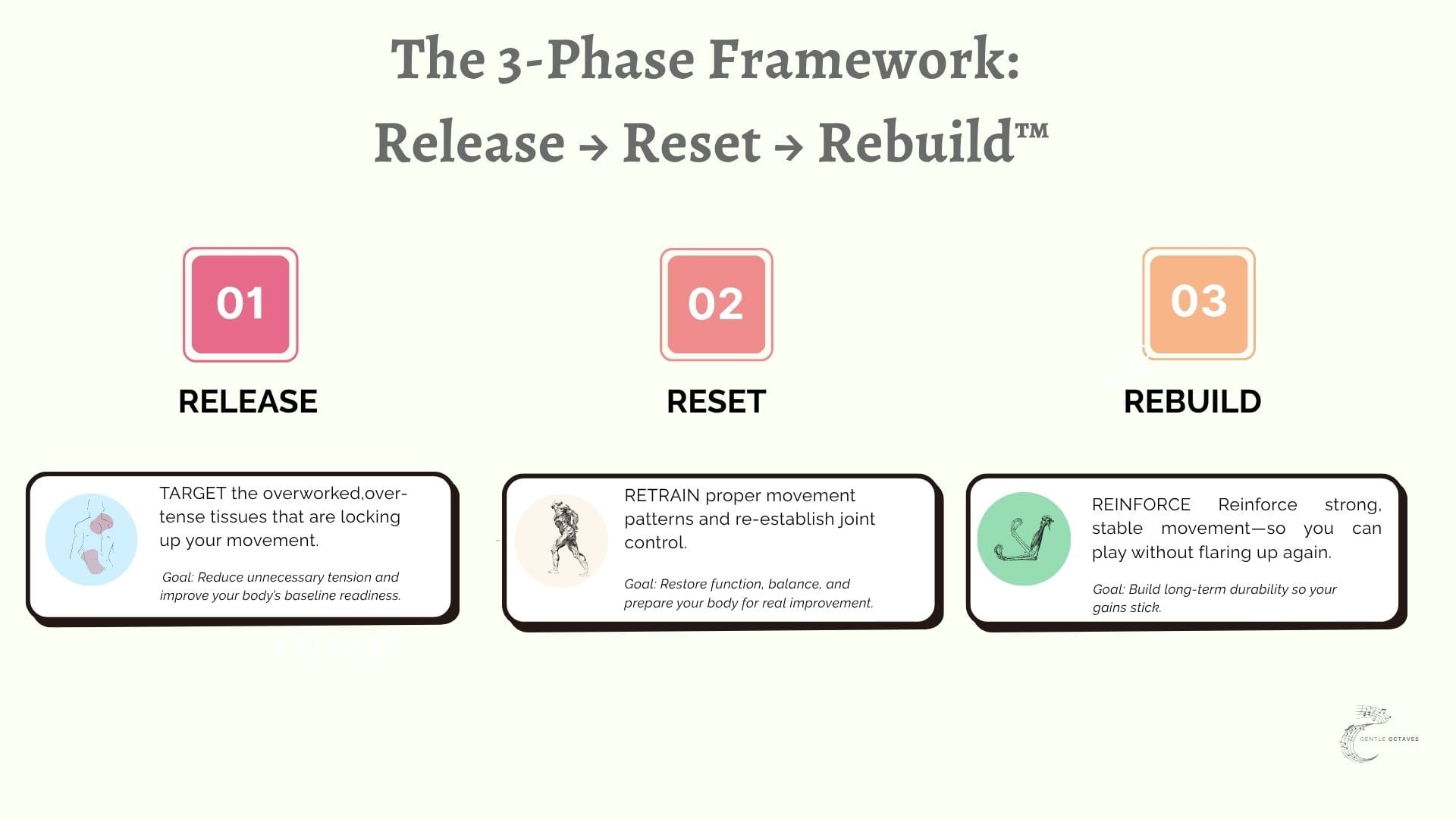
Alright, so here's the system. It's simple.
Three phases. Each one builds on the last.
And it works because it respects how the body actually heals.
You can't strengthen dysfunction. You can't just power through pain and expect it to get better.
You have to release the tension first, then reset the alignment, then rebuild with better mechanics.
1. Release: Down-regulating the "Grip" Response
This is where we start. Always.
Let go of chronic tension, gripping, and bracing patterns.
Your body's been in fight-or-flight mode for God knows how long. Maybe it's stress from work. Maybe it's years of playing with poor technique.
Maybe it's just accumulated tension from sitting at a desk forty hours a week and never really moving.
And that tension shows up everywhere: tight shoulders, clenched jaw, white-knuckle grip on the guitar neck, shallow breathing.
Whatever it is, your nervous system thinks it needs to brace. To grip. To protect.
Before you change how you sit or how you hold a pick, you must address the physiological bracing your body has developed over years of playing (and living).
If you try to "reset" your posture while your muscles are still in a state of chronic contraction, you are simply layering new tension over old tension.
We must first signal to the nervous system that it is safe to let go.
So we start with soft tissue release, mobility drills, and breathwork: resetting the nervous system from "fight" mode to flow.
We're telling your body: it's safe. You can let go. You don't have to hold on so tight.
This isn't woo-woo. This is nervous system regulation.
When your body feels safe, it stops bracing.
When movement becomes easier, tension lessens, and the potential for greater comfort increases.
The Science of "Biological Bracing"
For many adult guitarists, the act of picking up the instrument triggers a "fight or flight" response in the nervous system.
This isn't because the guitar is scary, but because your brain has associated the instrument with the physical stress of "performing" or the memory of past pain.
This leads to co-contraction: where opposing muscles (like the ones that open and close your hand) fire at the same time.
This is the "white-knuckle" feeling. Release is about breaking that loop.
So How do we start working on release, how do we starting easing guitar tension?
1.1 The Diaphragmatic "Neural Reset"
The fastest way to the hand is through the lungs. When your breathing is shallow (chest breathing), your "accessory" neck muscles, the scalenes, etc. tighten up to help you lift your ribcage.
These are the exact muscles that the nerves traveling to your arms must pass through.
- The Move: Place your guitar down. Place one hand on your belly and one on your chest.
- The Goal: Inhale for 4 seconds so that only the belly hand moves. Exhale for 6 seconds.
- The Why: This long exhale stimulates the Vagus nerve, physically forcing your nervous system out of "bracing" mode and into "flow" mode.
1.2 Soft Tissue Release: The "Forearm Sweep"
Over 40, our fascia (the "shrink wrap" around our muscles) becomes less hydrated and more prone to "sticking."
If you feel tightness in your wrist, the source is likely a "knot" in the forearm flexors.
- The Move: Rest your fretting-hand forearm on a flat surface, palm up. Use the opposite elbow to apply gentle, sinking pressure to the meaty part of the forearm near the elbow.
- The Action: While maintaining pressure, slowly rotate your wrist and wiggle your fingers.
- The Result: You are performing a "tack and stretch," manually creating space between the muscles so they can slide past each other without friction.
1.3 The "Shoulder-Neck" Decompression
"In the human body, the nerves for the hand originate in a network called the Brachial Plexus. This is why many movement specialists look at the neck and shoulder when a player feels hand tension.
If your shoulders are "wearing your ears" as earrings, you are literally pinching the power cable to your fingers.
- The Drill: Perform "Shoulder Shrug-Drops." Inhale and pull your shoulders to your ears with 100% tension. Hold for 3 seconds. Then, exhale and let them drop like dead weights.
- The Focus: Don't "place" them down; let gravity take them. Repeat 5 times. You are teaching your brain the binary difference between "On" and "Off."
You're not trying to force anything. You're just creating space. Inviting release.
Phase 2: Reset - Restoring Mechanical Advantage
Now that we’ve signaled the nervous system to let go of chronic "bracing," we can look at the foundation.
In this phase, we aren't "fixing" a medical condition; we are optimizing your mechanical advantage.
Think of your body like a crane. If the base of the crane is tilted, the arm has to work twice as hard to lift the same weight.
By resetting your alignment, we take the workload off your smaller muscles and give it back to your skeletal frame
This is where we retrain the small stabilizers around the neck, shoulders, and forearms to restore balance and precision.
Most players have no idea where their body is in space when they play.
They're hunched over, shoulders rolled forward, wrist cranked at weird angles, and they don't even notice it until someone points it out or the pain gets bad enough to force attention.
So we reset. We rebuild body awareness.
2.1 The "Neutral" Spine Reset
Slouching is the most common "mechanical bottleneck" for players over 40. When the mid-back rounds, the head naturally juts forward.
This posture can create a "kink in the hose" for the pathways that lead down to your arms.
- The Reset: Imagine a thread attached to the crown of your head, gently pulling you toward the ceiling. Feel your "sit bones" firmly on the chair.
- The Result: This lengthens the torso, providing a stable platform for your shoulders to rest on, rather than forcing them to stabilize your slumped weight.
- For more detail I have a whole post on guitar posture you can read here.
2.2 Optimizing the "Wrist-to-Neck" Angle
Many adult players use the "Casual" position (guitar on the right leg). While comfortable for a few minutes, this often forces the fretting wrist into a deep "hinge" or extreme angle to reach the lower frets.
- The Reset: Experiment with the Classical Position (guitar on the left leg, neck angled up at 45°).
- The Result: This simple shift in the instrument’s geometry allows the wrist to stay in a "Neutral Zone." We aren't diagnosing a wrist issue; we are simply removing the mechanical obstacle that was making the movement feel effortful.
This phase is about retraining patterns. Teaching your body what "neutral" actually feels like. Because if you've been playing with compensatory patterns for years, neutral feels unfamiliar at first
It thinks those are normal. So we have to gently, consistently, patiently retrain. Show the body there's another way.
A way that doesn't require constant tension and effort.
Phase 2 can also include:
- Postural resets: sitting tall, shoulders back and down, spine lengthened
- Wrist and hand alignment: keeping joints neutral, not hyperextended or collapsed
- Core engagement: using your whole body to support the guitar, not just your arms and hands
- Micro-adjustments: small changes in how you hold the guitar, where it sits, how you position your limbs
- A good time to also consider if your instrument is part of problem. May be with considering if the guitar suits your needs or if a setup could help you. Check out the post I did on that here.
Phase 3: Rebuild - Progressive Loading & Precision
This is where we gradually reintroduce playing movements with better mechanics and endurance.
After resetting the mechanics, we must "re-map" your playing habits so you don't fall back into the old patterns of tension.
We treat this like functional training for the hands
Strength meets sensitivity. Your technique evolves with freedom, not force.
But here's the key: we rebuild slowly. We don't just jump back into hour-long practice sessions and expect everything to be fine.
We build progressively. We respect tissue tolerance. We give the body time to adapt.
3.1 Establishing "Tissue Tolerance"
If you’ve taken a break due to discomfort, your "tissue tolerance", that is the amount of work your muscles can do before tiring, has likely decreased.
- The Strategy: Instead of one 60-minute session, try three 15-minute "Sprints."
- Tip: We want to stop before the first sign of tension. This keeps your movements clean and prevents the "bracing" response we worked so hard to release in Phase 1.
3.2 The "Minimum Effective Pressure" Rule
Many of us "over-fret." We press the strings with 5 lbs of pressure when the note only requires 1 lb. Over years, this adds massive wear and tear to the small joints of the hand.
- The Rebuild Drill: Place your finger on a string. Press down extremely slowly until the note just barely rings clearly. That is your "target pressure."
- The Goal: Practice your scales using only that minimum amount of force. This builds Precision over Power, allowing you to play longer with significantly less effort.
Phase 3 should look like:
- Shorter, smarter practice sessions with built-in rest
- Gradual increases in playing time and intensity
- Strengthening exercises for the small stabilizers
- Technique refinements that reduce strain and improve efficiency
This is where you start noticing real changes. Not just less tension. But better tone. More control.
More expressive freedom. Because when your body's working efficiently, your music flows more naturally.
This sequence works because it respects how the body heals.
You can't strengthen compensatory patterns. You can't skip steps. You have to release, then reset, then rebuild.
You can explore the detailed framework in my book Keep Playing It walks you through each phase with specific exercises, timelines, and troubleshooting.
Common Tension Patterns (And Where They Actually Start)
Discomfort is rarely limited to the spot you feel it. Here are some of the most common links I see:
Thumb discomfort → Often tied to shoulder stiffness and over-gripping. Your shoulder's tight, so your arm can't move freely, so your hand grips harder to compensate, so your thumb gets overloaded. We don't just release the thumb. We notice and release the shoulder.
Wrist tension → Linked to forearm imbalance or collapsed posture. When your posture's slouched, your wrist has to bend at sharper angles to reach the fretboard. We reset the posture, suddenly the wrist angle improves.
Numb fingers → When you experience discomfort or altered sensation in your fingers, the cause often lies further up the chain, potentially related to pressure along the nerve pathway. Read 5 Ways to Reduce Guitar Hand Pain and Keep Playing for Years
Instead of only focusing on the hand, we explore key areas like the neck and chest, where movement habits might be restricting nerve mobility and contributing to symptoms. Our focus is on restoring optimal movement along the entire pathway.
Elbow or shoulder tightness → Frequently from slumping or asymmetrical strumming patterns. One side's doing more work than the other, or your posture's creating uneven load distribution. We balance things out.
Each pattern has its own fix. And understanding where yours starts is half the battle.
Once you know the source, you can address it directly instead of just chasing symptoms.
Quick Self-Check (Take 60 Seconds Right Now)
Before we go any further, I want you to do a quick body scan. Just notice. No judgment. Just awareness.
Right now, as you're sitting here reading this:
- Can you fully straighten and flex each finger without strain or catching?
- Do your shoulders lift or tighten when you think about playing?
- Is your head jutting forward or your chin tucked down?
- When you played last, where did you feel the most tension after five minutes?
Now pick up your guitar (if it's nearby) and play something simple for two minutes:
- What's the first place you notice tension building?
- Is your breath shallow or full?
- Are you gripping harder than you need to?
- Does anything feel uncomfortable or effortful?
That's it. Just notice.
Awareness is the start of recovery. If you noticed at least one area of tightness or discomfort, you're not alone. And you can begin releasing it today.
Most players have been operating on autopilot for so long they don't even realize how much tension they're carrying until someone asks them to pay attention.
So this simple self-check? This is actually huge. Because you can't change what you're not aware of.
1-Minute Reset Practice (Do This Before You Play)
Alright, here's something practical you can do right now, today, before your next practice session.
It takes one minute. Maybe less. But it makes a real difference.
Try this before you pick up your guitar:
- Sit tall, feet flat. Feel your sit bones on the chair. Let your spine lengthen upward without stiffening.
- Roll your shoulders slowly back and down. Up toward your ears, back, then down. Feel your shoulder blades settle onto your ribcage. Do this three times.
- Take one deep breath in through the nose, out through the mouth. Fill your belly, then your chest. Exhale slowly, letting your ribcage soften. Let go of any tension you're holding.
- Gently open and close your hands five times. Notice any tightness, any resistance. Don't force. Just observe. Breathe into any tight spots.
- Place one hand on your heart, one on your guitar. Feel the connection. This isn't cheesy. This is grounding. This is telling your body: we're here to create, not to struggle.
That's it. You just told your nervous system it's safe to play.
You'd be surprised how much this simple ritual changes things. When you start from a place of calm and presence instead of rushing in with residual tension from the day, your playing feels different. Lighter. More connected.
Your Invitation
If you're ready to move beyond pain and rebuild confidence, start small.
You don't need to overhaul everything at once. You don't need to be perfect. You just need to begin paying attention and making small, consistent adjustments.
Start Free
Download the free guide: Play Without Pain
Inside, you'll find:
- Pre-practice warm-ups that prepare your body for playing
- Simple tension release techniques you can do in 5 minutes
- Posture resets that reduce strain immediately
- Warning signs to watch for
Ready to Play with Total Freedom?
If you’re tired of "toughing it out" and want a step-by-step roadmap to lifelong comfort, check out my complete guide: Get the full system: Keep Playing: The Release → Reset → Rebuild™ Method for Lifelong Guitar Playing
Inside, I dive deep into the exact movements and practice habits that help adult guitarists reclaim their technique. No medical jargon, just practical, body-smart strategies to help you stop thinking about your hands and start thinking about your music again.
You don't have to play through pain to prove your passion.
F.P. O'Connor
Founder, Gentle Octaves

F.P. O’Connor
F.P. O'Connor is a Musician and Movement Specialist whose work is informed by extensive training in Manual Osteopathy, Psychology, and Strength Coaching.
He is the founder of Gentle Octaves, helping adult players develop practical, science-based systems for ease, control, and long-term playing confidence.
Explore more at: GentleOctaves.com
Play better. Move freely. Create for life.
FAQ
Q: Can arthritis make guitar playing painful?
Yes arthritis can reduce joint mobility and increase strain, but it doesn’t mean you have to stop playing.
Arthritic joints often become stiff and sensitive, especially after rest. But pain isn’t just about joint surfaces, it’s also about how load is managed.
With better mechanics, pacing, and regular release work, many players regain meaningful comfort and function. Arthritis changes how you play but it doesn’t automatically end it.
If movement eases stiffness, intelligent motion is part of the solution.
Q: What if my pain gets worse after playing?
Worsening pain usually signals overload or compensation, not damage.
When pain increases after playing, it often means the body is working harder than it should: gripping, bracing, or compensating for poor mechanics.
The answer isn’t total rest. It’s reducing session length, improving setup, releasing tension before and after playing, and taking regular micro-breaks so load doesn’t accumulate. Pain that ramps up with time is a load problem, not a willpower problem.
Q: Should I stop playing until I’m completely pain-free?
Usually no: complete rest often leads to stiffness, weakness, and increased sensitivity.
While short breaks can help calm irritation, extended rest often reduces tissue tolerance and confidence.
The RRR system emphasises safe, scaled engagement: adjusting technique, lowering intensity, and keeping movement consistent so the body adapts rather than deconditions.
Play less than you think you should, but don’t disappear completely.
Q: How long does it take to see improvement with the Release → Reset → Rebuild™ system?
Many people notice early changes within 1–2 weeks, with more stable improvement over 4–6 weeks.
Release often creates quick changes in ease and range.
Reset takes longer, because the nervous system needs repetition to adopt new patterns.
Rebuild is ongoing: it’s how gains are protected long term.
How fast things improve depends on how long symptoms have been present and what mechanisms are involved. Timelines vary between individuals but early ease is a sign you’re on the right track and consistency is what makes it last.
Q: Do I need to see a doctor or therapist to use this system?
Not always but professional assessment is important if symptoms are sharp, neurological, or persistent.
Many players make meaningful progress by applying these principles independently. However, symptoms like sharp pain, numbness, tingling, or lack of improvement are signals to involve a clinician who understands musicians. The system supports recovery it doesn’t replace diagnosis.
Use the system to guide awareness; use professionals to confirm what’s going on.
Q: What makes the RRR system different from generic stretching or rehab advice?
It priorities sequence and reducing tension first, retraining movement second, and strengthening last.
Most approaches jump straight to strength or flexibility. RRR respects how the body actually adapts. By addressing restriction, coordination, and capacity in order, it reduces the risk of reinforcing the very patterns that caused pain in the first place.
If something feels harder the more you train it, the order may be wrong.
Q: How do I know if this system is appropriate for me?
If your pain fluctuates with posture, load, or fatigue, this system is likely relevant.
RRR is designed for playing-related pain not sudden trauma or acute injury.
If symptoms change with how you play, sit, breathe, or rest, they’re usually mechanical in nature and respond well to structured, movement-based approaches.
If awareness changes symptoms, mechanics matter.
Sources & Further Reading
Céleste Rousseau, Louna Taha, Gabor Barton, Peter Garden, Vasilios Baltzopoulos,
Assessing posture while playing in musicians – A systematic review, Applied Ergonomics,Volume 106,2023,103883, ISSN 0003-6870,
https://doi.org/10.1016/j.apergo.2022.103883.
(https://www.sciencedirect.com/science/article/pii/S000368702200206X)
Iglesias-Carrasco C, de-la-Casa-Almeida M, Suárez-Serrano C, Benítez-Lugo ML, Medrano-Sánchez EM. Efficacy of Therapeutic Exercise in Reducing Pain in Instrumental Musicians: Systematic Review and Meta-Analysis. Healthcare (Basel). 2024 Jul 5;12(13):1340. https://pmc.ncbi.nlm.nih.gov/articles/PMC11241052/
Journal of Orthopaedic & Sports Physical TherapyPublished Online:October 31, 2018Volume48Issue11Pages833-836 https://www.jospt.org/doi/10.2519/jospt.2018.0614
Kisner, C. and Colby, L.A. (2012) Therapeutic Exercise: Foundations and Techniques. F.A. Davis Company, Philadelphia.
Lv Y, Yin Y. A Review of the Application of Myofascial Release Therapy in the Treatment of Diseases. J Multidiscip Healthc. 2024 Sep 26;17:4507-4517. doi: 10.2147/JMDH.S481706. PMID: 39351042; PMCID: PMC11441305. https://pmc.ncbi.nlm.nih.gov/articles/PMC11441305/
O'Connor, F.P. (2025). Keep Playing: The Release → Reset → Rebuild™ Method for Lifelong Guitar Playing
Pawlukiewicz M, Kochan M, Niewiadomy P, Szuścik-Niewiadomy K, Taradaj J, Król P, Kuszewski MT. Fascial Manipulation Method Is Effective in the Treatment of Myofascial Pain, but the Treatment Protocol Matters: A Randomised Control Trial-Preliminary Report. J Clin Med. 2022 Aug 4;11(15):4546. doi: 10.3390/jcm11154546. PMID: 35956161; PMCID: PMC9369771. https://pmc.ncbi.nlm.nih.gov/articles/PMC9369771/
Rotter G, Noeres K, Fernholz I, Willich SN, Schmidt A, Berghöfer A. Musculoskeletal disorders and complaints in professional musicians: a systematic review of prevalence, risk factors, and clinical treatment effects. Int Arch Occup Environ Health. 2020 Feb;93(2):149-187. https://pmc.ncbi.nlm.nih.gov/articles/PMC7007903/