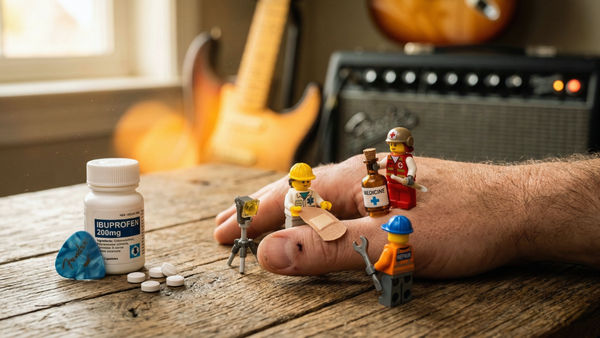
Three Tension Patterns in Guitarists Over 40 (And Why Each Needs a Different Approach)
Most guitarists over 40 aren’t dealing with “just hand pain.” They’re often fighting three very different tension patterns and that creep in after years of stop-and-start playing. And often these patterns overlap.

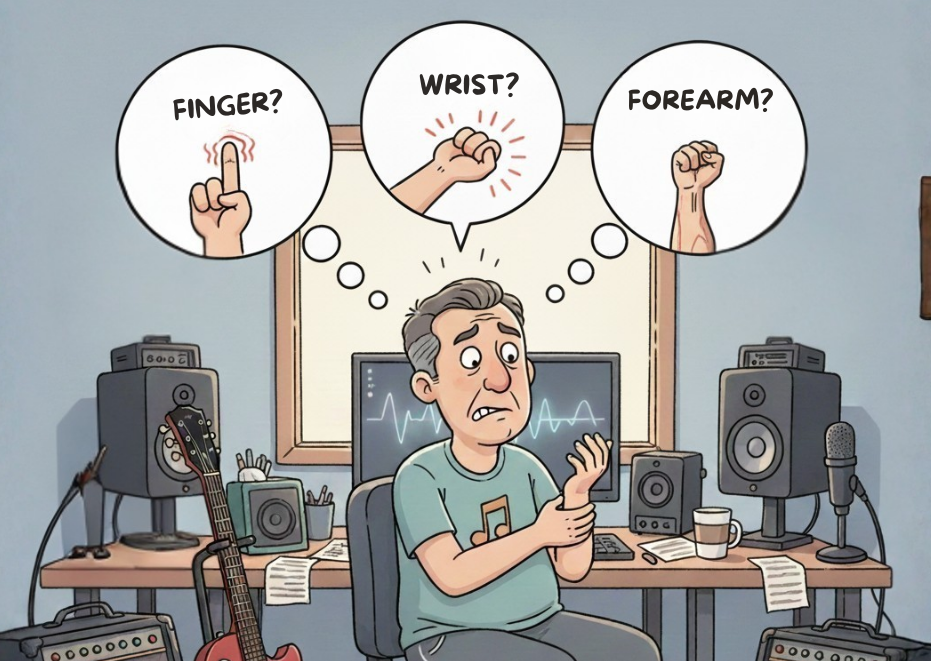
Let me tell you about three different guitarists I worked with last year.
Player A: Wakes up with stiff fingers. Takes fifteen minutes of playing before things loosen up. No sharp pain, just this persistent resistance in the joints. Morning's the worst.
Player B: Hands feel fine in the morning. But twenty minutes into playing, the base of the thumb starts aching. Rest for a few minutes and it settles. Push through and it gets worse.
Player C: Weird burning sensation down the forearm when playing certain passages. Sometimes the ring and pinky finger go a bit numb. Shaking the hand helps temporarily.
All three came in saying the same thing: "My hands are getting old. I think I have arthritis."
But when they got properly assessed by their doctors and physios, turned out they had three completely different things going on.
Player A's symptoms were consistent with early osteoarthritis in the finger joints.
Player B had tendinopathy in the thumb, an overuse injury from years of gripping too hard.
Player C had nerve irritation, likely from postural issues creating compression somewhere between the neck and hand.
Different problems. Different mechanisms. Different solutions.
And here's what I see constantly: guitarists over 40 lump everything under "my hands are getting old" or "it's probably just arthritis."
They treat it all the same way: ice, rest, maybe some supplements and wonder why nothing works consistently.
The reason it doesn't always work is because different tension patterns have different underlying mechanisms. And those mechanisms require different approaches.
I'm not here to diagnose you. But I can help you understand the different patterns I see in my work with musicians, why they matter, and why getting proper professional assessment is so important.
Because once you understand that not all hand pain is the same, you'll stop wasting time on approaches that don't match your actual problem.
Let's break down the three most common patterns I see.
Why "Just Arthritis" Isn't a Helpful Self-Diagnosis
Before we get into the patterns, I need to say this:
Most guitarists I work with have self-diagnosed "arthritis" without ever getting it properly assessed. They just assume that hand pain over 40 = arthritis = inevitable decline.
But in my years working with musicians as a manual osteopath, movement and rehabilitation specialist, I've seen that assumption lead people down the wrong path more often than not.
Here's what actually happens:
Someone's thumb hurts. They google "thumb pain guitar." Everything says "probably arthritis." So they rest it, ice it, maybe take some anti-inflammatories. It helps a bit, then comes back.
What they don't realize is that their pain might not be arthritis at all. It might be a tendon problem, which gets worse with too much rest. Or it might be nerve-related, which needs postural changes, not ice.
So they keep treating the wrong thing. The pain persists or gets worse. And they conclude that their body's just giving up on them.
That's why understanding these different patterns matters.
Not so you can diagnose yourself (you can't, and you shouldn't.) But so you can recognize that your hand pain might need a different approach than what you've been trying.
And so you can have an informed conversation with a healthcare professional who can actually assess what's going on.
Pattern 1: Morning Stiffness That Improves With Movement
What It Looks Like
Common descriptions I hear:
- "My fingers feel like rusty hinges when I wake up"
- "It takes 10-15 minutes of playing before things loosen up"
- "Mornings are the worst, evenings are usually better"
- "Cold weather makes it significantly worse"
- "Multiple joints feel stiff, not just one spot"
Key characteristic: Stiffness that improves with gentle movement and warmth.
What This Pattern Often Indicates
This pattern is commonly associated with osteoarthritis: the "wear and tear" kind of joint degeneration that becomes more common as we age.
With osteoarthritis, the cartilage that cushions joints breaks down over time. The joint gets inflamed, fluid builds up overnight, and you wake up stiff. Movement pumps fresh fluid through the joint and reduces stiffness.
But here's the important part:
If your pain follows this pattern and it turns out to be arthritis, the common advice of "just rest it" is actually counterproductive.
Arthritic joints need movement. Gentle, regular movement. Rest makes them stiffer.
That's why understanding the pattern matters and it changes what you do about it.
Pattern 2: Pain During Activity That Worsens With Continuation
What It Looks Like
Common descriptions I hear:
- "My hands feel fine until I start playing"
- "About 20 minutes in, this specific spot starts aching"
- "If I push through, it gets worse and worse"
- "Rest for a few minutes and it settles down"
- "It's localized to one specific spot—usually thumb, wrist, or forearm"
Key characteristic: Pain that starts during use and intensifies the more you continue.
What This Pattern Often Indicates
This pattern is commonly seen with tendinopathy (what people usually call tendonitis): irritation and micro-damage to a tendon from overload or repetitive stress.
Tendons connect muscle to bone. When you overload them, whether from poor technique, sudden increases in playing volume, or just years of accumulated strain they get irritated and painful during use.
The pain during activity that worsens with continuation is classic tendon behavior. The tendon's telling you it's being asked to do more than it can currently handle.
If this pattern matches what you're experiencing, a physiotherapist or sports medicine doctor can assess whether it's a tendon issue.
Why the Approach Matters
If it is a tendon problem, the approach is completely different from arthritis.
Tendons need relative rest (reduce load, don't eliminate it), followed by progressive loading to rebuild their capacity. They don't respond well to being pushed through pain, but they also don't heal with complete rest.
That's why the pattern matters it points toward a different recovery strategy.
Pattern 3: Burning, Tingling, or Numbness
What It Looks Like
Common descriptions I hear:
- "It's not really pain, it's more like burning or tingling"
- "Certain fingers go numb—usually ring and pinky, or thumb and index"
- "Sometimes it shoots down my arm"
- "Changing my position or shaking my hand helps temporarily"
- "It's worse when my posture's bad or when my neck is in certain positions"
Key characteristic: Nerve-type sensations (burning, tingling, numbness) that are position-dependent.
What This Pattern Often Indicates
This pattern often suggests nerve irritation or compression somewhere along the path from your neck to your hand.
Could be at the neck (cervical nerve roots), the shoulder, the elbow (cubital tunnel), the wrist (carpal tunnel), or anywhere in between.
Nerves run through a lot of structures, and if they get compressed or irritated, they create these characteristic burning/tingling/numbness symptoms.
If you're experiencing these symptoms, they're worth mentioning to a doctor or physiotherapist who can do proper nerve testing to figure out where exaclty the irritation is coming from. And its important to know that because:
Nerve issues respond to completely different interventions than joint or tendon problems.
Improving posture, releasing tight muscles that might be compressing the nerve, nerve mobility exercises these are the approaches that help. Ice and anti-inflammatories usually don't do much for nerve problems.
Again that's why recognizing the pattern first matters.
Why These Patterns Often Overlap (And Why That's Okay)
Here's the messy truth: most guitarists over 40 don't have just one of these patterns. They often have combinations.
You might have early arthritis and a tendon problem. You might have nerve irritation that developed because your posture compensated for joint stiffness. You might have multiple things contributing to your pain.
That's normal. Bodies are complex. Problems layer on top of each other. This is exactly why the first step is always professional assessment.
I can teach you to recognize patterns. I can explain why different mechanisms need different approaches. But I can't tell you which one you have, or how to treat it.
What I can do is give you the framework for understanding your body better, so when you do see a professional, you can describe what's happening accurately. And so you understand why they're recommending what they're recommending.
The Approach: Why Different Patterns Need Different Responses
No matter what the specific diagnosis ends up being, the overall framework I use with musicians follows the same pattern: Release → Reset → Rebuild™. See my post here for more detail.
But the emphasis changes depending on the mechanism.
For Pattern 1 (Stiffness That Improves With Movement)
Release: Gentle movement and heat to reduce stiffness. Anti-inflammatory strategies under medical guidance. Fascial release around joints.
Reset: Improve movement quality to reduce unnecessary joint stress. Address compensations that have developed.
Rebuild: Strengthen surrounding muscles to support and protect joints. Build endurance for longer playing sessions.
Key principle: Keep moving, but move intelligently. Don't rest completely.
For Pattern 2 (Pain During Activity)
Release: Relative rest to allow tendon to calm down. Address overworked muscles creating excessive load.
Reset: Fix the technique or postural issues causing overload. Restore proper movement patterns so load is distributed.
Rebuild: Progressive loading to rebuild tendon capacity gradually. Strengthen supporting structures.
Key principle: Reduce load temporarily, then rebuild capacity systematically.
For Pattern 3 (Nerve Symptoms)
Release: Release tight muscles that might be compressing the nerve. Improve posture to reduce compression.
Reset: Restore normal nerve mobility. Address postural and movement patterns creating irritation.
Rebuild: Strengthen postural muscles to maintain good alignment. Build nervous system resilience.
Key principle: Create space for the nerve, then maintain that space.
Important: These are general frameworks. Your healthcare provider will guide the specific protocol based on proper assessment of your situation.
What to Do With This Information
I'm not asking you to diagnose yourself. I'm asking you to pay attention. I wrote a whole post on the importance of awareness of your body and how it can have a huge impact on your music.
Notice your pain pattern:
- When does it hurt? (Morning? During playing? All the time?)
- What makes it better? (Movement? Rest? Position changes?)
- What makes it worse? (Activity? Cold? Certain postures?)
- Where exactly does it hurt? (Joints? Specific tendons? Radiating?)
- What does it feel like? (Stiff? Sharp? Burning? Tingling?)
Then take that information to a professional who can assess you properly:
- Your doctor
- A physiotherapist
- A sports medicine specialist
- An occupational therapist
- A hand specialist
Tell them: "I'm a guitarist. Here's my pain pattern. Here's when it's worst and what makes it better or worse."
That information helps them assess you more accurately. And it helps them understand that your hands aren't just tools for daily life: they're your instruments, and losing their function means losing something you care about.
They'll do proper assessment. Physical examination, maybe imaging, specific tests. That's how you figure out what's actually going on.
Then they'll guide treatment. Which might include the Release → Reset → Rebuild™ framework I use, or it might include medical interventions, or both.
The Most Important Thing to Understand
Your pain is trying to tell you something about what's happening mechanically.
Different patterns suggest different mechanisms. Different mechanisms need different approaches.
You can't figure this out alone.
But understanding these patterns helps you:
- Stop treating everything the same way
- Know when to seek help
- Communicate effectively with healthcare providers
- Understand why certain approaches are recommended
- Recognize when something's not working because it's the wrong approach for your pattern
Your Next Step
If you're dealing with persistent hand or wrist pain that's affecting your playing, get it properly assessed.
Book an appointment with someone who understands bodies: a doctor, physio, sports medicine specialist, or an osteopath.
Bring this information about pain patterns with you. Tell them which pattern sounds most like what you're experiencing.
Don't assume all hand pain is the same. Pay attention to the pattern. Get proper assessment. Then address the actual mechanism.
If you want support implementing a treatment plan, the Keep Playing guide provides the Release → Reset → Rebuild™ framework for common guitarist issues.
F.P. O’Connor
F.P. O'Connor is a Musician and Movement Specialist whose work is informed by extensive training in Manual Osteopathy, Psychology, and Strength Coaching.
He is the founder of Gentle Octaves, helping adult players develop practical, science-based systems for ease, control, and long-term playing confidence.
Understanding pain patterns is the first step in the Release → Reset → Rebuild™ framework.
For more on working with your body as a guitarist:
Keep Playing: The Release → Reset → Rebuild™ Method for Lifelong Guitar Playing
F.A.Q.'s
Q: Why does rest help sometimes but not fix the problem long-term?
Because some conditions improve with movement, while others worsen with too much rest.
Joint stiffness often improves with gentle motion, tendon problems need relative rest followed by progressive loading, and nerve irritation usually responds best to posture and movement changes. Rest alone rarely addresses the root cause.
Q: Can I tell which pattern I have just by reading this post?
No but you can recognize patterns that help guide proper assessment.
This article isn’t about diagnosing yourself. It’s about noticing when symptoms appear, what makes them better or worse, and how they feel, so you can communicate clearly with a healthcare professional who can assess you properly.
Q: Why do different pain patterns need different recovery approaches?
Because joints, tendons, and nerves respond to stress and recovery in very different ways.
Applying the same strategy, like icing or resting everything, ignores how different tissues heal. Matching the approach to the mechanism is what makes recovery effective.
Q: Is it common to have more than one pattern at the same time?
Yes. Most guitarists have overlapping patterns.
For example, joint stiffness can change posture, which irritates nerves, while poor mechanics overload tendons. This overlap is normal and exactly why professional assessment matters.
Q: Why do nerve symptoms feel so different from joint or tendon pain?
Nerves produce burning, tingling, or numbness rather than local aching.
When nerves are irritated or compressed, symptoms often travel, change with posture, or affect specific fingers. These issues rarely improve with ice or rest alone and usually require movement and postural changes.
Q: Should I stop playing guitar if I notice one of these patterns?
Not automatically but how you play matters.
Reducing volume, improving mechanics, and using targeted release or reset work is often more effective than complete rest. Sharp or worsening symptoms should always be assessed professionally.
Q: How does the Release → Reset → Rebuild system fit with these patterns?
The framework stays the same, but the emphasis changes based on the mechanism.
- Joint stiffness prioritises movement and support
- Tendon issues prioritise load management and rebuilding capacity
- Nerve symptoms prioritise decompression and postural control
The sequence stays consistent but the focus adapts.
Q: When should I seek professional help for hand or wrist pain?
If pain is persistent, worsening, sharp, or involves numbness or weakness.
Doctors, physiotherapists, sports medicine specialists, occupational therapists, and hand specialists can assess what’s actually happening which is something no article or program can replace.
Q: Why is posture and guitar setup mentioned so often in recovery?
Because small mechanical stresses accumulate over time.
Posture and setup influence how load travels through the entire arm. Poor mechanics don’t always hurt immediately but they often create problems years later.
Q: What’s the biggest mistake guitarists make with hand pain?
Treating all pain the same way.
Ice, rest, and supplements may help some issues temporarily but they fail when the underlying mechanism isn’t addressed. Understanding the pattern saves time, frustration, and unnecessary suffering.
Q: Is this article meant to replace medical advice?
No. It’s educational, not diagnostic or prescriptive.
Its purpose is to help you recognize patterns, ask better questions, and engage more effectively with healthcare professionals not to replace them.
Q: What should I do next if this sounds familiar?
Get assessed then follow a mechanism-matched recovery plan.
Once you know what’s actually going on, frameworks like Release → Reset → Rebuild™ help structure recovery safely and sustainably.
Sources & Further Reading
Austen, C., Redman, D., & Martini, M. (2024). Warm-up exercises reduce music conservatoire students’ pain intensity when controlling for mood, sleep and physical activity: A pilot study. British Journal of Pain, 18(1), 57–69. https://doi.org/10.1177/20494637231188306
Autret L, Shipley É, Lodde B, Hinojosa-Azaola A, Saraux A. Rheumatic and musculoskeletal disorders in musicians: risks, adaptations and management. RMD Open. 2025;11:e006149. https://doi.org/10.1136/rmdopen-2025-006149
O'Connor, F.P. (2025). Keep Playing: The Release → Reset → Rebuild™ Method for Lifelong Guitar Playing
Stamm, T. A., Machold, K. P., Smolen, J. S., Fischer, S., Redlich, K., Graninger, W., Ebner, W., & Erlacher, L. (2002). Joint protection and home hand exercises improve hand function in patients with hand osteoarthritis: A randomized controlled trial. Arthritis & Rheumatism, 47(1), 44–49. https://doi.org/10.1002/art1.10246
Storm S. A. (2006). Assessing the instrumentalist interface: modifications, ergonomics and maintenance of play. Physical medicine and rehabilitation clinics of North America, 17(4), 893–903. https://doi.org/10.1016/j.pmr.2006.08.003
World Health Organization. (2023). Musculoskeletal Health https://www.who.int/news-room/fact-sheets/detail/musculoskeletal-conditions
Zelazny C. M. (2001). Therapeutic instrumental music playing in hand rehabilitation for older adults with osteoarthritis: four case studies. Journal of music therapy, 38(2), 97–113. https://doi.org/10.1093/jmt/38.2.97