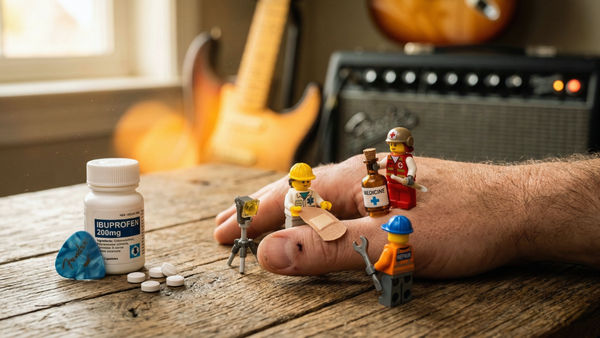
Thumb Fatigue When Picking Guitar? What’s Causing the Weakness (And How to Fix It)


Do you get that dreaded thumb tension every time you pick up your guitar? Maybe it's a dull ache and fatigue after twenty minutes of playing. Maybe it's sharp sensation during barre chords. Maybe it's that weird stiffness in your thenar muscle (that meaty bit at the base of your thumb) that won't quite release even when you're not holding the guitar.
Here's the thing: thumb tension and fatigue is insanely common for adult guitarists. I'd say 60-70% of players over 40 deal with it at some point.
And it's not because your thumbs is weak. It's not because you're getting old and it's not because your hands are "giving out."
It's almost always a technique issue that nobody taught you how to fix.
The good news? Once you understand the mechanics of what's actually happening, fixing this is surprisingly simple. Not overnight-miracle simple, but simple enough that you can feel a real difference today.
Let me show you exactly what's going on, and what to change.
The Real Reason Your Thumb Fatigues
Most thumb tension and fatigue comes down to one thing: you're working too hard.
Not in a "you need to toughen up" way. In a literal mechanical sense. Your thumb is doing way more work than it needs to do, and over time, that overwork shows up as pain.
Here's what's usually happening:
Too much squeeze between thumb and fingers.
You're creating a death grip on the neck like you're trying to stop it from running away. Your thumb and fingers are locked in constant battle against each other, creating compression through your whole hand.
Thumb acting as a clamp instead of a stabilizer.
Your thumb's job is to provide gentle counterpressure, not to hold the entire guitar in place. But most people use it like a vice grip, which means the muscles in your thumb and palm are constantly firing at max capacity.
Wrist angle creating tension up the chain.
If your wrist is bent at a weird angle (usually because your guitar's too low or you're twisted to see the fretboard), your thumb has to compensate. That compensation creates strain.
Neck position forcing the thumb to overwork.
If you can't see what you're doing without craning your neck down, your whole body adjusts, which usually means your thumb ends up in a compromised position doing extra work.
Nervous system tension making you grip harder.
When you're stressed or focused or trying really hard to get a passage right, your whole system tenses up. And that tension shows up as extra grip pressure you don't even realize you're creating.
All of this compounds. It's not just one thing. It's a chain of small mechanical issues that add up to your thumb screaming at you.
The Two Mistakes Almost Everyone Makes
Let's get specific. There are two mistakes I see constantly that cause most thumb pain.
Mistake 1: Thumb Too High Over the Neck
A lot of people wrap their thumb over the top edge of the neck. Sometimes it's because that's how they learned. Sometimes it's because they're trying to mute the low E string. Sometimes it's just habit.
But here's what that position does:
- Creates compression through the joint at the base of your thumb
- Reduces how far your fingers can reach (so you end up stretching harder than you need to)
- Forces your wrist into a bent position, which creates strain up your forearm
Unless you're specifically doing a thumb-over technique for a particular passage, your thumb shouldn't be hanging over the top. It should be behind the neck.
Mistake 2: Thumb Squeezing Way Too Hard
This is the big one. Most people are squeezing the neck with about five times more pressure than they actually need.
I'm not exaggerating. Five times.
You think you need that much grip to get clean notes. But you don't. You're compensating for something, whether that's stiffness in your fingers, tightness further up the chain in your upper arm or shoulders, lack of confidence in your technique, or just years of habitual tension.
That excessive squeeze causes fatigue, creates pain, and leads to long-term problems in your thumb joint and the muscles in your palm.
And here's the thing: most adults do this because they're trying to compensate for years of stiffness or self-doubt. It's not that you're doing anything "wrong." You're just working harder than the task requires because nobody showed you there was an easier way.
If you want to explore more specific adjustments you can make to your playing posture, setup and ergonomics to reduce hand and thumb fatigue when playing, or if you play with arthritis check out my extensive post here on The Guitarist Body Blueprint.
The Simple Fix (Step-by-Step)
Alright, let's fix it. This is practical, 80/20 stuff. You don't need to overhaul your entire technique. Just make these adjustments.
1. Place Your Thumb Halfway Down the Back of the Neck
Not dead center behind the neck. Not hugging the top edge. Halfway down. Behind the neck. Roughly opposite your middle finger.
This gives you mechanical advantage. Your thumb provides counterpressure without having to squeeze, and your fingers can reach without straining.
2. Lighten the Squeeze by 30%
Literally imagine there's a dial controlling your grip pressure, and you're turning it down by about a third.
You're not letting go. You're just releasing the death grip and finding the minimum pressure needed to fret cleanly.
This feels weird at first. You'll think the notes won't sound. But try it. You'll be surprised how little pressure you actually need.
3. Drop Your Shoulder and Shake Your Hand Once
Before you re-grip the neck, drop your shoulder away from your ear. Shake out your hand for two seconds. Let the tension go.
This resets your nervous system. It tells your body we're not in fight-or-flight mode, we're just playing guitar.
4. Re-Fret a Simple Chord
Pick something easy. A minor. C major. Doesn't matter. Just fret it with your new thumb position and your lighter grip.
5. Notice What Changed
Does your thumb feel different? Do your fingers have more reach? Does the chord sound cleaner even though you're using less effort?
That's efficiency. That's what we're after.
Key reminder: Your thumb is a guidepost, not a clamp.
Quick Test: Are You Still Holding Too Hard?
Here's how you know if you're squeezing too much:
- Fret any chord
- Lift your thumb completely off the back of the neck
If the chord collapses immediately and all the notes go dead, you're squeezing way too hard. Your fingers are relying on that thumb pressure to stay in place, which means they're not actually doing their job.
If the chord stays mostly clean for a second or two before things start to buzz, you're in the right zone. Your fingers are holding themselves in position, and your thumb is just providing gentle support.
Try this test a few times. It's confronting, but it's honest feedback. Let yourself feel the difference between gripping and guiding.
When Thumb Pain Isn't About Technique
Look, sometimes it's not just technique. Sometimes there's something else going on.
If you've made these adjustments and your thumb still hurts, consider:
Arthritis flare-ups.
If you've got arthritis in your thumb joint, technique adjustments help, but they're not a cure. You might need to manage inflammation, adjust your practice volume, or work with a physio on specific exercises. I have more posts below on plating wiht artists and straggles ot help you manage and still play your best"
3 Arthritis rest move to do before you pick up the guitar
Arthritis Friendly Guitar Chords
Old wrist or forearm injuries.
Past injuries create compensation patterns. Your thumb might be overworking because your wrist doesn't move the way it used to. This requires targeted rehab, not just technique fixes.
The Guitar Comfort System: Release-Reset-Rebuild post is a good place to start if you have old injuries
Excessive practice volume.
If you're going from zero to two hours a day, your thumb's going to complain. Volume matters. Build up gradually.
Poor guitar setup.
If your action's too high, you have to press harder to fret cleanly. That extra effort shows up as thumb pain. Get your guitar set up properly. It's worth the money. The Guitarists Body Blueprint post will help you again here.
Restriction further up the chain
Im talking about the kinetic chain: The human body's segments (joints, muscles, ligaments, and fascia) are connected in series, much like links in a mechanical chain.
Sometimes thumb pain is the symptom of tightness or movement dysfunction in your shoulder or even upper back tension.
This is where my Osteopathy background comes in handy. I've worked with enough musicians to know that sometimes the problem isn't just how you play, it's what you're playing with and what your body's dealing with underneath.
If your thumb pain persists despite fixing your technique, see someone who understands bodies. Don't just push through it.
Mini-Exercise: 60-Second Thumb Reset
Right, before you go back to playing, do this quick reset. Takes one minute.
Shake out both hands. Literally shake them like you're flicking water off your fingers. Ten seconds.
Slow wrist circles. Five circles in each direction with each wrist. Keep it gentle. You're not trying to stretch aggressively, just moving things around.
Gentle thumb flexion stretch. Use your other hand to gently pull your thumb back toward your wrist. Hold for ten seconds. Switch hands. No pain, just a mild stretch.
Place your thumb on the neck lightly. Remember: halfway down the back, light pressure.
Play four or five slow chord transitions. A minor to C. G to D. Whatever. Slow. Focus on keeping that soft touch with your thumb. Notice when you start to grip harder and consciously release.
That's it. One minute. Do this before every practice session and watch how much faster your thumb stops complaining.
If you want more routines like this that are specific to your issue my book outlines a step by step approach with assessments, exercises and illustrated examples for each step so you know exactly what to do and what works for you and your body:
Keep Playing: The Release → Reset → Rebuild™ Method for Lifelong Guitar Playing
Keep Your Hands Happy, Keep Playing
Here's what I want you to take away from this:
Thumb pain is fixable. It's usually not a serious injury. It's usually just your body telling you that your technique needs adjusting.
Will it be perfect tomorrow? Probably not. Changing habits takes time. You'll forget and slip back into the death grip. That's normal. Just notice when it happens and reset.
You're not breaking yourself. You're learning your body. And that's the whole point.
If thumb pain, wrist pain, or hand stiffness keeps coming back despite making these changes, there might be something deeper going on. That's where the full system comes in.
Inside Keep Playing I walk you through the complete Release → Reset → Rebuild™ process.
It's designed specifically for adult guitarists dealing with tension, fatigue, old injuries, arthritis, or just stiffness that won't quit. Daily routines, technique adjustments, and the real body mechanics that keep you playing for decades.
But start with what's here. Fix your thumb position. Lighten your grip. Do the 60-second reset. See what shifts.
Your hands have gotten you this far. Let's make sure they can take you the rest of the way.

F.P. O’Connor
F.P. O'Connor is a Musician and Movement Specialist whose work is informed by extensive training in Manual Osteopathy, Psychology, and Strength Coaching.
He is the founder of Gentle Octaves, helping adult players develop practical, science-based systems for ease, control, and long-term playing confidence.
FAQ
Q: Why does my thumb feel weak or fatigue quickly when I play guitar?
Most thumb weakness or fatigue comes from excessive grip pressure, inefficient thumb placement, or wrist collapse.
When the thumb grips too hard or sits in an awkward position, it absorbs far more load than it’s designed for. This tension often travels into the forearm and wrist.
If basic adjustments don’t help, the issue may be upstream involving shoulder posture, neck position, or overall playing mechanics rather than the thumb itself.
If relaxing your grip reduces pain within seconds, mechanics are the main driver.
Q: How do I stop my thumb from hurting when playing guitar?
Reduce grip pressure, improve thumb placement, and adjust wrist angle.
Most players squeeze far harder than necessary. Lightening your grip by even 20–30% dramatically reduces strain. Positioning the thumb roughly halfway down the back of the neck and keeping the wrist more neutral allows the fingers and not the thumb to do the work.
If notes still sound clean with less pressure, you were gripping too hard.
Q: Is thumb pain normal for guitar players?
It’s common, but it’s not normal.
Thumb pain is usually a sign of tension, inefficient technique, or setup issues, not age, weakness, or lack of toughness.
Many players assume pain is inevitable, but in most cases it’s preventable once mechanics improve.
Pain is feedback not a rite of passage.
Q: What is the fastest way to reduce guitar thumb pain?
Relax the shoulder, reduce grip pressure, reposition the thumb, and raise the guitar neck slightly.
Thumb pain rarely exists in isolation. When the shoulder relaxes and the guitar sits at a better angle, the hand no longer has to overwork to stabilise the neck.
This combination often produces immediate relief even before strength or conditioning changes.
If the hand feels lighter instantly, you’re on the right track.
Q: Why does my thumb get tired so quickly when fretting?
Rapid fatigue usually means you’re using far more pressure than needed.
Most adult players squeeze 3–5× harder than required to fret cleanly. This overloads the thumb early and creates unnecessary fatigue.
Efficiency, not strength, determines endurance.
Play as softly as possible while still getting clean notes, that’s your baseline.
Q: Can guitar setup cause thumb pain?
Yes high action or poor setup significantly increases thumb and wrist strain.
If the strings sit too high or the neck relief is off, the hand has to work harder for every note. Over time, that extra force accumulates in the thumb joint.
Even small setup adjustments can dramatically reduce load.
If playing feels easier on another guitar, setup matters.
Q: Why does my thumb hurt most during barre chords?
Barre chords amplify inefficient thumb mechanics and excessive pressure.
Barres demand coordination, not force. When the thumb clamps instead of supporting, pain and fatigue increase quickly.
Correct thumb placement, lighter pressure, and better arm positioning often improve both comfort and tone.
If the barre sounds cleaner with less effort, you’re usually doing it right.
Q: Should I push through thumb pain to “build strength”?
No! Pushing through pain usually reinforces poor mechanics.
Strength built on tension doesn’t last. It teaches the body to compensate harder instead of moving efficiently. Reducing load first, then rebuilding capacity with better mechanics, leads to far more durable progress.
If pain increases as you push, stop and adjust instead.
Q: When should I get thumb pain checked professionally?
If pain is sharp, persistent, worsening, or associated with numbness or weakness.
While most thumb pain is mechanical, ongoing or neurological symptoms deserve proper assessment especially if changes in technique don’t help.
If symptoms don’t change with adjustment, get another set of eyes on it.