Anti-Inflammatory Habits That Actually Support Your Guitar Playing


The short version
Anti-Inflammatory Habits That Actually Support Your Guitar Playing
Most advice for guitarists with sore hands focuses on what happens at the guitar. Lighter strings, different chord shapes, a better warm-up. That advice has its place. But there is an upstream variable most players have never touched, and it is the one that determines how much your hands can handle before a session starts going sideways.
What this covers
- Why systemic inflammation shows up in your hands specifically
- Sleep as the highest-leverage anti-inflammatory habit most players overlook
- What an anti-inflammatory diet actually means for someone who plays guitar
- The role of stress and nervous-system state in how tissue responds to playing load
- Movement away from the guitar and why it matters for longevity at the instrument
- One thing you can change this week without overhauling your whole life
The core truth
These habits do not replace good technique or sensible practice limits. They change the baseline your body operates from, and that changes how every session after feels.
There is a version of Tuesday where you sit down, play for forty-five minutes, and your hands feel fine. There is another version of Tuesday where the same chord shapes, the same guitar, the same forty-five minutes, and your hands are done before you are halfway through.
Same day of the week. Same instrument. Different body.
Most players put this down to getting older. A few blame the chord they were working on.
The actual variable, in most cases, is not in the room at all. It is how the previous 24 to 48 hours went: what you ate, how you slept, and what your nervous system was quietly managing while you were not thinking about guitar.
That is what anti-inflammatory habits for guitarists are really about. Not a supplement or a diet overhaul. The background conditions your tissue operates in, every single session.
Look, I know you're probably not associating all this with guitar playing. Guitar is meant to be a hobby, something you do for fun. You shouldn't have to think about what you're doing before you sit down to pick up the guitar.
Honestly, these are just general principles that are probably good to apply to your life anyway, because when you feel better about yourself, or when you feel better physically, you know you play better, so it all correlates.
The pros know this and most of them are preparing for their performances beforehand more similar to athletes. They are actually preparing their body for the demands of touring and the physical and psychological demands of being on stage for a few hours each night.
You don't have to be a pro to take this approach into how you play. Even if it's just a hobby and you're just playing guitar on your own in your space, putting your body in the right state is only going to help your playing in the long run
What are anti-inflammatory habits for guitarists?
Anti-inflammatory habits for guitarists are daily lifestyle practices, including sleep quality, food choices, stress management, and movement away from the instrument, that reduce the body's background inflammatory load. When that load is lower, the tissues in your playing chain become less reactive to mechanical stress, and common patterns of hand and wrist discomfort often become more manageable.
The Problem With the Advice That Is Already Out There
The standard guidance is not wrong. Eat more omega-3 fatty acids. Try turmeric. Use lighter strings. Take breaks. It is all reasonable, and none of it will harm you.
What it misses is the mechanism. And the mechanism is the whole point.
Inflammation is not a condition that lives in your hands. It is a whole-body tissue state. Your hands are where you feel it most acutely because they are the end of the loaded chain.
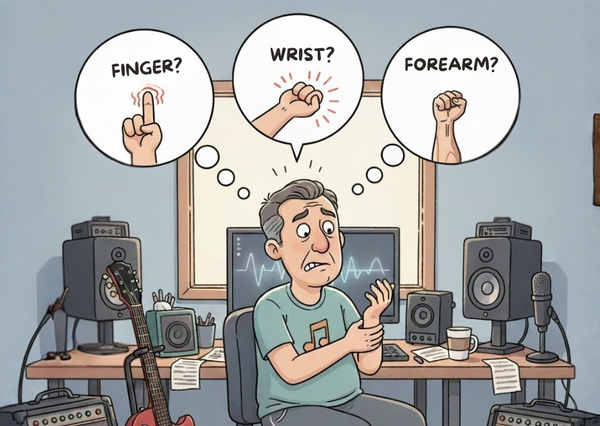
The finger joints, wrist, and forearm are reporting on something that originates much further upstream, in how you slept, how stressed you are, what your gut is doing, and what your immune system has been managing all week.
Treating the hands in isolation is like adjusting the action on a guitar while the neck is warping. You can make small improvements, but you are working around the actual problem.
The players who make the most meaningful and lasting progress are not always the ones who found a better warm-up routine. Often they are the ones who started looking after themsleves properly and noticed the warm-up suddenly needed less work.
Free 15-page Guitar Comfort Guide
Play with less tension. Keep the music moving.
A short, practical guide to help your body feel more prepared before you pick up the guitar.
- Warm up properly in five minutes
- Find a playing position that feels supported
- Learn the seven pillars of playing posture
No spam. No daily sales sequence. Just practical guidance for keeping music in your life. Unsubscribe at any time.
One note worth making here: for players who are hypermobile, connective tissue already tends to be more reactive to systemic load. If that describes you, the habits in this post are not optional background noise. They carry more weight.
Why Your Hands Pay the Bill That the Rest of Your Body Ran Up
The most frequently used part of kinetic chain in guitar playing runs from the thoracic spine and shoulder girdle down through the elbow and forearm to the wrist and fingers. That is a long chain, and it loads incrementally. Every restriction or compensation upstream adds demand downstream.
Ok so then layer systemic inflammation onto elevated inflammatory markers ( substances your body produces when inflamed). Your body is in a slightly irritated state. When tissues are inflamed, they're reacting as if they're under mild stress or trying to heal something. (It's the same process that makes a cut go red and puffy just at a lower level, and spread across the tissues )
In practical terms, it means those connecting tissues may be more sensitive, less resilient, and slower to recover than they would be if everything were calm.
The same chord you have played ten thousand times now hits tissue that is already sensitised. The threshold between fine and that is enough has moved, not because of anything you did at the guitar, but because of the conditions the tissue was already in when you sat down.
This is why the variability happens. Not because the hands are deteriorating. Because the baseline they are working from shifts day to day based on factors most players are not monitoring.
Playing-related musculoskeletal disorders in musicians are well documented, and consistent findings across the research point to the same pattern: these problems are not purely about technique or cumulative playing hours.
The systemic context matters. If you have ever wondered why three tension patterns can present so differently in players with similar technique and practice habits, the upstream systemic state is part of the answer.
Sleep Is the Lever Most Players Have Not Touched
If you could change one thing, start here.
Sleep deprivation elevates inflammatory markers directly. It also drives something called central sensitisation, where the nervous system amplifies pain signals independently of what is actually happening in the tissue.
The same mechanical load produces a stronger pain response not because the tissue is more damaged, but because the signalling system is turned up.
For guitarists, that means a bad night of sleep does two things at once. It raises the systemic inflammatory load on the tissue. And it makes the nervous system more sensitive to whatever load does arrive. Both simultaneously.
The inverse is also true. Consistent, adequate sleep is probably the most anti-inflammatory intervention available, ahead of any specific food or supplement.
This is not commonly said in guitar spaces, where the conversation tends to go straight to diet and stretching. Sleep is boring to write about, and it is not something anyone can sell you.
Seven to nine hours, most nights. Not occasionally. Consistently. The research on sleep and inflammatory markers is not subtle.
If your sessions are variable and you are not sleeping reliably, that is the first place to look. Not the strings. Not the chord shapes. The previous night.
Yes and I know it sounds crazy that to improve your guitar playing you should be thinking about how much you sleep every night! But the direct link has been well established showing that people who sleep less have higher levels of inflammatory markers and that changing your sleep such increasing let's say from 5.5 hours to 7 hours can reduce inflammatory markers meaningfully even within a few weeks.

What Food Actually Does (and What It Does Not Do)
Okay so food. You probably don't need me to lecture you on what to eat, but I will I will explain what actually works as it's another key factor in the overall anti-inflammatory picture.
An anti-inflammatory diet is not a specific protocol. It is a general pattern: more of the foods that dampen the inflammatory response, less of the foods that amplify it.
The broad strokes have decent research support. Fatty fish, including salmon, mackerel, and sardines, are high in omega-3 fatty acids that reduce specific inflammatory proteins, including C-reactive protein.
Leafy greens, berries, and most vegetables contain antioxidants that help manage oxidative stress. The Mediterranean dietary pattern, built around these foods alongside olive oil and nuts, has consistently correlated with lower inflammatory markers in population studies.
On the other side, highly processed food, excess sugar, and alcohol tend to elevate inflammatory markers. Not catastrophically from one meal, but cumulatively when they are the daily baseline.
The guitarist angle here is that none of this is a rescue operation. One good meal does not offset a week of poor choices in the same way one good night of sleep does not undo a fortnight of insomnia. What matters is the accumulated pattern over weeks and months.
Turmeric gets mentioned constantly in this context. It has some support as an anti-inflammatory compound, but the effect size in isolation is modest. If you enjoy it, use it. If you are hoping it compensates for what sleep and food are not doing, it will not get there.
Stress, the Nervous System, and Why a Hard Week Wrecks a Good Session
Okay so next is stress. Cortisol, the body's primary stress hormone, has a complicated relationship with inflammation. Short-term cortisol is actually anti-inflammatory.
Chronic elevation, from sustained work pressure, difficult circumstances, or the low-grade grind of being busy all the time, which seems to be the norm for most of us in todays world, tips the balance in the other direction.
Chronic stress also keeps the nervous system in a state of partial arousal. Not full fight-or-flight, but not fully settled either. In that state, tissue sensitivity is elevated and recovery from playing load is slower.
This is not a minor variable. Some of the most significant shifts I see in players dealing with recurring hand and wrist discomfort are not the result of a new exercise. They come from changes to the nervous system state the person arrives in when they sit down to play. Less screen time before a session. A short walk between work and practice. A few minutes of deliberate breathing before picking up the guitar.
None of that requires a complete life restructure. It does require acknowledging that the state you are in when you sit down to play is not incidental. It is part of the session.
Movement Away From the Guitar
Regular exercise as we know has well-established anti-inflammatory effects. It improves circulation, supports joint fluid dynamics, and reduces the resting inflammatory load over time.
If your day involves a ton of sitting whether at work or at the guitar, this is a relatively static loaded position for the upper back and shoulder girdle. The tissue upstream of the hands gets very little dynamic loading from guitar practice alone.
Moving the rest of your body through walking, swimming, or light resistance work creates the systemic conditions where localised tissue is less reactive. You do not need to become an athlete.
But sedentary plus guitar is a difficult combination for connective tissue health over time, and there are straightforward ways to ease hand tension that start well before you play the first note.
Players who move regularly also tend to carry less resting tension through the shoulder girdle and neck. Less upstream tension means less loading arriving at the hands before you have even begun.
One Thing to Start This Week
The most useful single action is not to try all of this at once. It is to identify the variable that is most obviously off and address that first.
For most players, it is sleep. If you are consistently getting fewer than seven hours, or your sleep quality is poor, that is the upstream lever. Start there before changing anything else.
If sleep is broadly fine, look honestly at what a typical week of food looks like and identify one shift rather than an overhaul. More vegetables with meals, less processed food in the gaps.
If both of those are reasonably in order, the question becomes what the hour before you pick up the guitar usually looks like. If it is work stress, screens, and rushing, the session that follows starts from behind.
Free 15-page Guitar Comfort Guide
Play with less tension. Keep the music moving.
A short, practical guide to help your body feel more prepared before you pick up the guitar.
- Warm up properly in five minutes
- Find a playing position that feels supported
- Learn the seven pillars of playing posture
No spam. No daily sales sequence. Just practical guidance for keeping music in your life. Unsubscribe at any time.
Small adjustments to upstream conditions accumulate. The hands will not feel the difference immediately. But over a few weeks of more consistent sleep and a calmer pre-practice routine, many players notice their sessions become steadier. Not because anything changed at the guitar. Because what the guitar was loading into changed.
And a practical note on the active flare situation: these habits work at the background level. During a period when inflammation is already elevated and tissue is reactive, adding stretching or loading to sensitised joints tends to amplify rather than settle the response.
That is a different conversation. These three pre-playing reset moves are more appropriate when you are already in a flare. What is in this post is about reducing the conditions that lead there.
If you want a complete system for protecting your body for the long game, not just habits but the full framework for playing longevity across all its phases, that is what Keep Playing is built around. https://payhip.com/b/ItW5E

F.P. O'Connor
Manual Osteopath · Guitarist · Movement Nerd
Fergus is a manual osteopath and guitarist who spent nearly two decades watching players quietly give up because nobody gave them a straight answer about why their body was protesting.
→ Download the free Pain-Free Guitar GuideFrequently Asked Questions
Does diet actually affect arthritis pain in guitar players?
Diet alone is not a treatment for arthritis, and it should not be framed that way. But there is solid evidence that dietary patterns affect systemic inflammatory markers, and elevated inflammation amplifies the pain response from mechanical stress. For guitarists with arthritis or joint sensitivity, a consistent anti-inflammatory dietary pattern can contribute to a lower baseline of tissue reactivity. It works in the background over time, not as an immediate intervention.
What is the best anti-inflammatory diet for someone with hand or joint pain from playing guitar?
The Mediterranean dietary pattern has the most consistent research support. It emphasises fatty fish, leafy greens, vegetables, olive oil, and nuts. It is not a strict protocol or a supplement list. The practical version is more of those foods as a regular pattern, and less processed food, sugar, and alcohol over time. No single food is transformative on its own.
Does poor sleep make joint pain worse for musicians?
Yes, through two distinct pathways. Sleep deprivation directly elevates inflammatory markers, raising the background sensitivity of connective tissue. It also drives central sensitisation, where the nervous system amplifies pain signals independently of what is happening in the tissue. Both happen together, which is why a poor run of sleep tends to make sessions noticeably harder even when technique and practice load have not changed.
Can exercise help with guitar-related hand and wrist pain?
Regular movement has well-documented anti-inflammatory effects and reduces resting tension through the shoulder girdle and upper back, which means less load arrives at the hand before playing begins. The benefit is not from direct hand exercises alone, though those have their place. It comes from the systemic effect of being generally active. Walking, swimming, and light resistance training all contribute. A sedentary lifestyle combined with repetitive instrument practice is a difficult combination for connective tissue health over time.
Are there supplements that help guitarists with arthritis or inflammation?
Omega-3 supplements have reasonable research support for reducing specific inflammatory markers. Vitamin D is worth monitoring, as deficiency is common and associated with increased pain sensitivity. Turmeric has some evidence but modest effect size in isolation. No supplement does the work that consistent sleep, diet, and movement habits do. They are additions to those foundations, not replacements.
This post is for educational purposes only. If you are experiencing persistent or worsening pain while playing, please consult a qualified health professional.
References
- Mullington JM, Haack M, Toth M, Serrador JM, Meier-Ewert HK. "Cardiovascular, Inflammatory, and Metabolic Consequences of Sleep Deprivation." Progress in Cardiovascular Diseases, 2009. https://pubmed.ncbi.nlm.nih.gov/19110062/
- Casas R, Sacanella E, Estruch R. "The Immune Protective Effect of the Mediterranean Diet against Chronic Low-grade Inflammatory Diseases." Endocrine, Metabolic and Immune Disorders Drug Targets, 2014. https://pubmed.ncbi.nlm.nih.gov/25244229/
- Woolf CJ. "Central Sensitization: Implications for the Diagnosis and Treatment of Pain." Pain, 2011. https://pubmed.ncbi.nlm.nih.gov/20961685/
- Zaza C. "Playing-Related Musculoskeletal Disorders in Musicians: A Systematic Review of Incidence and Prevalence." CMAJ, 1998. https://pubmed.ncbi.nlm.nih.gov/9680956/