Hand Cramps Playing Guitar? What to Change Before You Stretch
Hand cramping during guitar does not automatically mean you need stronger fingers or more stretching. Learn how to change one playing demand at a time, what the response can tell you, and which symptoms deserve assessment.

The short version
A hand cramp while playing guitar does not automatically mean you need stronger fingers, more stretching, or an electrolyte drink. "Cramp" can describe ordinary fatigue, painful tightening, or something more unusual such as unwanted finger movement or loss of coordination.
Before you chase the sore spot, change one playing demand and see what happens.
What this covers
- how ordinary playing fatigue differs from unusual movement
- why stretching is not always the smartest first response
- five playing variables worth changing one at a time
- why fretting-hand and picking-hand cramps are different jobs
- when numbness, weakness, or loss of coordination deserves assessment
The core truth: make the task cheaper before asking your hand to work harder.
You are halfway through a song and the hand starts to bunch up.
Maybe it is the fretting hand during a barre chord. Maybe it is the picking hand after a fast strumming pattern. The palm tightens, the thumb joins the argument, and suddenly the guitar feels twice as difficult.
The usual advice arrives quickly: stretch your fingers, drink more water, take magnesium, strengthen your grip, relax.
Some of that may be useful in the right situation. The problem is that the word cramp does not tell us what the situation actually is.
What are hand cramps while playing guitar?
Hand cramps playing guitar can describe painful tightening, fatigue, or a feeling that the fretting or picking hand is locking during play. Playing pressure, repeated load, and position may influence the experience, but recurring involuntary finger movements or loss of coordination deserve a different level of attention.
First, work out what you mean by "cramp"
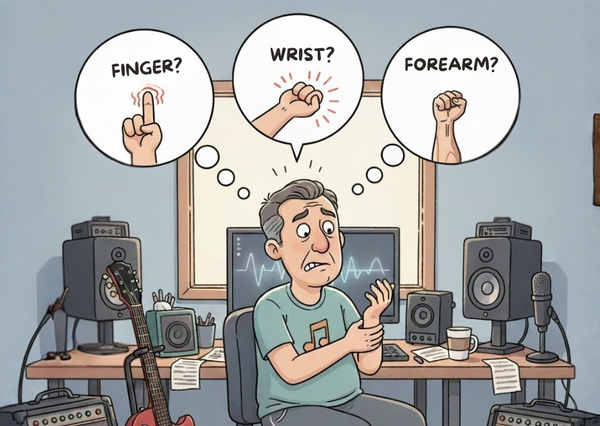
One guitarist means, "My hand gets tired and I cannot hold the chord cleanly anymore."
Another means, "The muscles in my palm suddenly tighten."
Another means, "One finger starts moving when I do not want it to."
Those are not interchangeable descriptions.
Reviews of musician health describe pain, weakness, stiffness, and loss of control among playing-related hand and wrist problems, while showing how uncertain specific causes can be.
So do not diagnose yourself from a symptom word. Notice what is happening.
Ask whether this is mainly tiredness, a painful tightening, a clamping feeling during a demanding task, or an unwanted movement or loss of control. Also notice numbness, tingling, unusual weakness, or reduced dexterity.
That first distinction changes what makes sense next.
Why I would not start by stretching harder
When something feels tight, stretching feels logical.
But "feels tight" does not automatically mean "needs more length."
A hand can feel tight because it has been working hard. Your thumb can feel like a vice because you are using more pressure than the note requires. In those situations, stretching may change the sensation without changing the playing demand that brought it on.
So my first question is not:
What stretch should I do?
It is:
What happens if I make the playing task easier?
Even in sport, where exercise-associated muscle cramps have been studied far more than guitar hand cramps, modern reviews describe cramping as multifactorial and challenge the idea that dehydration or electrolyte loss explains every case.
That research does not tell us what causes a guitarist's hand cramp. It does tell us not to confidently blame one thing because it sounds tidy.
Try the Change-the-Demand Test
Choose a short passage you know well. Do not choose the hardest thing you can play. The point is to compare, not to prove anything.
Play it once normally and notice what happens.
Then change one variable.
1. Reduce fretting or picking pressure
For the fretting hand, gradually reduce pressure until the note begins to buzz, then add only enough to make it clean again.
For the picking hand, loosen the pick grip slightly and see whether the pick can still move cleanly through the strings.
You are looking for pressure you need versus pressure you have added out of habit.
2. Change what the thumb is doing
Notice whether the fretting thumb is squeezing hard into the neck or the picking thumb is pinching the pick as if somebody is about to steal it.
Do not force it into one "correct" position. Let it do a little less and compare.
3. Change the guitar position
Bring the neck a little higher or support the instrument so it is not sliding away.
You are not searching for perfect posture. You are testing whether the position changes how much reach, grip, or holding effort the hand needs.
4. Change the musical demand
Slow the passage down. Use a partial chord instead of a full barre. Play fewer strings.
If the cramp changes when the task becomes simpler, that is useful information. It does not prove which structure is responsible.
Free 15-page Guitar Comfort Guide
Play with less tension. Keep the music moving.
A short, practical guide to help your body feel more prepared before you pick up the guitar.
- Warm up properly in five minutes
- Find a playing position that feels supported
- Learn the seven pillars of playing posture
No spam. No daily sales sequence. Just practical guidance for keeping music in your life. Unsubscribe at any time.
5. Change the support above the hand
Let the shoulder settle and bring the elbow somewhere it does not have to fight the guitar.
The hand is connected to the rest of you. If changing the arm or instrument support changes the hand demand, keep that information.
The rule
Change one thing at a time.
If you change the chair, guitar height, grip, tempo, shoulder position, and chord shape all at once, you may feel different, but you will not know what mattered.
If the cramping escalates, produces numbness or tingling, or your fingers begin behaving in a way you cannot control, stop the experiment.
Fretting-hand and picking-hand cramps are different jobs
The two hands do very different work.
The fretting hand may deal with sustained finger pressure, barre chords, thumb opposition, stretches, and repeated chord changes.
The picking hand may deal with repeated small movements, pick grip, string resistance, strumming, and the effort of stabilising the hand or arm against the guitar.
So a cramp during a full barre chord is not automatically the same problem as a picking thumb that tightens during fast alternate picking.
Start with the job the hand is doing when the symptom appears.
If it looks more like playing load, make the task cheaper first
Suppose the hand behaves normally at rest, the cramping appears during a demanding section, and reducing pressure, tempo, or chord difficulty noticeably changes it.
That does not give you a diagnosis. It gives you a practical direction.
Keep the easiest useful change for the next few sessions.
You might use a partial barre, lower the tempo, break a difficult passage into shorter bouts, or change the arrangement so one hand is not doing all the work.
This is the same logic behind adaptive guitar: before demanding more from the body, see whether the music or instrument can ask for less.
Capacity still matters. A hand returning after months away may fatigue sooner, and a new barre-heavy song may demand more than your usual repertoire.
Strengthening should answer a real capacity problem, not become punishment for a hand already working harder than necessary. If the hand is over-gripping, reduce that demand first.
When "cramp" means something different
There is one distinction I do not want buried.
Musician's focal hand dystonia is a rare neurological, task-specific movement disorder. Research describes involuntary finger movements, abnormal postures, and loss of fine dexterity during the musical task. It is often described as painless.
That does not mean a guitarist whose hand cramps has dystonia.
It means recurring unwanted finger movement should not automatically be treated as ordinary fatigue.
Worth getting assessed:
- one or more fingers repeatedly curl, extend, or move in a way you are not choosing
- coordination or dexterity is noticeably deteriorating
- you develop new or progressive weakness
- numbness or tingling persists or keeps returning
- symptoms occur away from the guitar as well as during playing
- the pattern is worsening or simply does not make sense to you
Sudden numbness with weakness or other acute neurological symptoms needs urgent medical attention.
You do not need to panic about every twitch, or practise through something you do not understand.
Gentle Octaves provides education about movement, ergonomics, practice, and self-observation. It does not diagnose or treat medical conditions.
What about hydration and electrolytes?
Drink water. Basic hydration matters.
But there is not good evidence for the idea that every exercise cramp comes from dehydration or salt loss. Reviews describe muscle cramping as more complicated than that.
For a guitarist sitting in a room whose hand cramps on the same barre-heavy passage every night, I would not make "buy electrolytes" the first move.
I would first ask what changes when the playing demand changes.
Four things I would avoid
- Forcing through until the hand gives up. A symptom that escalates as you repeat the same task is information.
- Throwing five stretches at it. If you do not know what the sensation represents, random stretching is mostly guesswork.
- Buying a grip trainer because the hand feels weak. Fatigue, excess pressure, reduced tolerance, and neurological weakness are not the same thing.
- Searching for one perfect posture. Look instead for a position that supports the guitar and lets the task happen with less unnecessary effort.
What to do next
For your next practice session, pick one song or passage that tends to bring the cramp on.
Change one variable.
Use less pressure. Let the thumb do less. Raise the neck. Slow the passage. Simplify the chord. Support the arm differently.
Then ask:
Did the hand behave differently?
If yes, keep the useful change and build from there.
If no, test a different variable next time.
If the problem is recurring, worsening, involves numbness, weakness, or loss of coordination, or simply feels outside the normal "my hand is tired" territory, get it assessed rather than trying to solve it from an article.
The goal is not to become brilliant at analysing your hand.
The goal is to get back to playing with one less unnecessary fight.
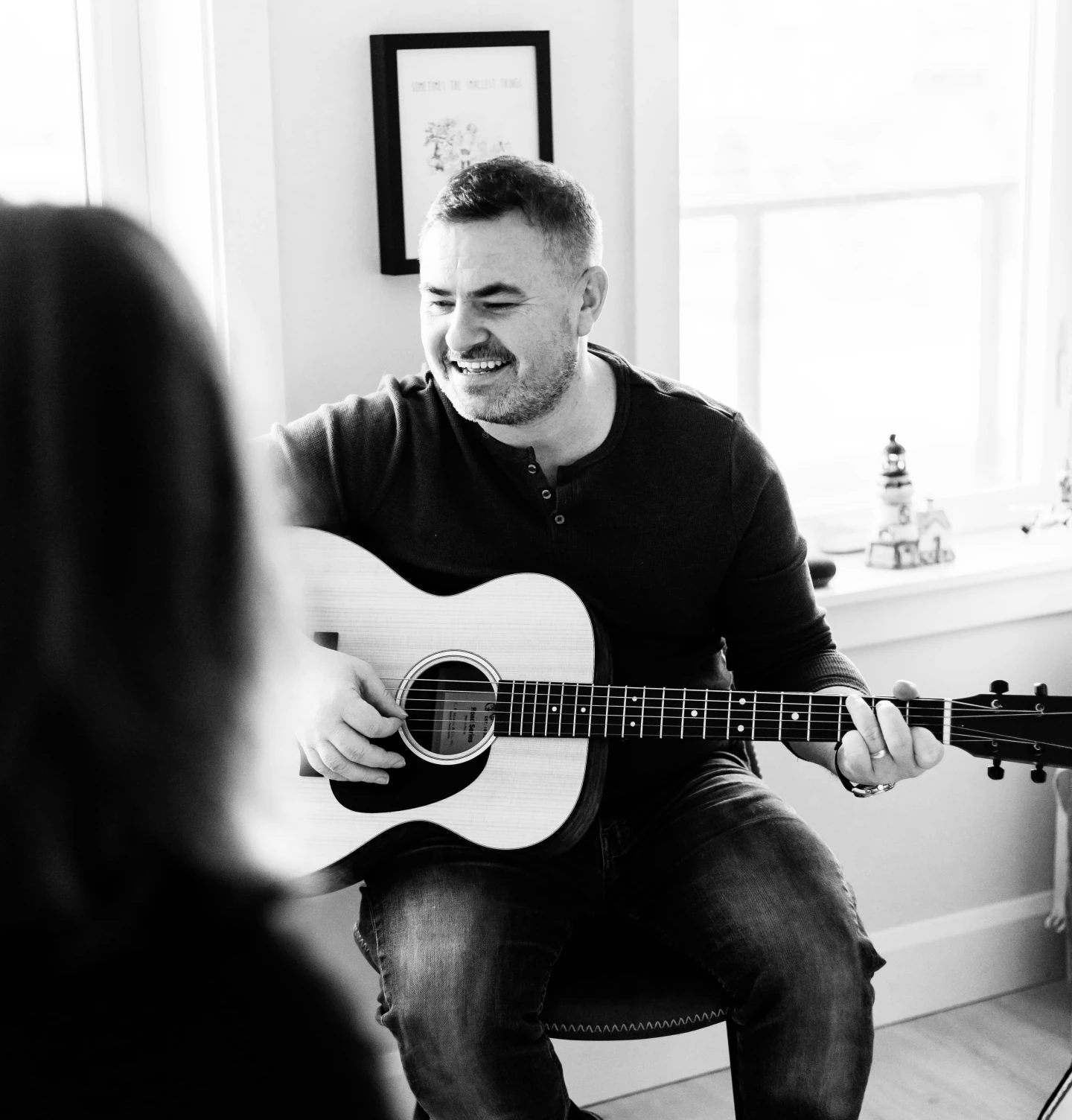
F.P. O'Connor
Download the free Pain-Free Guitar GuideFAQ
Why does my fretting hand cramp when I play guitar?
There is no single answer from the symptom alone. Fretting pressure, thumb effort, playing position, chord demand, and practice load are all variables worth testing. Change one at a time and compare the response.
Is it normal for my hand to cramp during barre chords?
Barre chords can be demanding, especially if you are using more pressure than necessary or returning after time away. Reduce the pressure or chord demand and see what changes. Recurrent or worsening symptoms deserve more caution.
Am I pressing the guitar strings too hard?
Possibly. Slowly reduce pressure until the note starts to buzz, then add only enough to make it clean again. Compare that with your normal pressure.
Should I stretch my hand when it cramps?
A gentle stretch may feel useful for some ordinary muscle cramps, but it is not automatically the best first response to every guitar hand symptom. If the same task keeps provoking the problem, change the playing demand and observe the response.
Why does my hand cramp more when I play fast?
Faster playing can increase repetition and coordination demands and may tempt you to grip harder. Slow the passage enough to compare pressure and movement without fighting for tempo.
More guidance on this topic
Adaptive Guitar: 12 Ways to Keep Playing When Standard Technique Gets Harder
Browse the Gentle Octaves article library
Free Guitar Comfort Guide
If hand fatigue, setup, or playing position is part of the problem, the free 15-page Guitar Comfort Guide gives you a short warm-up, practical setup checks, and warning signs that should not be ignored.
Get the free Guitar Comfort Guide
Sources & Further Reading
- Betzl J, Kraneburg U, Megerle K. Overuse syndrome of the hand and wrist in musicians: a systematic review. Journal of Hand Surgery (European Volume). 2020. PubMed
- Cerda-Díaz L, et al. Musculoskeletal disorders in musicians: an overview of systematic reviews. Occupational Medicine. 2026. PubMed
- Miller KC, Stone MS, Huxel KC, Edwards JE. Exercise-associated muscle cramps: causes, treatment, and prevention. Sports Health. 2010. PubMed
- Miller KC, et al. An Evidence-Based Review of the Pathophysiology, Treatment, and Prevention of Exercise-Associated Muscle Cramps. Journal of Athletic Training. 2021. PubMed
- Comoletti S, et al. Focal dystonia in musicians, a literature review. Journal of Hand Therapy. 2024. PubMed
- Mayo Clinic. Numbness in hands: when to see a doctor. Mayo Clinic