When Standard Chords Get Harder: 4 Guitar Tunings That Change What Your Hand Has to Do
Standard tuning is useful, but it is not compulsory. Drop D, Open G, Open D and DADGAD can all change what your fretting hand has to do. The useful question is not which tuning is easiest, but which one removes the movement that is currently costing you too much effort.


You know the song and you know the chords. But one shape now feels like far more work than the music deserves.
Maybe the stretch is awkward or four fingers no longer want to arrive together. Maybe a full barre turns an enjoyable song into a bloody wrestling match.
The usual response is to just work harder at the chord. And sometimes that is exactly what you want to do. We learn new songs, we're exposed to new chords: We practice those chords and then we have that in our tool box th enext time we need to play a song that has the chord.
But there are some songs that just kick you right in the you know where. Whether it's the specific fingering of one chord or repetitive bar chords or just that one chords that you struggle with, and you wonder if you're ever going to be able to play this song?
But there is another variable guitarists often forget they are allowed to change:
the tuning of the guitar itself.
Different tunings change the notes available on open strings, the chord shapes and the transitions between them. None is universally easier.
The useful question is not, “Which tuning is easiest?” It is:
Which part of this song is asking my hand to do more than it needs to, and can a different tuning change that job?
The short version
If standard chord shapes are getting difficult, alternate tunings can sometimes make a particular song more workable because they change the available chord shapes and open strings.
Start by identifying the expensive movement:
- a wide stretch;
- too many fingers landing at once;
- repeated full barres;
- a large jump between chord shapes;
- or more fretting effort than the song seems worth.
Then try one tuning on one familiar song and compare the task.
Do not switch to DADGAD because somebody called it good for stiff hands. Do not switch to Open G because somebody called it easy. Make the tuning solve an actual problem.
Standard tuning is useful. It is not sacred.
Standard E-A-D-G-B-E gives us an extraordinary amount of music under the hand. But every tuning creates its own map of chord shapes, stretches and open strings. Change that map and you change what the fretting hand must do.
This is part of what I mean by adaptive guitar. Instead of assuming the player's body must always adapt to conventional technique, sometimes we change the music, instrument, setup or technique first.
If that idea is new to you, start with Adaptive Guitar: 12 Ways to Keep Playing When Standard Technique Gets Harder. Here, we are taking one part of that idea and going deeper.
First decide what you are trying to change
Before touching a tuning peg, play the troublesome chord or short section once and name the demand plainly.
Is it reach, finger count, barre pressure, a large transition, or the same demanding shape repeated over and over?
You do not need an anatomical theory. You need to know what the guitar is asking you to do.
That gives you something useful to compare.
Four tunings, four different jobs
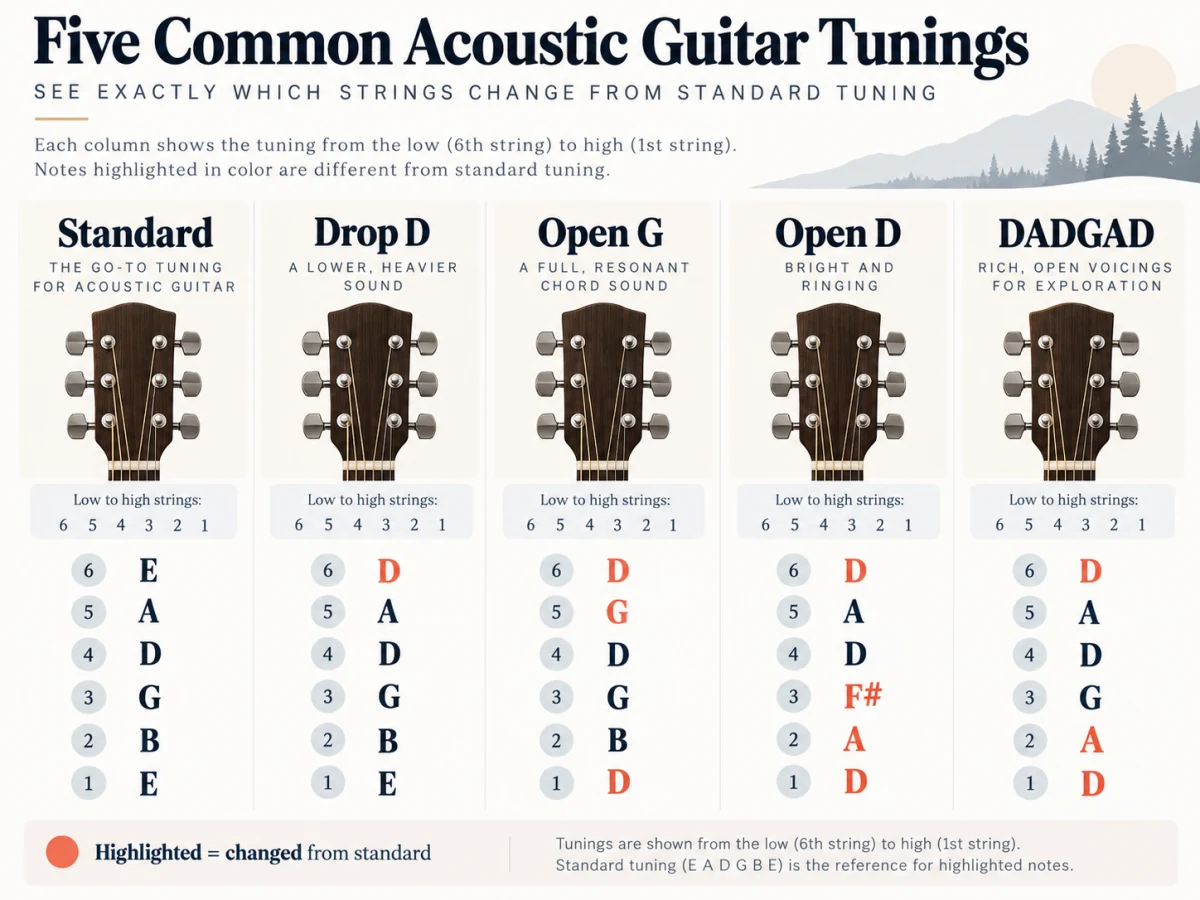
| Tuning | Low to high | What changes most | May be useful when | Main trade-off |
|---|---|---|---|---|
| Drop D | D A D G B E | Only the 6th string changes | You want minimal relearning or simpler low-string shapes | Most standard chord demands remain |
| Open G | D G D G B D | Open strings form G major | You want open harmony and simple movable major relationships | Many common shapes use a barre |
| Open D | D A D F# A D | Open strings form D major | You want more harmony supplied by open strings | The familiar chord map changes substantially |
| DADGAD | D A D G A D | Open strings form a Dsus4/modal sound | You want drones and folk/Celtic voicings with different fingerings | Different does not automatically mean easier |
Choose the tuning that best changes the movement you want to test.
1. Drop D: the smallest experiment
Drop D changes only one string. Tune the low E down a whole step to D:
D-A-D-G-B-E
That makes it a good experiment if you want minimal relearning. Your top five strings stay exactly where they were, while low-string root-fifth-octave power chords can be played across the lowest three strings at one fret.
That can simplify repeated low-string riffs or power-chord work.
But if your problem is a full F barre, a wide open-chord stretch or organising four fingers at once, Drop D may change very little.
Use Drop D when you want the smallest change, not when you need the biggest adaptation.
2. Open G: simple harmony, but watch the barre assumption
A common Open G tuning is:
D-G-D-G-B-D
Strum the open strings and you already have G major. Move a straight barre up the neck and major chords become very economical, which is one reason Open G works so well for blues, rock, folk and slide.
For some hands, that is a major simplification.
Free 15-page Guitar Comfort Guide
Play with less tension. Keep the music moving.
A short, practical guide to help your body feel more prepared before you pick up the guitar.
- Warm up properly in five minutes
- Find a playing position that feels supported
- Learn the seven pillars of playing posture
No spam. No daily sales sequence. Just practical guidance for keeping music in your life. Unsubscribe at any time.
For others, it is exactly the wrong answer. If flattening the index finger across several strings is the movement you are trying to avoid, the classic one-finger Open G solution may simply replace one problem with another.
The broader point is this:
A chord with fewer fingers is not automatically a chord with lower demand for your hand.
3. Open D: let the open strings carry more harmony
Open D is commonly tuned:
D-A-D-F#-A-D
The open strings already produce D major. That gives you drones, partial shapes and movable chord relationships around an established harmony without needing a conventional multi-finger D shape just to get started.
That can let open strings carry more of the arrangement while the fretting hand does less simultaneous work. The trade-off is relearning because familiar chord shapes no longer mean what your muscle memory expects.
4. DADGAD: different possibilities, not a magic easy mode
DADGAD is:
D-A-D-G-A-D
Its open strings create a suspended, modal D sound. If you play folk, Celtic or singer-songwriter material, that can be wonderfully useful. Open drones and compact modal voicings can create rich harmony without constantly gripping full six-string shapes.
But DADGAD is different, not inherently easy.
Some voicings use fewer fingers but a wider span. Others feel economical. Andy Ellis's 2026 Guitar Player lesson is useful because it treats DADGAD as a way to unlock different musical possibilities, not as a health intervention.
Does tuning down make the strings easier to press?
There is a useful technical point here, but it needs careful wording.
String tension depends on factors including string gauge, scale length and pitch. D'Addario's technical guidance is clear: with the same string on the same guitar, lowering pitch reduces tension.
All four tunings here lower at least one string from standard tuning and do not require any string to be tuned higher. So the strings you lower will operate at lower tension.
What we cannot conclude from that is that a particular tuning reduces joint load by a known amount, treats arthritis or guarantees less discomfort.
Playing demand also depends on chord shape, number of fretted notes, setup, technique, repetition and the individual player.
Treat lower tension as one changed variable, not a medical promise.
A useful musician example: change the arrangement, not the identity
Bruce Cockburn has described revisiting older songs after arthritic changes affected what his left hand could do, using different fingerings or tunings to bring some material back into his repertoire. That is a musician's example, not medical evidence.
The lesson is simpler: the arrangement is negotiable.
The One-Song Tuning Test
Choose one familiar song where a specific chord or transition has become unnecessarily difficult.
1. Play the difficult section in standard tuning
Notice only the musical task:
- widest stretch;
- maximum number of fingers fretting at once;
- full or partial barre;
- largest chord-to-chord reorganisation;
- shape that repeatedly makes you add pressure.
2. Name the main cost
For example:
“The problem is not the whole song. It is repeatedly jumping from C to a full F barre.”
That is much more useful than “my hand is bad.”
3. Choose one tuning that changes that cost
If you want minimal relearning, try Drop D.
If open major harmony could replace large shapes, explore Open D or Open G.
If the song suits drones and modal harmony, DADGAD may be worth testing.
4. Rearrange only enough to compare
Find two or three usable chord relationships and play the same short section.
Then ask:
Does this version let me make the music with less unnecessary work?
Maybe yes. Maybe the new tuning creates a worse problem. Both answers are useful.
5. Keep the winner, not the theory
If the alternate version gives you a more workable task, build fluency in it gradually.
If it does not, return to standard tuning and change another variable instead: chord voicing, capo position, setup, arrangement or playing load.
This is a comparison, not a test you can fail.
The main downside is musical relearning
Alternate tunings move the furniture. Chord shapes and familiar landmarks change, so do not collect tunings for their own sake if your goal is adaptation. Start with:
one tuning, one song, a few useful relationships.
Give the new map enough time to prove whether it earns its keep.
If you play live, include the practical cost too. Retuning, grouping songs by tuning or carrying a second guitar are part of the decision. The body is part of the system. So is the gig.
This is Reset before Rebuild
In Release-Reset-Rebuild, this sits mainly in Reset: change the playing strategy so the task asks for less unnecessary effort. Rebuild means learning the new shapes and transitions well enough that the adaptation survives a whole song, rehearsal or performance.
The goal is to keep making music, not to prove that your hand can still obey every old convention.
A proportionate safety note
Changing tuning changes the musical task. It cannot tell you why a hand is painful, stiff or behaving differently.
If symptoms are severe, worsening, unexplained, associated with significant injury, or include persistent altered sensation, progressive weakness or loss of coordination, that moves beyond a guitar-arrangement experiment and deserves appropriate professional assessment.
For ordinary adaptation questions, keep the experiment simple: change one musical variable, observe the result, and keep only what genuinely helps the playing task.
Frequently asked questions
What is the easiest guitar tuning for stiff hands?
There is no universally easiest tuning. Open G can simplify some major-chord relationships but often uses barres. Open D supplies more open-string harmony but requires relearning. Drop D changes very little, which is both its strength and its limitation.
Can open tunings make guitar easier to play with arthritis?
They can change chord shapes and make a particular arrangement more workable for some players. They are not a treatment for arthritis and are not automatically easier.
Is DADGAD easier than standard tuning?
Not universally. DADGAD makes some drones, modal voicings and chord relationships natural, while familiar standard-tuning shapes no longer work. Think of it as a different map, not an easier map.
Is Open G easier on the fretting hand?
It can be for some tasks because the open strings already form G major and simple movable major relationships are available. But common Open G playing often uses straight barres. If barres are the movement you are trying to reduce, use partial voicings or test another approach.
Does tuning down reduce string tension?
Yes. With the same string and scale length, lowering pitch reduces tension. That mechanical fact does not by itself tell us whether a tuning will be more comfortable for a particular player.
Can I use a capo with an open tuning?
Yes. A capo can transpose the open-tuning relationships while keeping the same basic shapes, which is useful when the tuning suits your hand but the open key does not suit your voice or the song.
What to do next
Pick one song that has started asking too much from one chord or transition.
Try one alternate tuning that directly changes that movement. Learn just enough of the song to compare it fairly.
If the guitar can do more of the work while the music still sounds like yours, that is not cheating.
That is arranging.
More guidance
Adaptive Guitar: 12 Ways to Keep Playing When Standard Technique Gets Harder The wider framework for changing chords, tunings, setup, playing position and other variables when standard technique becomes the barrier.
Free 15-page Guitar Comfort Guide
Play with less tension. Keep the music moving.
A short, practical guide to help your body feel more prepared before you pick up the guitar.
- Warm up properly in five minutes
- Find a playing position that feels supported
- Learn the seven pillars of playing posture
No spam. No daily sales sequence. Just practical guidance for keeping music in your life. Unsubscribe at any time.
Get the free Guitar Comfort Guide A free 15-page guide to guitar setup, movement and practical comfort strategies for adult players.
Sources & Further Reading
- D'Addario, “What Is Guitar String Tension?” - Technical explanation of the relationship between pitch, gauge, scale length and string tension.
- Fender, “9 Essential Alternate Guitar Tunings” - Reference for common alternate and open tunings and their musical uses.
- Fender, “How to Tune a Guitar to Open G” - Open G tuning reference and musical examples.
- Guitar Player, “DADGAD for Dummies: You Already Know 50 Percent of This Tuning” - 2026 musical introduction to DADGAD.
- Bruce Cockburn, Grateful Web interview, 2024 - Cockburn discusses arthritic changes in his hands, rearranging older material and using alternate tunings in his own playing.