Hand Tension While Playing Guitar? Try This 5-Minute Reset That Actually Works
If your fingers feel stiff or sore halfway through practice, you're not alone. Many guitarists unknowingly strain their hands before they even play a single chord. The good news? Relief might only be five minutes away.

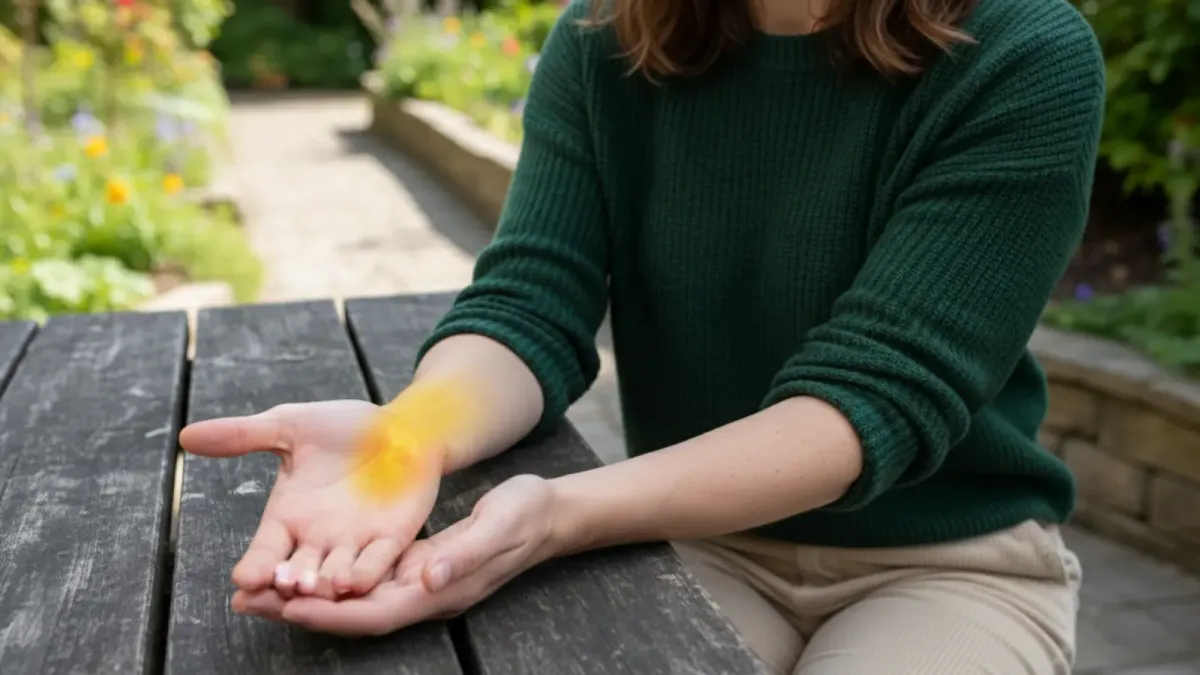
Your hands are your instruments too: treat them like VIPs, not afterthoughts.
If your fingers stiffen halfway through a session, you’re not alone.
Most adult guitarists don’t warm up they just dive in, hoping for flow, hoping the fingers will find their way.
But when hands tighten, rhythm falters. When wrists tense up, confidence shrinks.
The good news? A simple five-minute ritual can change everything.
This post gives you a practical warm-up that improves blood flow, reduces tension, and protects your hands before you play.
The Real Culprit?
Micro-Tension You Can’t Feel...Yet
You might not feel it at first. But tiny, unnoticed tension in your wrists and fingers builds up like rust on strings.
That micro-tension is the enemy of smooth fretting, clean strumming, and fluid creativity.
You grip a little too hard...
Your fingers hover, half-tensed between chords...
Your wrist locks without realizing.
Left unchecked, it can turn into further problems down the line: tendonitis, nerve compression, or chronic stiffness.
Good news? You can intercept it in just five minutes before it ruins your session. When your ready to progress take look at my post on 5 Ways Guitarists Over 40 Can Ease Hand Tension and Play Longer
Why Warming Up Actually Works
You wouldn’t run a marathon without stretching your calves.
So why play guitar with cold, tight hands?
A proper warm-up:
- Increases blood flow
- Loosens tendons and fascia
- Signals your nervous system to coordinate, not guard
- Creates a moment of focus before diving into practice
It's not a small thing. It’s injury prevention and creative prep.
A 5-Minute Pre-Play Ritual Based on Evidence
Here’s the exact sequence I use: backed by years of experience with musicians and informed by my extensive training in movement, manual osteopathy and exercise.
- Wrist Circles (1 min):
Gentle fists, rotate both directions, fingers wide at the end. - Prayer Stretch (30 sec):
Palms together, drop slowly to feel forearm stretch. - Reverse Prayer + Wrist Extensor Stretch (1 min):
- Back of hands together
- Then, arm extended + pull fingers back gently
- Finger Tendon Glides (1 min):
Run through:- Straight hand
- Hook fist
- Full fist
- Tabletop
- Thumb Stretch (30 sec/side):
Gently pull thumb back and down. - Shake & Flick (30 sec):
Flick water off your fingers — it’s awkward but golden.
Your Hands Are Your First Instrument
Without your hands there’s no music. Most people treat their instruments better than their hands.
So why do most guitarists neglect them?
Here’s the truth:
- If your fingers are stiff, your creativity suffers.
- If your wrists are inflamed, your rhythm dies.
- If you’re in pain, you’ll play less or not at all.
Musicians don’t need longer practice. We need smarter prep.
Pain isn’t a rite of passage. It’s a warning and it’s reversible. If arthritis is slowing you down check out 3 Guitar Exercises That Actually Help Arthritis
Smart musicians don’t just practice more. They prepare better.
Try This Today
Set a timer before your next practice session.
Just five minutes. No skipping.
And notice:
- How your hands feel after
- Whether your chords flow easier
- If your focus sharpens just a bit sooner
Then try it again tomorrow. Make it part of the ritual.
If you want the full system I developed from 15 years of experience treating musicians then check out my full book. Keep Playing.

F.P. O’Connor
F.P. O'Connor is a Musician and Movement Specialist whose work is informed by extensive training in Manual Osteopathy, Psychology, and Strength Coaching.
He is the founder of Gentle Octaves, helping adult players develop practical, science-based systems for ease, control, and long-term playing confidence.
F.A.Q.
Q: Do I still need to warm up my hands even if I’m not experiencing pain?
A: Yes because tendon tension starts long before pain shows up, and a proper warm-up reduces the load your fingers take on during fretting and picking.
Hand and forearm tendons don’t have great blood supply, especially as we age. Most over-40 players don’t feel problems until the tissue is already irritated. A structured 5-minute reset increases circulation, improves tendon gliding, and reduces the micro-tension that builds up from regular daily use (typing, gripping, phone scrolling, cold mornings, etc.).
In practice, players who warm up consistently:
- Grip lighter,
- Have smoother finger independence,
- Fatigue slower,
- And avoid the “tight by the second song” problem.
When to change approach: If a warm-up increases sharp pain or produces tingling, stop.
Q: Can tension or pain in my hand actually come from my shoulder or neck?
A: Yes tension in the neck and shoulder can increase load on the forearm and hand because it disrupts the whole kinetic chain used in guitar playing.
Your picking and fretting hands don’t work in isolation. Every note you play starts at the spine, stabilizes through the shoulder, travels down the arm, and ends at the fingertips. When the foundation is tight (especially the neck, upper traps, pec minor, or the deep cervical stabilizers), the smaller muscles in the forearm overwork to compensate.
This often shows up as:
- Finger fatigue within minutes,
- “Tendon tightness” that returns after every practice,
- Grip weakness,
- Over-pressing on the fretboard,
- Irritation on the inside or outside of the elbow.
Releasing tension upstream (spine → shoulder → arm) often gives more relief than stretching the hand alone.
Q: Is the 5-Minute Hand Reset safe to use if I have arthritis or long-term joint stiffness?
A: Most people with arthritis tolerate gentle mobility well, as long as movements stay comfortable and not forced.
Arthritic joints often become stiff when they’re inactive or cold. Light, comfortable-range movements increase synovial fluid circulation and can reduce that “rusty joint” feeling many players experience.
What typically works well for arthritis:
- Slow, controlled range of motion
- Gentle tendon gliding
- Light activation, not gripping or resistance
- Short bursts of movement rather than long holds
What to avoid:
- Forced stretch,
- High rep volume,
- Fast or ballistic movements,
- Anything that increases pain in the joint.
Please note: This is not a personal medical assessment and you should adjust based on your own symptoms. You should consult with your doctor before beginning any exercise program.
Q: How does a warm-up actually reduce tension or strain in my tendons?
A: A warm-up improves tendon glide, reduces friction, and prepares the tissue for load, which decreases the chance of overuse flare-ups.
Tendons act like cables. When they’re cold or stiff, they don’t slide smoothly in their sheaths. This increases friction, which your body reads as irritation. Over time, that irritation can become the “deep ache” or “tight ropey feeling” guitarists describe.
In your 5-Minute Reset, three things happen:
- Circulation increases: delivering nutrients to tissue with limited blood supply.
- Tendon glide improves: reducing friction and making movement feel smoother.
- Neuromuscular priming kicks in: your brain re-establishes clean movement patterns before you load the fingers with real playing.
This is why players often say:
“After the reset, the guitar just feels lighter.”
Q: Will this warm-up help if my fingers feel stiff in the mornings or after long breaks?
A: Yes, stiffness is often just reduced fluid movement in the joints and tendons, and warm-ups restore it quickly.
Morning stiffness or “first-play stiffness” is incredibly common after 40. Overnight, circulation slows and fluid settles, making joints and tendons feel sticky. A short mobility sequence is often enough to restore glide and control.
Most players find that once the system is moving, the stiffness fades within minutes.
Q: What are the signs I’m overdoing a warm-up rather than preparing properly?
A: If the movement causes sharp pain, tingling, swelling, or fatigue, it’s not a warm-up anymore, it’s overload.
A warm-up should feel like easing tension out, not like training.
Overdoing it can irritate the tendons and produce the very symptoms you’re trying to avoid.
Signs you’re overcooking it:
- Your forearm burns or shakes
- Grip feels fatigued before you play
- Fingers feel clumsy instead of smooth
- You’re stretching aggressively instead of mobilizing gently
A warm-up is preparation, not punishment. Keep it light.
Q: Can this hand reset routine prevent tendon flare-ups?
A: It reduces the risk by improving tissue readiness, but it’s not a treatment for injury.
Most guitar-related tendon flare-ups happen due to:
- Cold tissue suddenly taking load
- Poor spinal/shoulder alignment
- Over-gripping
- Repetitive tension without breaks
- Old injuries or inflammation patterns
A warm-up prepares the system so tendons don’t get hit with sudden demand.
It’s prevention, not rehab but prevention does a lot of heavy lifting.
Sources & Further Reading
Austen, C., Redman, D., & Martini, M. (2024). Warm-up exercises reduce music conservatoire students' pain intensity when controlling for mood, sleep and physical activity: A pilot study. British journal of pain, 18(1), 57–69. https://doi.org/10.1177/20494637231188306
Feasibility and impact of an expanded upper extremity musculoskeletal health for musicians (MHM) program on arm and hand pain in musicians. Basseri, Benjamin et al.Journal of Hand Therapy, Volume 38, Issue 4, 736 - 744. https://www.jhandtherapy.org/article/S0894-1130(25)00027-4/abstract
Autret L, Shipley É, Lodde B, Hinojosa-Azaola A, Saraux A. Rheumatic and musculoskeletal disorders in musicians: risks, adaptations and management. RMD Open. 2025;11:e006149. https://doi.org/10.1136/rmdopen-2025-006149