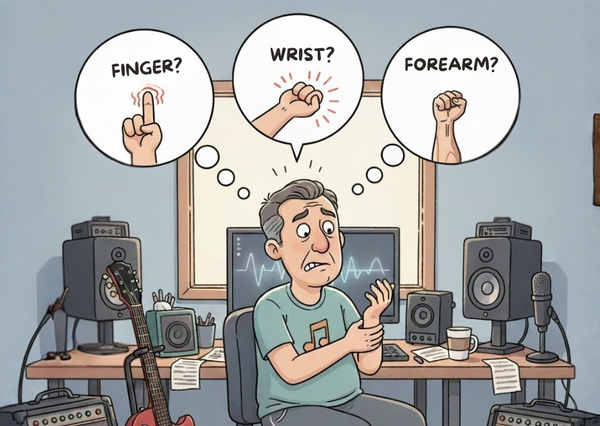
3 Guitar Exercises for Stiff or Sensitive Hands


Sensitive and stiff joints don’t mean the music has to stop. They do mean you need to change how you move.
As both a guitarist and a movement specialist with training in manual osteopathy and therapeutic exercise, I’ve spent years helping older players loosen up their hands, protect their joints, and keep playing the songs they love.
This post will give you 3 practical exercises that actually work for stiff, arthritic or sensitive hands.
Not gimmicks. Not 20-minute routines.
Just simple resets based on my 18 + years of experience and adult learning. Some of the core ideas that guide my approach:
- Structure governs function: line up your joints, and they’ll work better.
- The body works as one: fix the shoulders, and the fingers often follow.
- Order of Exercises Matter: if you try and strengthen before you have properly released the tissues that are causing issues , you'll just end up back where you began eventually
Why Exercises for Sore Joints?
Think of it this way: strumming without warming up is like sprinting straight out of bed. Your joints will rebel, and they’ll win.
Sensitive joints need gradual movement to wake up tissues and improve blood flow. Skip that, and you risk inflammation, stiffness, and the dreaded “claw hand” mid-song.
The goal isn’t just to loosen fingers; it’s to set up your entire playing posture for comfort and endurance. Read more on the importance of playing post in my post on The Spine to String Connection.
What Actually Helps: Stability First Then Mobility
Ive seen a lot of “joint-friendly” routines start with aggressive stretching. But if your joints are not primed or unstable, that often just makes things worse.
You need to calm the nervous system and reestablish joint safety before chasing flexibility.
That’s what the movements below are designed to do:
- Relieve protective bracing
- Rebuild trust in your fingers and wrists
- Create a solid, pain-aware foundation for your future practice
3 Movements Backed by Evidence (Not Hype)
When preparing the upper extremity for fine motor tasks such as playing or managing stiffness from conditions like osteoarthritis, it helps to focus on movements that encourage and establish proximal stability for distal mobility.
Here are three highly evidence-based movements that address the kinetic chain from the shoulder down to the hand, making them ideal for individuals needing precise, pain-free movement.
- Tendon Glides
What it does: Tendon glides are highly effective because they are not traditional "stretches." Instead, they act as a precise mechanical pump almost and a tissue-flossing mechanism that respects the tightly packed, complex anatomy of the hand and wrist.
When dealing with fine motor demands such as guitar playing, passive stretching often falls short because it doesn't address the sliding surfaces between tissues. Tendon glides work on several biomechanical and neurological levels.
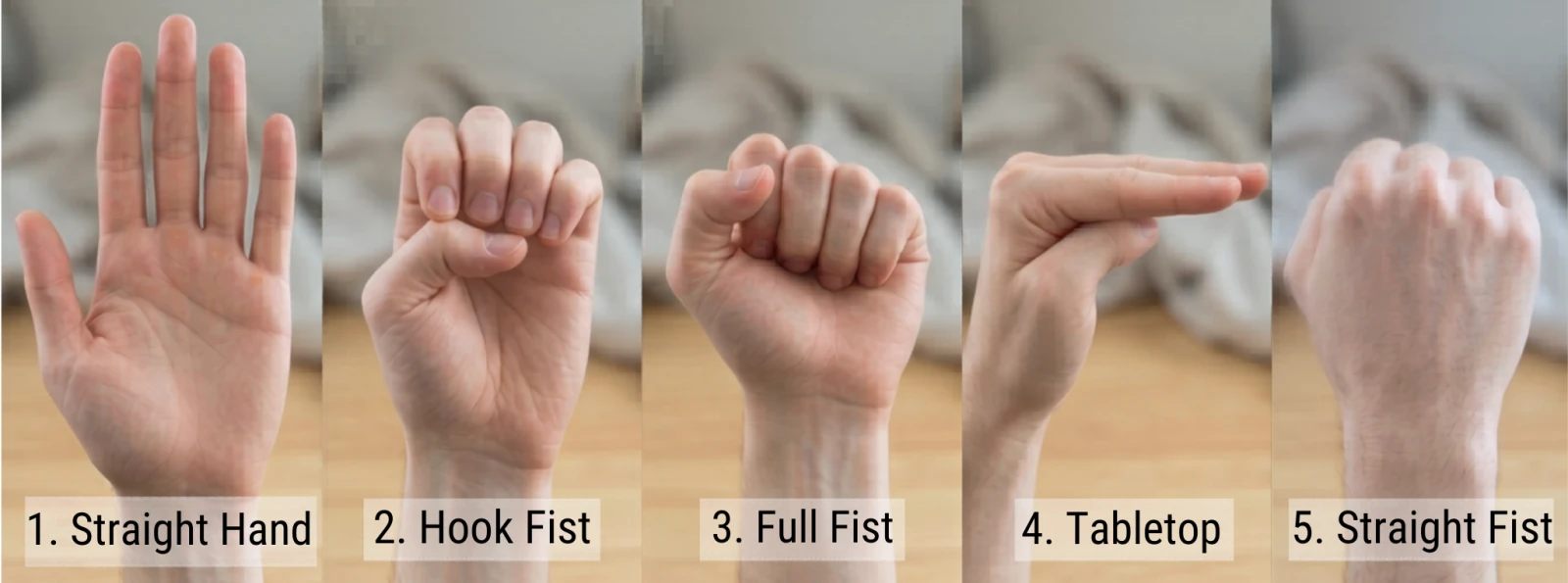
The Movement:
5–10 cycles each hand
- Straight Hand: Fingers fully extended.
- Hook Fist: Flex the distal and proximal interphalangeal (DIP and PIP) joints, keeping the knuckles (MCP joints) straight.
- Full Fist: Flex all joints into a standard fist.
- Tabletop: Flex the knuckles (MCP joints) to 90 degrees while keeping the DIP and PIP joints perfectly straight.
- Straight Fist: Flex the knuckles and PIP joints, but keep the fingertips pointing straight down to the palm (DIP joints extended).
2. Wrist Controlled Rotations
Wrist controlled are evidence-based for maintaining joint capsule health and maximizing active, pain-free range of motion. Unlike passive stretching, which doesn't prepare the tissue for load, CARs actively engage the surrounding musculature to control the joint through its outer limits, stimulating mechanoreceptors and synovial fluid production.

The Movement:
3-5 extremely slow, controlled rotations in each direction.
- Isolate the forearm by holding it flat with the opposite hand (preventing pronation/supination).
- Keep the fingers straight and strictly move the wrist through its maximum pain-free circle.
- Move into full flexion, then extension, and roll into pronation and supination. (You can also add ulnar/radial deviations here)
When preparing the upper extremity for fine motor tasks or managing stiffness from conditions like osteoarthritis, it helps to focus on movements that encourage synovial fluid production, improve neurodynamics, and establish proximal stability for distal mobility.
Here are three highly evidence-based movements that address the kinetic chain from the shoulder down to the hand, making them ideal for individuals needing precise, pain-free movement.
3. Scapular Wall Slides (Shoulder Girdle)
Wait what.... shoulder slides? I thought this was a hand and wrist warm up . Well yes it is. The rule we follow is distal mobility requires proximal stability: This means if the shoulder girdle is restricted, the elbows, wrists, and hands often compensate, leading to overuse injuries. Wall slides target the serratus anterior and lower trapezius, promoting upward rotation of the scapula which helps release the other joints downstream.
The Movement:
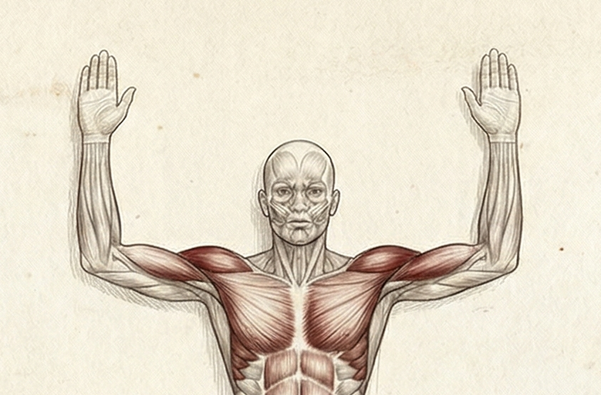
2 sets of 8–10 repetitions. If wall contact is too difficult this can be modified to a floor slide (supine).
- Stand with the back against a wall, feet slightly forward.
- Place the elbows and the backs of the hands against the wall at about 90 degrees (a "goalpost" position).
- Slowly slide the arms up the wall into a "Y" position, actively depressing the shoulder blades down as the hands reach up.
- Return to the starting position without letting the elbows or hands leave the wall.
Safety Checklist
- Tempo: Move at half the speed of a normal strum slow is key for neuromotor priming.
- Pain Rule: If pain rises above 2/10 or lingers > 30 s, stop and shake out.
- Breath + Posture: Exhale on effort, keep shoulders down, spine tall.
- Consistency: Do the set once before every play session; that single habit delivers most of the benefit.
Now your all warmed up check out my other post on Arthritis friendly guitar chords you can adapt, which are easier to play and still sound great:
Free 15-page Guitar Comfort Guide
Play with less tension. Keep the music moving.
A short, practical guide to help your body feel more prepared before you pick up the guitar.
- Warm up properly in five minutes
- Find a playing position that feels supported
- Learn the seven pillars of playing posture
No spam. No daily sales sequence. Just practical guidance for keeping music in your life. Unsubscribe at any time.
 Gentle Octaves
Quick Motivation
- Less than 5 mins and it protects the joints, primes the nerves, and steadies the shoulders.
- Each drill is low-load and guitar-friendly; you can run through it backstage or at your desk.
Why bother?
A 2024 pilot study in music-conservatoire students showed that daily physical warm-ups significantly reduced playing-related pain after accounting for sleep, mood, and activity levels. Pairing the three drills above meets that criterion in just five minutes.
Play longer by moving smarter move smarter to play longer.
Your Invitation
Download the Pain Free Guitar Guide

F.P. O’Connor
F.P. O'Connor is a Musician and Movement Specialist whose work is informed by extensive training in Manual Osteopathy, Psychology, and Strength Coaching.
He is the founder of Gentle Octaves, helping adult players develop practical, science-based systems for ease, control, and long-term playing confidence.
Release → Reset → Rebuild™ your sound
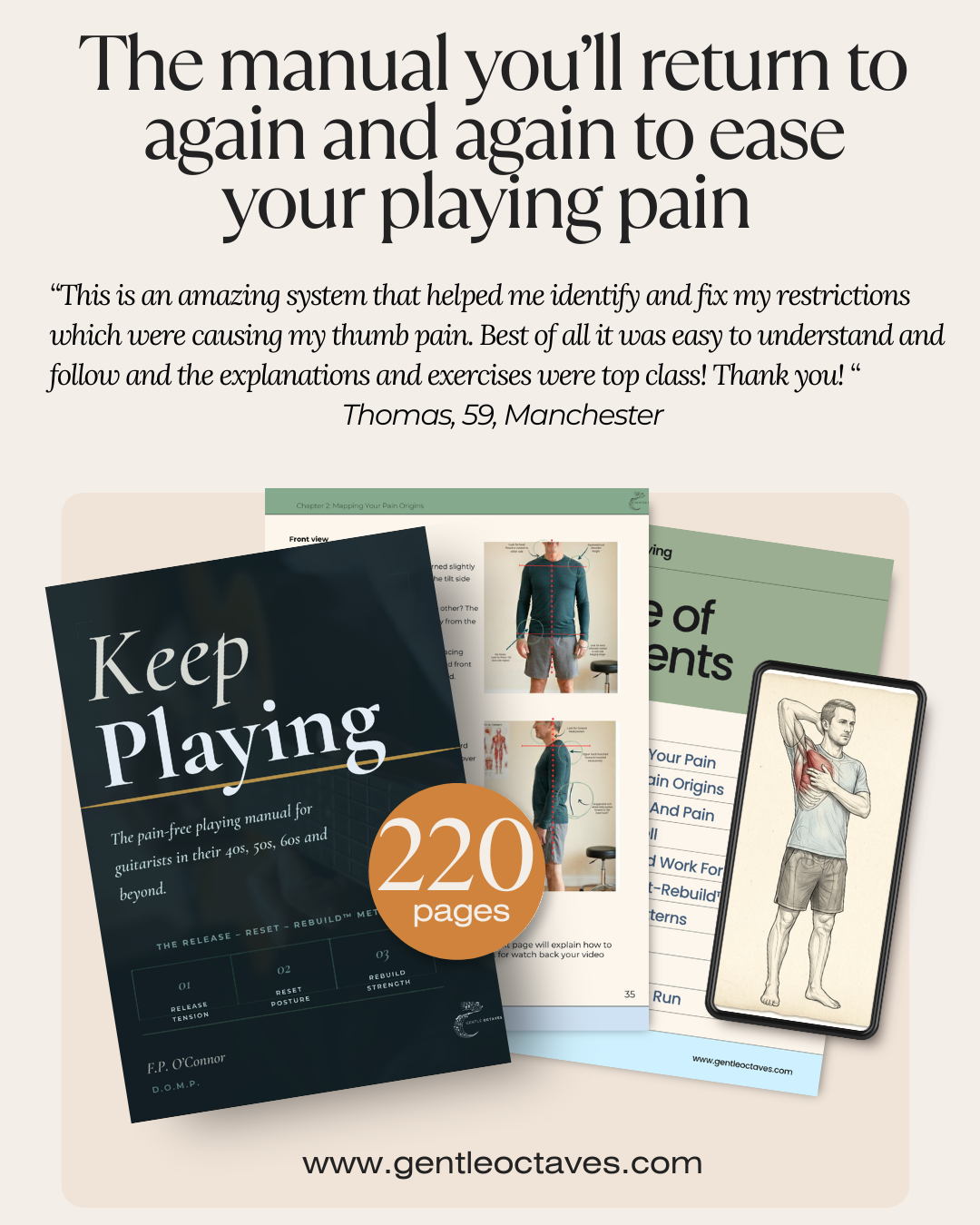
If you’d like my personal sequence, plus the posture adjustments that make the biggest difference, I wrote a book called Keep Playing. Check it out here:
FAQ
Q: Are these exercises safe for stiff or sensitive hands?
A: Yes: as long as the movements stay light, smooth, and within a comfortable range, these exercises are generally well-tolerated.
Stiffness isn’t usually a sign of harm, it’s often reduced circulation, cold tissue, or mild tendon friction. Controlled mobility improves tendon glide and joint lubrication, which is exactly why slow, low-load movements feel so good on stiff hands.
For sensitive hands, the key is dose. You don’t need intensity, you need clarity. Smooth range, gentle activation, no forcing. Most guitarists over 40 respond best to slow tendon-glide work rather than aggressive stretching.
If it feels smoother after 3–5 reps, you’re on the right track. Remember this is general movement guidance, not a diagnosis.
Q: Will these exercises help if I get “morning stiffness” before I play?
Yes , morning stiffness often improves quickly with gentle mobility that increases heat and circulation to the hand.
After sleep, the fluid inside your joints settles and tendons glide less efficiently. That’s why first movements feel “sticky,” especially over 40.
The exercises in this routine restore glide, wake up the small stabilizers, and reduce that “rusty hinge” feeling most players notice in their first 10 minutes of practice.Stop if any movement causes sharp or radiating pain.
Do the sequence before touching the guitar, not after your fingers are already irritated.
Q: Can these exercises reduce the risk of tendon irritation or flare-ups?
They reduce the risk by preparing tendons for load, but they’re not a treatment for injury.
Most tendon flare-ups in guitarists come from:
- Playing with cold hands
- Jumping into difficult passages without preparation
- Over-gripping
- Shoulder/neck tension increasing load downstream
A proper mobility sequence improves readiness by increasing circulation and reducing friction in the tendon sheath. It doesn’t “fix” tendonitis, nothing in a blog post does, but it sets the stage so you’re not asking cold tendons to perform precision work immediately. If your fingers feel “lighter” after the warm-up, the tendons are primed.
Q: Are these exercises okay if I have arthritis or long-term joint changes?
A: For most people with arthritis, gentle mobility is safe and often reduces stiffness as long as you avoid forced stretch and sharp pain.
Arthritic joints thrive on controlled motion. Movement increases the flow of synovial fluid, which decreases the grinding, stuck, or “gritty” sensations many players describe. These exercises focus on smooth motion, not loading, not stretching , which makes them suitable for the majority of arthritic hands.
The key rule:
Comfortable range = good.
Forced end-range = no.
If a joint feels warmer and more mobile after the routine, it’s responding well.
Q: How soon should I feel a difference after doing these exercises?
A: Most guitarists feel smoother movement and less stiffness within 1–2 minutes.
Tendons respond quickly to increased circulation and decreased friction. Neuromuscular priming (your brain re-establishing movement patterns) also kicks in fast. What takes time is tissue adaptation: what changes instantly is coordination and glide.As always, if symptoms get worse, stop immediately.
You’re looking for “lighter fingers,” not bigger stretch.
Should I do these before or after playing?
A: Before. A warm-up is preparation not recovery.
Cold tendons + sudden load = the #1 recipe for irritation in adult guitarists.
Doing mobility work first resets the movement system, reduces unnecessary grip force, and helps you start with a lighter touch.
After playing, stick to gentle shake-outs or light stretching not activation.
Do the routine → pick up the guitar → feel the difference in the first chord.
Sources & Further Reading
- Arthritis Society Of Canada (2025) Physical Activity Guide
- Austen, C., Redman, D., & Martini, M. (2024). Warm-up exercises reduce music conservatoire students’ pain intensity when controlling for mood, sleep and physical activity: A pilot study. British Journal of Pain, 18(1), 57–69. https://doi.org/10.1177/20494637231188306
- Osteopathic International Alliance. (2021). Osteopathic principles and practice overview.
- Stamm, T. A., Machold, K. P., Smolen, J. S., Fischer, S., Redlich, K., Graninger, W., Ebner, W., & Erlacher, L. (2002). Joint protection and home hand exercises improve hand function in patients with hand osteoarthritis: A randomized controlled trial. Arthritis & Rheumatism, 47(1), 44–49. https://doi.org/10.1002/art1.10246
- World Health Organization. (2023). Musculoskeletal Health https://www.who.int/news-room/fact-sheets/detail/musculoskeletal-conditions