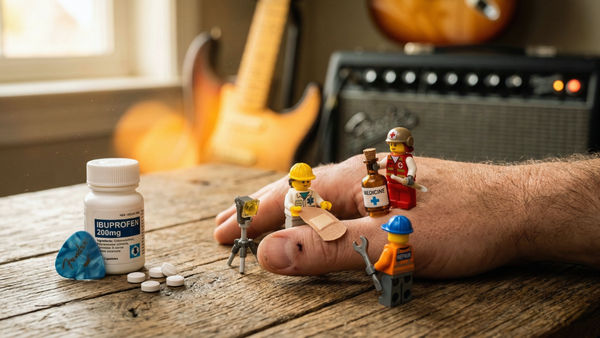
Rebuild Stronger: The Guitarist's Recovery System

Why Strength Alone Isn't Enough
Let me tell you about a pattern I've seen a hundred times: a guitarist starts getting pain. Maybe it's the forearm. Maybe it's the wrist. Maybe it's that weird ache at the base of the thumb that won't go away.
They take some time off. They rest. They wait for it to feel better.
And it does feel better. So they pick up the guitar again. They play for twenty minutes, maybe an hour. And the pain comes back. Sometimes worse than before.
So they rest again. And the cycle repeats. Rest, attempt, pain, rest, attempt, pain. Until eventually they're not sure if they can trust their body anymore.
They've lost confidence. They're afraid that playing guitar might just be over for them.
If that sounds familiar, if your hands ache more than your strings sing , uou dont need to stop playing.
But you do need a different approach.
This isn't a "push through it" program. It's not about toughing it out or building more strength or ignoring what your body's telling you.
This is the Release → Reset → Rebuild™ system: a framework I’ve refined over fifteen years working with musicians to help them adapt how they move, practice, and respond to strain so playing becomes more sustainable over time.
It works because it addresses what's actually happening in your body, not just what you feel on the surface.
And yes, I'm going to walk you through the whole thing. Because you deserve to play guitar for the rest of your life, and this is how you make that possible.
Understand the Pattern: From Fatigue to Protective Tension
Before we get into solutions, we need to understand the actual problem. Because most people think they're dealing with "overuse": like they just played too much and wore something out. But that's not quite right.
What's really happening is this: you've created a pattern of tension and compensation that your nervous system has now learned as "normal."
Your muscles are working harder than they need to. Your fascia (that connective tissue web) we talked about in the this post and in the Body Blueprint, may begin holding protective tension patterns that feel ‘stuck’ over time.
Your nervous system is guarding because it's flagged guitar playing as potentially dangerous.
The most common spots I see this show up:
Forearm flexors: the muscles on the underside of your forearm that control your fingers. These get overworked from gripping too hard and from the constant repetitive motion of fretting.
Thumb base: (first dorsal interosseous and thenar muscles) especially for people who grip the pick too tightly or who have their thumb wrapped over the neck when they shouldn't.
Shoulder girdle: your traps, levator scapulae, and rotator cuff muscles. These get stuck holding your shoulder in elevated or protracted positions when your posture is compromised.
Wrist extensors: on the top of your forearm. These work overtime when your wrist is constantly flexed (bent) while playing.
Why Rest Alone Doesn't Fix Guitar Pain
Here's the thing about just resting: rest removes the aggravating activity, but it doesn't change the underlying pattern.
You're giving inflamed tissue a chance to calm down, which is good. But you're not addressing why it got inflamed in the first place.
Think of it like this...you can't refill a clenched fist. If your system is locked in protective tension, just waiting for it to relax doesn't work. You have to actively teach it to let go.
That's what the Release phase is about. And that's why we're not just resting we're actively rebuilding the system.
Overload
Repeated low-level strain can accumulate when movement habits and recovery don’t keep pace with demand.
Overload is when a single incident exceeds your tissue's tolerance like if you practiced for eight hours straight after taking six months off. That's acute overload.
Most of what I see is repeated low level strain. Which means the solution isn't dramatic.
It's systematic. It's about changing the patterns that created the accumulation in the first place.
Phase 1: RELEASE Let Go of Guarding and Grip
The Decompression Stage
Alright, so Phase 1 is about convincing your nervous system that it's safe to let go. We're not forcing anything. We're not "breaking up scar tissue" or any of that aggressive nonsense.
We're gently, consistently showing your body that it can release the protective tension it's been holding.
This phase usually takes 7-14 days if you're consistent. Some people need longer. That's fine. You're not racing anyone.
1. Soft-Tissue Self-Release
This is where you start: gentle, patient work on the areas that are holding tension.
What to do:
Get a massage ball (lacrosse ball works) or a massage gun if you have one. We're going to work on your forearms, your hands, and your upper back/shoulders.
Forearm release points:
Lay your forearm on a table, palm up. Take the ball and slowly roll it along the muscle belly of your forearm flexors (the meaty part on the underside). Not on bone. Not on the wrist joint. Just the muscles.
When you find a tender spot, pause there. Don't press harder, just maintain gentle pressure and breathe slowly for 30-60 seconds. You should feel the tissue soften under the ball.
Do this for 3-5 minutes per forearm. Once a day is enough. More isn't better here.
Upper trap and neck release: Lie on your back with the ball between your upper trap (the muscle between your neck and shoulder) and the floor. Let your body weight create the pressure: don't actively push.
Find a tender spot, breathe, wait for it to soften. 2-3 minutes per side.
Rule: Stop before sharp pain. We're convincing the body, not forcing it. If you're gritting your teeth or holding your breath, you're pressing too hard.
Check out the post on Fascia for more information on the importance of Release.
2. Gentle Nerve Friendly Movements & Fascia Glide
Gentle nerve-friendly movements encourage comfortable motion through the arm and hand without force.
Your median and ulnar nerves run through your forearm into your hand. Sometimes they dont move as well as they should, especially if you've got chronic tension patterns. Gentle nerve movements can help them glide more smoothly through the surrounding tissue.
Median nerve movements:
- Extend your arm out to the side at shoulder height, palm up
- Gently extend your wrist back (fingers pointing toward the floor)
- Tilt your head away from that arm
- Hold for 2 seconds, then relax everything back to neutral
- Repeat 10 times, slowly and smoothly
You should feel a mild stretch or slight pulling sensation down your arm. Not pain. Not tingling. If you get sharp symptoms or numbness, you're overdoing it.
Ulnar nerve movements :
- Bend your elbow and bring your hand up toward your shoulder
- Make a gentle fist
- Tilt your head toward that shoulder
- Hold 2 seconds, release to neutral
- Repeat 10 times
Do these once or twice a day. They take 3 minutes total and make a surprising difference to how your hands feel.
3. Breath Reset for Parasympathetic Switch-On
This is the piece most people skip, and it's actually the most important. Your nervous system has two modes: sympathetic (stress/tension) and parasympathetic (rest/recovery).
If you're stuck in sympathetic mode (which most people with chronic pain are) your muscles can't fully release no matter how much you massage them.
Breathing properly switches you into parasympathetic mode. It's not mystical. It's just physiology.
What to do:
Twice a day, morning and evening, or before and after playing, do this for 5 minutes:
Sit comfortably. Close your eyes. Breathe in through your nose for a count of 4. Breathe out through your mouth for a count of 6. That's it.
The exhale being longer than the inhale is what activates your vagus nerve and switches on parasympathetic mode.
Don't force it. Don't breathe too deeply. Just slow, steady, with a longer exhale. Your body will do the rest.
Read the post on The Breath Body Beat Method for a more detailed routine.
Phase 2: RESET - Re-educate Movement and Awareness
Retrain the Brain-Body Link
Okay, so you've released some tension. Your tissue feels a bit softer. Your nervous system may be starting to calm down. Now we need to teach it new movement patterns : ones that don't recreate the problem.
This is neuromuscular reprogramming. Sounds fancy. Really just means your nervous system is learning to trust movement again. You're building new motor patterns to replace the dysfunctional ones.
This phase takes 2-3 weeks of consistent practice. You'll know you're ready to move to Phase 3 when you can do these movements without discomfort and with conscious control.
1. Posture Drills: Scapular Awareness and Neck Alignment
Most guitar-related injuries start with postural compensation. So we need to rebuild proper positioning.
Scapular wall slides:
- Stand with your back against a wall, feet about 6 inches away from the base
- Bring your arms up into a "goal post" position (elbows bent 90 degrees, upper arms at shoulder height)
- Press your elbows and the back of your hands gently against the wall
- Slowly slide your arms up the wall, maintaining contact, until they're straight overhead
- Slide back down
- Repeat 10 times, slowly
This teaches your shoulder blades to move properly on your ribcage and reminds your nervous system what stable shoulder positioning feels like.
Chin tucks:
- Sit or stand with neutral spine
- Without tilting your head up or down, draw your chin straight back (like you're making a double chin)
- Hold for 5 seconds
- Release
- Repeat 10 times
This resets your neck position and takes strain off the muscles at the base of your skull that get overworked when you're craning your neck to see the fretboard.
Do these daily. They take 5 minutes. They're boring. They work.
Looking for more detail? Check out the post on The Guitarists Body Blueprint
2. Motor-Control Work: Slow-Tempo Fretting and Chromatic Warm-Ups
Now we start bringing guitar playing back in, but with extreme awareness and control.
Single-string chromatic exercise:
Pick one string. Play it chromatically (every fret) from the first to the twelfth fret, using one finger per fret. But here's the key: do it slowly. Like, painfully slowly. One note per second or slower.
Why? Because you're not practicing the pattern - you're practicing noticing. Notice how much pressure you're using. Notice if you're gripping with your thumb. Notice what your shoulder is doing. Notice your breathing.
After each string, shake your hand out gently, roll your shoulders, take a breath. Then do the next string.
This isn't about building stamina yet. It's about rebuilding the neural map of "here's how we play guitar without tension."
Open chord awareness drill:
Pick three simple open chords. G, C, D. Or Am, Dm, E.
Form the first chord shape. Before you strum, pause. Check in:
- How much pressure am I using?
- Can I release 20% and still get a clean sound?
- What's my thumb doing?
- Are my shoulders hiked up?
Make adjustments. Now strum. Hold for four slow breaths. Release the shape completely, shake out your hand. Form the next chord. Repeat the check-in.
Do this for 10 minutes a day. It's tedious. It's essential.
3. Sensory Reset: Light Finger-Pad Percussion and Proprioceptive Tapping
This one's a bit different, but I've found it really helpful for people who've lost confidence in their hands.
Finger-pad percussion:
On a table or your leg, gently tap each fingertip in sequence: index, middle, ring, pinky, then back. Do this slowly, paying attention to the sensation of contact. You're reminding your nervous system that your fingers can move accurately without tension.
Do this for 2-3 minutes a day. It sounds stupid. It rebuilds fine motor control and sensory awareness.
Proprioceptive tapping:
Close your eyes. Touch your thumb to each fingertip in sequence without looking. Notice what it feels like. Where's the pressure? Can you do it lightly? Can you do it with minimal effort?
This builds proprioception: your body's sense of where it is in space. The better your proprioception, the less you need to see what you're doing, which means less neck strain and more fluid playing.
For the complete system including easy to follow colour coded guides for each phase and each exercise you can check out Keep Playing here
Phase 3: REBUILD - Strengthen for Endurance, Not Bulk
Functional Strengthening for Small Stabilizers
Alright, now we're ready to build capacity. Not bulk. Not max strength. Endurance and control in the small stabilizing muscles that keep everything working smoothly.
This phase is ongoing. Once you're here, you maintain this work 2-3 times per week to keep your system resilient.
1. Elastic-Band Resistance Work
You need a resistance band, light or medium tension is fine. We're anchoring it to a door or wall and doing movements that strengthen your posterior chain (back of your body) and counteract the forward-pulling patterns of guitar playing.
Band rows:
- Anchor the band at chest height
- Hold one end in each hand
- Step back until there's tension in the band
- Pull the band toward your chest, squeezing your shoulder blades together
- Slowly release
- 3 sets of 15 reps
This strengthens your mid-back and teaches your shoulders to retract (opposite of the rounded-forward posture most guitarists live in).
Pallof presses:
- Anchor the band at chest height to your right side
- Stand perpendicular to the anchor, holding the band with both hands at your chest
- Press your hands straight out in front of you, resisting the band's pull to rotate you
- Hold for 3 seconds
- Bring hands back to chest
- 10 reps, then switch sides
This builds anti-rotation core strength, which stabilizes your spine and gives your arms a solid platform to work from.
2. Eccentric Control Drills (Wrist and Finger Work)
Eccentric work is where you slowly lower a weight or resistance. It builds strength differently than concentric (lifting) work and is particularly good for tendon health.
Eccentric wrist curls:
- Sit with your forearm resting on a table, palm up, hand hanging off the edge
- Hold a light dumbbell (2-5 pounds is plenty to start)
- Use your other hand to help lift the weight up (wrist extending back)
- Slowly lower it down over 5 seconds, controlling the descent
- 2 sets of 10 reps per arm
Do the same thing palm-down for your wrist extensors.
Finger flexion/extension work:
- Get a hand grip strengthener or therapy putty
- For flexion: slowly squeeze, then very slowly release
- For extension: wrap a rubber band around your fingers and thumb, then slowly open your hand against the resistance
- 2 sets of 15 reps
Focus on the slow release. That's where the magic happens.
3. Integrated Chain Work (Shoulder and Core Link to Hand)
Your hand doesn't work in isolation. It's connected to your wrist, forearm, elbow, upper arm, shoulder, shoulder blade, thoracic spine, core. We need to train that whole chain together.
Plank with shoulder taps:
- Get in a plank position (on your hands, not elbows)
- Keeping your hips stable, lift your right hand and tap your left shoulder
- Replace it, then lift your left hand and tap your right shoulder
- That's one rep
- 2 sets of 10 reps
This builds core stability, shoulder stability, and the coordination between them.
Bird-dog:
- On your hands and knees
- Extend your right arm forward and left leg back simultaneously
- Hold for 5 seconds, keeping your core stable (don't let your back arch or rotate)
- Return to starting position
- Switch sides
- 10 reps per side
This trains the cross-body stabilization pattern that underlies all functional movement.
Integration: Daily & Weekly Routine Planner
Your Weekly Cadence
Here's what a sustainable recovery routine looks like once you're in the maintenance phase:
Daily (5-10 minutes):
- Morning: Breath reset (5 min)
- Before playing: Quick release work on forearms and shoulders (3-5 min)
- During playing: Reset checks every 15-20 minutes (30 seconds each)
- After playing: Gentle stretches and cool-down (3-5 min)
3x per Week (20-30 minutes):
- Full Release sequence (soft-tissue work, nerve flossing): 10 min
- Reset movement drills (posture and motor control): 10 min
- Rebuild strengthening circuit: 10-15 min
Weekly Check-in:
- Assess your symptoms: Are they improving, stable, or worsening?
- Adjust your practice volume accordingly
- Record what's working and what's not
You're Rebuilding
Look, I've worked with a lot of musicians over the years. And the ones who come back strongest from injury aren't the ones who push through pain or who have some superhuman pain tolerance. They're the ones who shift their mindset.
They stop seeing themselves as "injured players" and start seeing themselves as intelligent musicians who are learning how their body works. They understand that recovery isn't weakness, it's the foundation of everything that comes next.
Your body isn't betraying you. It's communicating. And what it's saying is: "The way we've been doing this isn't sustainable. Let's find a better way."
That's an invitation to play guitar more skillfully, more sustainably, and with more awareness than you've ever had before.
Recovery is just strength disguised as patience. And patience is what separates the players who make it a lifetime from the ones who burn out.
You've got more music in you. A lot more. This system is how you get there. save this post come back to it and apply it again and again.
Your Next Steps
Want the free starter guide?
👉 Download Play Without Pain
Ready for the complete system?
👉 Grab Keep Playing on Payhip
The full program with detailed protocols and the complete Release → Reset → Rebuild™ framework.
The Release–Reset–Rebuild™ framework is a structured movement-education system designed to help guitarists understand tension patterns, refine movement habits, and build sustainable playing capacity over time.
Rather than chasing symptoms, it focuses on awareness, coordination, and progressive adaptation, supporting comfort, confidence, and longevity at the instrument.
Recovery isn't the end of your playing. It's the beginning of playing smarter.
F.P. O’Connor
F.P. O'Connor is a Musician and Movement Specialist whose work is informed by extensive training in Manual Osteopathy, Psychology, and Strength Coaching.
He is the founder of Gentle Octaves, helping adult players develop practical, science-based systems for ease, control, and long-term playing confidence.
Gentle Octaves | Pain-free music for adult musicians
Release → Reset → Rebuild™ your sound.
www.gentleoctaves.com
FAQ: Using the Release → Reset → Rebuild Framework
Q: How do I know which phase I should be in?
Your current symptoms tell you the phase: restriction and pain need Release, uncertainty needs Reset, and stable movement needs Rebuild.
You don’t choose the phase intellectually, your body chooses it for you.
- Release is appropriate if you’re in acute pain, recently irritated, stiff, guarded, or feeling “stuck.”
- Reset is appropriate when pain has settled but movement feels uncertain, tense, or fragile.
- Rebuild is appropriate when you can play without pain but want more endurance, confidence, or long-term resilience.
When people get stuck, it’s usually because they skip Release or rush Rebuild.
If movement feels blocked or guarded, start with Release. It’s always the safest entry point.
Q: Can I do all three phases at once?
Not immediately after injury but once you’re rebuilding, all three phases can coexist.
Expert explanation:
Early on, the body needs clarity, not complexity. After irritation or flare-ups, Release must come first.
However, once you’re in Phase 3 (Rebuild), the phases overlap naturally:
- Release → daily, to keep tissue free
- Reset → before playing, to reinforce clean patterns
- Rebuild → a few times per week, to build strength and endurance
This isn’t three separate programs it’s one system at different intensities. If strength work increases tension, you’re rebuilding too early.
Remember these are general sequencing principles not post-injury rehabilitation advice.
Q: What if I don’t have time for a full routine every day?
Five focused minutes done consistently matter more than occasional long sessions.
The nervous system responds best to regular, low-threat input.
Daily micro-practices keep tissue calm, movement familiar, and fear low — especially for musicians juggling work, family, and recovery.
A simple baseline works surprisingly well:
- 3–5 minutes of Release
- a brief warm-up before playing
This maintains progress and prevents flare-ups better than “all-or-nothing” routines. Consistency changes systems. Intensity just exhausts them.
Q: Should I completely stop playing during Phase 1 (Release)?
Not always. Gentle, limited playing can be helpful if it doesn’t increase symptoms.
Complete rest isn’t automatically protective. For some musicians, it increases fear and sensitivity.
In many cases, short, gentle playing (10–15 minutes, low effort, full awareness) helps maintain confidence and coordination as long as symptoms don’t escalate.
The rule is simple:
- Sharp pain, increasing pain, or symptoms that linger → stop
- Mild discomfort that settles and doesn’t worsen → often acceptable
Your goal in Phase 1 is safety and calm, not productivity. Play less than you think you should, and stop sooner than you want to.
Persistent or worsening symptoms should be assessed by a clinician.
Sources & Science
- Ranney D, Wells R, Moore A. Upper limb musculoskeletal disorders in highly repetitive industries: precise anatomical physical findings. Ergonomics. 1995 Jul;38(7):1408-23. doi: 10.1080/00140139508925198. PMID: 7635130. https://pubmed.ncbi.nlm.nih.gov/7635130/
- Zaza C, Farewell VT. Musicians' playing-related musculoskeletal disorders: an examination of risk factors. Am J Ind Med. 1997 Sep;32(3):292-300. doi: 10.1002/(sici)1097-0274(199709)32:3<292::aid-ajim16>3.0.co;2-q. PMID: 9219660. https://pubmed.ncbi.nlm.nih.gov/9219660/
- Lederman RJ. Neuromuscular and musculoskeletal problems in instrumental musicians. Muscle Nerve. 2003 May;27(5):549-61. doi: 10.1002/mus.10380. PMID: 12707974. https://pubmed.ncbi.nlm.nih.gov/12707974/
- Cook G, Burton L, Hoogenboom B. Pre-participation screening: the use of fundamental movements as an assessment of function - part 1. N Am J Sports Phys Ther. 2006 May;1(2):62-72. PMID: 21522216; PMCID: PMC2953313. https://pubmed.ncbi.nlm.nih.gov/21522216/