
Why Guitarists Develop Rounded Shoulders and Why Stretching Your Chest Won't Fix It


The short version
Why Guitarists Develop Rounded Shoulders and Why Stretching Your Chest Won't Fix It
Guitar playing structurally loads the left shoulder into protraction before you play a single note. Rounded shoulders in guitar players are not simply a posture habit — they are driven by how the instrument is held and, underneath that, by a thoracic spine that cannot support a neutral position.
What this covers
- Why the guitar itself drives shoulder protraction (and why it tends to be asymmetric)
- The role of the thoracic spine — and why it is the piece most posture advice skips
- What serratus anterior actually does and what happens when it underperforms
- Why the pec stretch gives temporary relief but rarely holds
- The sequence that addresses the source, not just the symptom
The core truth
You cannot stretch a rounded shoulder back into place if the thoracic spine behind it will not move. The thorax is the platform. Fix the platform first.
The stretch happens before the guitar even comes out. Chest opener against the doorframe, shoulders rolled back, a couple of deep breaths. Then you pick up the guitar, and within ten minutes the left shoulder has drifted forward again.
This is the pattern most rounded-shoulder guitar players know well, and the reason it keeps happening is not a lack of effort. The chest stretch is targeting the wrong place.
Rounded shoulders in guitar players tend to get framed as a posture habit, something you have fallen into through years of hunching over the instrument. That framing is not entirely wrong.
But it misses two things: the role of the thoracic spine in the middle of your back, and the way the guitar itself structurally loads the shoulder into protraction from the moment you sit down to play.
What are rounded shoulders in guitarists? Rounded shoulders are a postural pattern where the shoulder blades sit in a forward, protracted position on the ribcage, driven partly by how the instrument is held and partly by thoracic spine stiffness. It commonly shows up as neck tension, upper trap tightness, and a sense of the shoulders creeping forward no matter how often you stretch.
The Guitar Is Part of the Problem
Most posture advice treats rounded shoulders as something the player has done to themselves through carelessness. The instrument barely gets a mention.
Think about what playing guitar actually asks of your body. The guitar rests across your torso, and the fretting arm reaches across the body toward the neck. That reaching motion structurally encourages the left shoulder to move forward, inward, and slightly downward. Not because you have bad posture. Because that is the geometry of holding the instrument.
This is before any tension patterns accumulate, before fatigue sets in, before years of practice. The starting position of guitar playing loads the left shoulder into protraction. Add an hour on a difficult passage, the forward lean over the body of the guitar, and the concentration that tends to make everything tighten incrementally, and you have a consistent recipe for sustained scapular protraction.
The right side follows a different pattern. The strumming or picking arm moves away from the body in a more predictable arc, which tends to load the shoulder differently. What this means is that the rounding is often asymmetric, more pronounced on the left, and any approach that treats both sides identically is starting from an incomplete picture.
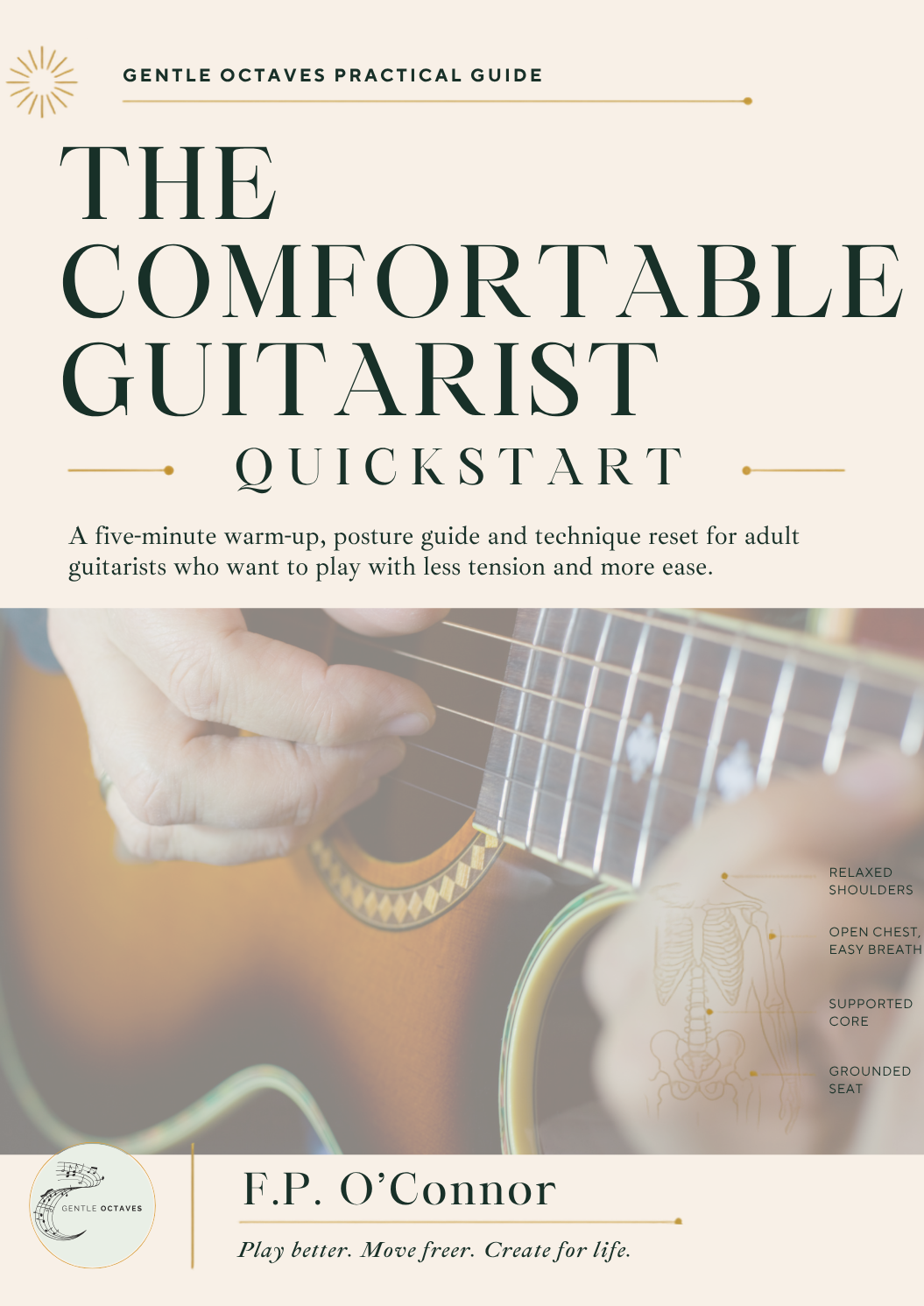
Free 15-page Guitar Comfort Guide
Play with less tension. Keep the music moving.
A short, practical guide to help your body feel more prepared before you pick up the guitar.
- Warm up properly in five minutes
- Find a playing position that feels supported
- Learn the seven pillars of playing posture
No spam. No daily sales sequence. Just practical guidance for keeping music in your life. Unsubscribe at any time.
This is worth knowing if you have been working hard on your posture and still finding your left shoulder consistently further forward than your right. It is partly structural. The instrument is contributing to it every time you play.
Why the Thoracic Spine Matters More Than the Chest
The standard advice for rounded shoulders in guitar players targets the chest: stretch the pectoralis minor, open the front of the shoulder, strengthen the muscles across the back. There is something to this. But it frequently fails to produce lasting change, and the reason is the thoracic spine.
The shoulder blade sits on the rib cage, which is attached to the thoracic spine (the twelve vertebrae running from below your neck to the base of your ribs) When the thoracic spine is restricted in extension, which is common in anyone who sits for long periods with a forward lean, it holds a fixed kyphotic curve.
And when the thorax is locked in flexion, the rib cage tilts forward, and the shoulder blade has nowhere to sit except in that protracted position.
This is the part that tends to get missed: you can work diligently on your pec stretches, have functional range of motion in the shoulder joint itself, and still find that the shoulder rounds forward within minutes of picking up the guitar, because the platform the shoulder blade sits on cannot support a neutral position.
Stretching the chest in this context is like trying to flatten a rug while the floor underneath it is uneven. You can smooth it out temporarily. It comes back as soon as weight goes on it.
What thoracic restriction feels like in practice
Players with thoracic restriction often describe a general stiffness across the upper back, a sense that sitting fully upright takes real effort and does not feel like it belongs there, or a tension that builds steadily across the shoulder blades during longer sessions. The thorax itself is not usually the painful area. The pain tends to appear downstream in the neck, the upper trapezius, and sometimes into the base of the skull which is why the thorax rarely gets investigated.
This is a pattern worth looking at if neck or upper-back tension keeps returning after playing, particularly on the fretting side. The neck tension loop in guitar players often traces back to a scapular system that is already compromised before the fingers touch the strings.
What Serratus Anterior Does (and What Happens When It Stops)
Serratus anterior is a muscle that wraps around the side of the ribcage, connecting the inner surface of the shoulder blade to the ribs. Its job is to hold the shoulder blade flat against the rib cage and rotate it upward as the arm lifts or reaches. When it is working well, the scapula moves cleanly and stays in contact with the rib cage. When it underperforms, the scapula tips and wallows.
In players with persistent rounded shoulders, serratus anterior is often the overlooked piece. The pectoralis minor gets attention because it is tight, accessible, and easy to stretch. Serratus is harder to feel, harder to train in isolation, and almost entirely absent from standard guitar posture guidance.
A pattern commonly observed in players with this presentation: the scapula does not track cleanly on the rib cage when the arm moves. Instead of rotating upward and staying flat, it tips forward into anterior tilt and drifts outward into protraction.
The upper trapezius then compensates, hiking the whole shoulder girdle upward to achieve the clearance that serratus should be providing. This is where the neck gets recruited into a system it was not designed to anchor. Shoulder tension in musicians frequently follows this scapular pattern.
The muscle picture tends to look like this. Pec minor locked short, pulling the shoulder blade forward and into anterior tilt. Lower trapezius and serratus locked long and unable to generate enough force to counteract it. Rhomboids working too hard to pull the blade back, creating tightness without providing actual stability.
Stretching the pec in this situation gives temporary relief. But without serratus and lower trapezius able to hold the shoulder blade in a neutral position, the pec minor shortens again at the next loading opportunity. Which is every time you pick up the guitar.
Why the Standard Fix Does Not Hold
The typical advice, and it is not wrong in principle, is to strengthen the back. Rhomboid rows, band pull-aparts, mid-trap work on a table. These exercises have their place. But loading the system before the thorax can extend tends not to produce lasting change, because the shoulder blade still has nowhere neutral to sit.
What tends to work better is a specific sequence.
Step 1: Release the thorax first
A restricted thoracic spine cannot be strengthened into mobility. It needs passive extension before any active work begins. The thorax is the upstream structure. If it stays locked in flexion, every downstream correction is working against a fixed foundation.
A simple place to start: roll a bath towel lengthwise to roughly 10 centimetres in diameter. Place it on the floor. Sit in front of it with your knees bent, then lower your upper back onto the towel so it sits across the mid-back, roughly level with your shoulder blades or just below. Let the arms rest. Breathe into it for 60 to 90 seconds.
This is passive extension, not a stretch you are pushing into. The towel stays still. You settle onto it. Notice whether the restriction feels central or more pronounced on the left side, since asymmetric thoracic stiffness is common in players who have been holding the fretting position for years.
Step 2: Reset scapular control before strengthening
Once the thorax has some capacity for extension, the shoulder blade has somewhere neutral to sit. From here, serratus anterior can begin to find its function. This does not necessarily mean isolated serratus exercises initially. It means loading positions where the scapula is asked to stay flat while the arm moves, progressively, starting from a place the thorax can support.
From here, the pec stretch becomes useful because it is completing a picture rather than compensating for two other unaddressed problems. The shoulder has somewhere to go. The stretch holds. And the guitar is no longer loading a system that was already behind before you started.
For the setup changes that can reduce how much thoracic load builds during a session, guitar chair selection and positioning is worth examining.
The position you play in shapes the position you carry afterward, and small setup changes compound over the length of a session.
The body mechanics chapter in Keep Playing covers the scapular system in more detail — why it leads in the kinetic chain, and what happens downstream when it is not doing its job. If this pattern sounds familiar, it is worth a look: https://payhip.com/b/ItW5E
Free 15-page Guitar Comfort Guide
Play with less tension. Keep the music moving.
A short, practical guide to help your body feel more prepared before you pick up the guitar.
- Warm up properly in five minutes
- Find a playing position that feels supported
- Learn the seven pillars of playing posture
No spam. No daily sales sequence. Just practical guidance for keeping music in your life. Unsubscribe at any time.

F.P. O'Connor
Manual Osteopath · Guitarist · Movement Nerd
Fergus is a manual osteopath and guitarist who spent nearly two decades watching players quietly give up because nobody gave them a straight answer about why their body was protesting.
→ Download the free Pain-Free Guitar GuideFrequently Asked Questions
Why do my shoulders keep rounding no matter how much I stretch?
If the thoracic spine is restricted in extension, the shoulder blade cannot sit in a neutral position regardless of how much chest stretching you do. The thorax is the platform the scapula sits on if it is locked in flexion, the shoulder drifts forward again as soon as load is applied.
Working on thoracic extension before shoulder work tends to produce more durable results than addressing the chest in isolation.
Is rounded shoulder posture from guitar playing permanent?
Not in most cases. The pattern is driven by a combination of muscle imbalances and thoracic restriction, both of which respond to the right kind of work. The timeline depends on how long the pattern has been established and what other factors are contributing, but it is generally not a fixed state.
Small, consistent changes to the practice environment, particularly chair height and guitar position, also reduce how much the pattern gets reinforced during playing. The Left Shoulder Trap post covers some of the fretting-arm specifics that overlap with this.
What muscles cause rounded shoulders in guitarists?
The pattern typically involves a shortened pectoralis minor pulling the shoulder blade into protraction and anterior tilt, combined with an underperforming serratus anterior that cannot hold the scapula flat against the rib cage.
Lower trapezius and rhomboids are often stretched and inefficient rather than tight. Thoracic restriction in the mid-back compounds all of it by removing the neutral position the shoulder blade needs to return to. This is why approaches that focus on the chest and upper back alone tend to produce only partial improvement.
Does the type of guitar affect rounded shoulder posture?
It can. Acoustic guitars tend to create more thoracic load than electrics due to body depth and weight distribution. Classical guitar played in traditional position, with the left leg elevated, changes the fretting arm geometry relative to a steel-string held in a more standard position.
Body width affects how far the fretting arm has to reach across, which directly influences how much left shoulder protraction the playing position demands. If you are working on postural habits, accounting for your instrument is worth doing alongside the physical work. The Guitarist's Body Blueprint covers instrument geometry in more detail.
Can rounded shoulders from guitar playing cause neck pain?
Yes, this is a common downstream consequence. When the shoulder blade sits in protraction and serratus is underperforming, the upper trapezius compensates by hiking the shoulder upward to provide the clearance the arm needs. The levator scapulae, which connects the shoulder blade to the cervical spine, then carries load it was not designed to sustain over long sessions.
The result is neck tension on the fretting side that often feels unrelated to the shoulder and is typically treated at the neck rather than traced back to the scapula where the pattern is being driven. Scapular positioning and scapulohumeral rhythm are both worth addressing before chasing neck symptoms directly.
References
- Borstad JD. "Resting position variables at the shoulder: evidence to support a posture-impairment association." Physical Therapy. 2006;86(4):549–557. https://pubmed.ncbi.nlm.nih.gov/16579671/
- Kibler WB, McMullen J. "Scapular dyskinesis and its relation to shoulder pain." Journal of the American Academy of Orthopaedic Surgeons. 2003;11(2):142–151. https://pubmed.ncbi.nlm.nih.gov/12670140/
- Cools AM, Struyf F, De Mey K, Maenhout A, Castelein B, Cagnie B. "Rehabilitation of scapular dyskinesis: from the office worker to the elite overhead athlete." British Journal of Sports Medicine. 2014;48(8):692–697. https://pubmed.ncbi.nlm.nih.gov/24473488/
- Lee JH, Cynn HS, Kwon OY, Yi CH, Yoon TL. "Different shoulder exercises affect the activation of deltoid and pectoralis major muscle in subjects with rounded-shoulder posture." Journal of Physical Therapy Science. 2014;26(4):563–568. https://www.ncbi.nlm.nih.gov/pmc/articles/PMC4085215/
