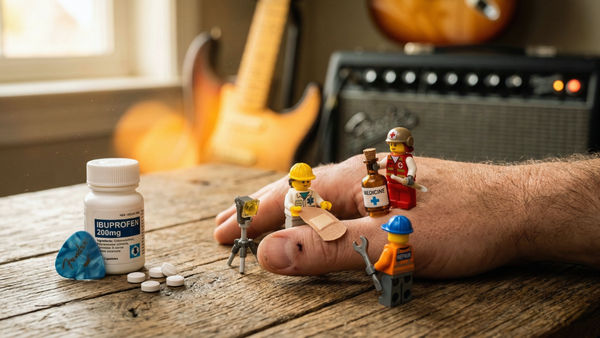
The 10-Minute Ritual That Could Save Your Playing Years
Reduce pain, improve performance, and protect your hands for decades.

You wouldn't sprint without stretching. Why do you play without warming up?Prepare your body. Protect your music.
You grab the guitar after a long day at the desk. Your shoulders are tight, your wrists feel stiff, and you've got maybe thirty minutes before life pulls you away again.
So you skip the warm-up. You dive straight in.
And twenty minutes later, your forearm's burning, your fingers won't cooperate, and that tension headache's creeping up the back of your skull.
Sound familiar?
Here's what I learned working with bodies for fifteen years: your instrument doesn't injure you. How you meet it does.
In this post, I'll show you a simple 10-minute ritual: 5 minutes before, 5 minutes after, that protects your hands, reduces pain, and actually makes you play better. Not someday. Today.
Why Warm-Ups Matter More After 40
Look, I'm not going to sugarcoat this: your tissues don't recover like they did at twenty-five.
Tendons get less elastic. Joints hold more tension. Blood flow to extremities slows down a bit. That's not failure, that's just biology.
But here's the thing most guitarists miss: preparation isn't about avoiding weakness. It's about respecting the system you've got.
You can also read my post on Guitar Comfort Secrets to ensure you are setting up properly before you even warm up. When you warm up properly, you're telling your nervous system: "Hey, we're about to do something precise and repetitive. Get ready.
You're increasing blood flow to the hands and forearms. You're lubricating the joints. You're waking up proprioception: that sense of where your body is in space.
And when you cool down? You're signaling the parasympathetic nervous system to shift from "perform mode" to "recover mode." You're flushing out metabolic waste. You're giving your tissues permission to reset.
I've seen so many players treat their bodies like rented cars. Just gas and go. And then they wonder why tendonitis shows up, why that nagging wrist pain never quite goes away.
Your body's not the enemy. It's the instrument underneath the instrument. Treat it right, and it'll carry your music for decades.
If you've been away from music and you're worried about starting again, read this first."
What Happens When You Skip the Ritual
Let me tell you about a guy I worked with Tom, he's 52. Played guitar since he was a teenager, but life got in the way. Kids, career, all that.
Came back to it in his late forties. Loved it. Played every night after work. Here' s why its never too late to play again
Except his hands started hurting. Then his wrists. Then his forearms felt like they were on fire halfway through a session.
He thought it was arthritis. Maybe carpal tunnel. Maybe just "getting old."
But really: He was going from eight hours at a keyboard straight to thirty minutes of barre chords. Cold muscles. No prep. No recovery.
We didn't change what he played. We changed how he arrived to the guitar.
Added a five-minute warm-up. Gentle wrist circles. Finger stretches. A bit of neck and shoulder release because, yeah, tension travels.
And a cool-down: slow stretches, a little self-massage, intentional breath.
Within two weeks, the burning stopped. Within a month, he was playing longer and better than he had in years.
Not because he got stronger. Because he got smarter.
The 5-Minute Pre-Play Warm-Up
Here's the routine. It's simple. It works. And it takes less time than scrolling Instagram while you're "getting ready to practice."
1. Neck & Shoulder Release (60 seconds)
- Slow head tilts: ear toward shoulder, hold 10 seconds each side
- Gentle chin tucks: pull your head back like you're making a double chin, then release
- Shoulder shrugs: lift to your ears, hold 3 seconds, drop and relax
Why? Tension in your neck and shoulders pulls on everything downstream. Your arms, your wrists, your fingers — they're all connected.
2. Wrist Circles & Figure-8s (60 seconds)
- Extend your arms in front, make loose fists
- Circle your wrists slowly: 10 times one direction, 10 times the other
- Then trace a figure-8 pattern with your hands (like drawing infinity symbols in the air)
Why? This lubricates the wrist joints and wakes up the small stabilizer muscles.
3. Finger Stretches (90 seconds)
- Gently pull each finger back toward your wrist, one at a time (don't yank — just a light stretch)
- Spread your fingers wide, then make a fist. Repeat 10 times.
- Touch each fingertip to your thumb in sequence: 1-2-3-4, then reverse 4-3-2-1. Do this 5 times each hand.
Why? This primes the fine motor control you need for fretting and picking.
4. Forearm Flexor & Extensor Stretch (60 seconds)
- Extend one arm, palm up. Use your other hand to gently pull your fingers back toward your body. Hold 15 seconds.
- Flip your hand palm-down, pull fingers toward you again. Hold 15 seconds.
- Repeat on the other arm.
Why? These are the muscles that do the work when you play. Warming them up prevents strain.
5. Quick Body Scan (60 seconds)
- Sit or stand, close your eyes for a moment
- Take three deep breaths — in through your nose, out through your mouth
- Notice where you're holding tension. Your jaw? Your shoulders? Your lower back?
- Consciously soften those areas.
Why? You play with your whole body, not just your hands. Tension anywhere becomes tension everywhere.
The 5-Minute Post-Play Cool-Down
This is the part most people skip. And honestly, it's just as important as the warm-up — maybe more.
1. Slow Stretch Repeat (90 seconds)
- Go back through the wrist and finger stretches from the warm-up
- But now do them slower, with more intention
- You're not preparing anymore — you're releasing
2. Self-Massage (90 seconds)
- Use your thumb to gently press into your forearm muscles (both flexors and extensors)
- Work from wrist to elbow, finding any tight or tender spots
- Breathe into them. Don't attack them.
- Massage the base of each finger and the webbing between thumb and index finger
Why? This helps flush out lactic acid and reduces adhesions in the fascia.
3. Shake It Out (30 seconds)
- Let your arms hang loose at your sides
- Shake your hands like you're flicking water off them
- Rotate your shoulders a few times
Why? This signals your nervous system that the work is done. Time to let go.
4. Gratitude Breath (90 seconds)
- Sit quietly, hands in your lap
- Take five slow, deep breaths
- On each exhale, mentally acknowledge one thing: your hands, your instrument, the time you just spent, the music itself, the part of you that showed up today
Why? This is you marking the moment. Giving your body and mind permission to rest. Building a ritual that makes practice sacred instead of stressful.
What If You Only Have 5 Minutes Total?
Fair question. Life's messy. Time's tight.
If you can only do one thing:
Do the wrist circles, finger stretches, and one deep breath before you play.
That's it. Sixty seconds. That alone will make a difference.
And after? Even just thirty seconds of shaking out your hands and taking a breath matters.
Something is always better than nothing. Always.
The Mistakes Most Guitarists Make
I've seen these patterns over and over:
Mistake #1: Treating warm-ups like cardio
You don't need to break a sweat or push hard. This isn't boot camp. Gentle, mindful movement wins every time.
Mistake #2: Only warming up when you're already in pain
That's like only putting on your seatbelt after the crash. Warm-ups are preventative, not reactive.
Mistake #3: Skipping the cool-down because "I feel fine"
Yeah, you feel fine now. But that cumulative strain? It shows up later. In your forties. In your fifties. When your hands suddenly "just don't work like they used to."
Mistake #4: Going straight from the computer to the guitar
Your body's been in one position for hours. Your wrists are flexed. Your shoulders are rounded. You have to reset before you add more repetitive strain.
Mistake #5: Thinking this is optional
It's not. If you want to play for the next twenty years, even the next twenty days without pain, this is non-negotiable.
Try This: The 7-Day Warm-Up Challenge
Here's your homework:
- For the next 7 days, commit to the full 10-minute ritual (5 before, 5 after)
- Keep a simple log: date, how your hands felt before, how they felt after, any changes in your playing
- Notice patterns. Does your left hand fatigue less? Do your fingers feel more responsive? Is that shoulder tension easing up?
By day 7, if this hasn't changed how you feel, I'll be genuinely surprised.
And once you've got the rhythm, it becomes automatic. Like tuning your guitar. You just do it.
It's Not Extra. It's Essential.
I know you're busy. I know you want to maximize your practice time.
But here's the truth: five minutes of preparation saves you months of recovery.
I've watched players push through pain, ignore the warning signs, and end up sidelined for weeks or months because they thought warm-ups were for "serious" musicians or "athletes" or someone else.
You are a serious musician. You're a human being asking your body to do precise, repetitive work. Respect that.
Your hands aren't just tools. They're how you speak when words aren't enough. They're how you connect to something bigger than yourself.
Treat them like they matter. Because they do.
Your Invitation + Tool
If you've been playing through pain or just feeling like your body's not keeping up with your musical ambitions, start here.
Try the 10-minute ritual for one week. Just one.
Then reply and tell me: What shifted? What surprised you? What questions came up?
And if you want a complete system — one that integrates posture, tension release, and body-aware practice check out the whole system based on my 15 years working with musicians and guitarists :
Keep Playing: The Release → Reset → Rebuild™ Method for Lifelong Guitar Playing
You don't have to choose between playing and protecting your body. You can do both.
F.P.
Founder, Gentle Octaves
About the Author

F.P. O’Connor
F.P. O'Connor is a Musician and Movement Specialist whose work is informed by extensive training in Manual Osteopathy, Psychology, and Strength Coaching.
He is the founder of Gentle Octaves, helping adult players develop practical, science-based systems for ease, control, and long-term playing confidence.
Explore more at: httpss://www.gentleoctaves.com
Play better. Move freely. Create for life.
FAQ
Q: Can arthritis make guitar playing painful?
Yes arthritis can limit joint mobility and increase strain, but it doesn’t automatically mean you have to stop playing.
Arthritic joints often become stiff and sensitive, especially after rest. Pain usually comes less from the joint itself and more from how load is managed while playing.
With proper warm-ups, posture resets, pacing, and small technical modifications, many players regain significant comfort and function. Arthritis changes how you play, not whether you can play.
If gentle movement reduces stiffness, intelligent motion is part of the solution.
Q: How long should I warm up before playing guitar?
About 5 minutes is ideal, but even 60–90 seconds is better than nothing.
Warm-ups prepare joints, tendons, and the nervous system for load. They reduce early stiffness and improve coordination before effort ramps up.
Consistency matters more than duration a short, regular warm-up outperforms long routines done sporadically.
If your hands feel freer after warming up, it’s working.
Q: Should I stop playing guitar if my hands hurt?
Not automatically: pain is a signal, not a sentence.
Pain often reflects overload, tension, or poor mechanics rather than irreversible damage. Many players do better by reducing session length, improving posture, and adding warm-ups and breaks rather than quitting altogether.
That said, pain that persists, worsens, or includes numbness or sharp sensations should be professionally assessed.
Scale back intensity first; stop only if symptoms escalate.
Q: Do I really need to cool down after playing?
Yes cooling down supports recovery and reduces cumulative strain.
After playing, the nervous system stays in a heightened state. Light movement and breathing help it shift into recovery mode, reduce residual tension, and limit stiffness building up between sessions.
A few minutes now often prevents flare-ups later. If you want tomorrow’s session to feel easier, cool down today.
Q: Are warm-ups and cool-downs really that important if I don’t play for long?
Yes shorter sessions still place load on small joints and tendons.
Hands and wrists tolerate stress best when prepared and unloaded properly. Even brief playing sessions can accumulate strain over time without basic preparation and recovery habits.
Short sessions still deserve preparation.
Q: What’s more important: stretching, posture, or technique?
Posture and technique determine how much stretching you actually need.
Stretching helps temporarily, but if posture and technique overload the hands, tension returns quickly. Efficient setup and movement reduce how hard tissues have to work in the first place.
If stretching helps briefly but pain returns, look at mechanics next.
Sources & Further Reading
Brandfonbrener, A. G. (2003). Musculoskeletal problems of instrumental musicians. Hand Clinics, 19(2), 231–239.
[https://doi.org/10.1016/s0749-0712(02)00100-2]
Iglesias-Carrasco C, de-la-Casa-Almeida M, Suárez-Serrano C, Benítez-Lugo ML, Medrano-Sánchez EM. Efficacy of Therapeutic Exercise in Reducing Pain in Instrumental Musicians: Systematic Review and Meta-Analysis. Healthcare (Basel). 2024 .https://pmc.ncbi.nlm.nih.gov/articles/PMC11241052/
Rosset-Llobet, J., Rosinés-Cubells, D., & Saló-Orfila, J. M. (2000). The effect of preventive intervention in playing-related disorders of musicians. Medical Problems of Performing Artists, 15(1), 33–37.
Zaza, C., & Farewell, V. T. (1997). Musicians' playing-related musculoskeletal disorders: An examination of risk factors. American Journal of Industrial Medicine, 32(3), 292–300.
[https://doi.org/10.1002/(SICI)1097-0274(199709)32:3<292::AID-AJIM16>3.0.CO;2-Q].