Never too Old: Play Guitar and Reclaim Your Musical Joy


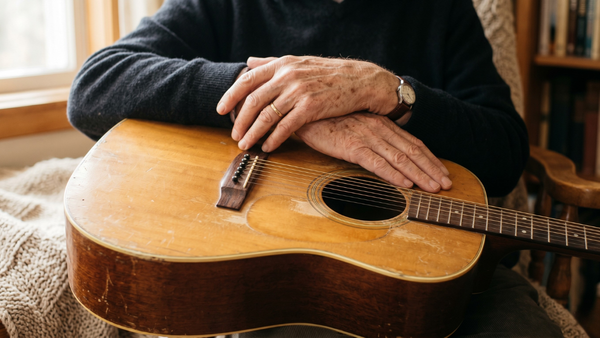
You pick up your guitar and your fingers start to ache. Maybe your joints whisper your too old or your body resists movement you once took for granted. You tell yourself, “Maybe Im not able for this anymore, maybe that was a thing I could do when I was younger, I just have to accept where I am now"
Maybe, or maybe not. Heres what I've seen first hand , working with older guitarists and musicians for years now and I mean this: that ache, that hesitation, that doubt that shows up ?
They're not signs you missed your chance and should give up. They're actually the signal that your creative flame is still alive, still quietly pushing you forward. Still asking you to pay attention.
In this post, I'm going to help you stop believing the myth of "too late." We'll reframe your learning around what actually matters: meaning, not speed. Understanding and respecting your body and your mind but not letting it stop you from actually playing guitar and making music.
And I'll give you one practical thing you can do today to start rebuilding that creative flame again no matter how long it's been since you played.
The Real Myth You’ve Been Believing
Ok so maybe the dust has settled a bit in your life now. Kids are older, work's calmed down some, or maybe things just got quieter. That old hunger to create? It's knocking again.
But when you try to answer the door, fear and doubt barge in first.
"Wait a minute there my friend, where do you think you're going with this? You'll prob end up just hurting yourself or making a fool of yourself, why bother?"
Somewhere along the way, and I don't know where exactly for you, maybe school, maybe culture, maybe just the accumulation of a thousand small messages you likely absorbed the lie that music belongs to the young.
That fast fingers matter more than feeling. That if you didn't start early, you missed your shot, that if you stopped years ago you shouldn't or can't start again because your hands are too sore or your back aches or that old clicky shoulder is clicking.
But the timeline you were sold is complete BS. And you likely know it deep down: it's just drowned out by the loud voices of fear, doubt, or safety.
Real learning doesn't care how many birthdays you've had. It cares about presence, repetition, and meaningful attention: all things you actually likely have way more of now than you did at 22.
I know I do. When I was younger, I had the time but not the depth. Now? I've got the depth. I just have to work a bit smarter with the body I've got to make the time. I have to watch the amount I play, the way I warm up, the things I can play.
And I still have to overcome the inner critic almost every time I go to pick up the guitar: not today, your too stiff, your voice sounds like shit, theres too much to do, this is wasted time and on and on and on....
Maybe now the dust has settled a bit, and that old hunger to create is knocking again.
Why Age and Pain Don’t Cancel Neuroplasticity
Ok so maybe your friends with that ol inner critic, well acquainted likely if you've been together for a few decades.
Why is he showing up even harder now when you're supposed to be doing something fun, something good for you something healthy even? Well, because you’re stepping into something that genuinely matters.
And that’s scary.It’s vulnerable.
And honestly we don’t talk enough about how courageous that is.
A kid learning music? They've got nothing to prove. It's cool if they pick up an instrument, right? The guitar, the piano, whatever "oh wow.... your taking lessons, your learning how to sing, your writing songs" ... maybe its just the carefree attitude and adventure of youth.....like theres always hope as a kid at 16 learning to play could we could become the next big thing, sell stadiums, see our face on t-shirts...
But an adult?Especially a middle aged adult?
We have a lifetime of stories, criticism, shame, and comparison stacked against us.
We're not just learning a chord, we're confronting every voice that ever told us we weren't musical enough, weren't disciplined enough, weren't good enough.
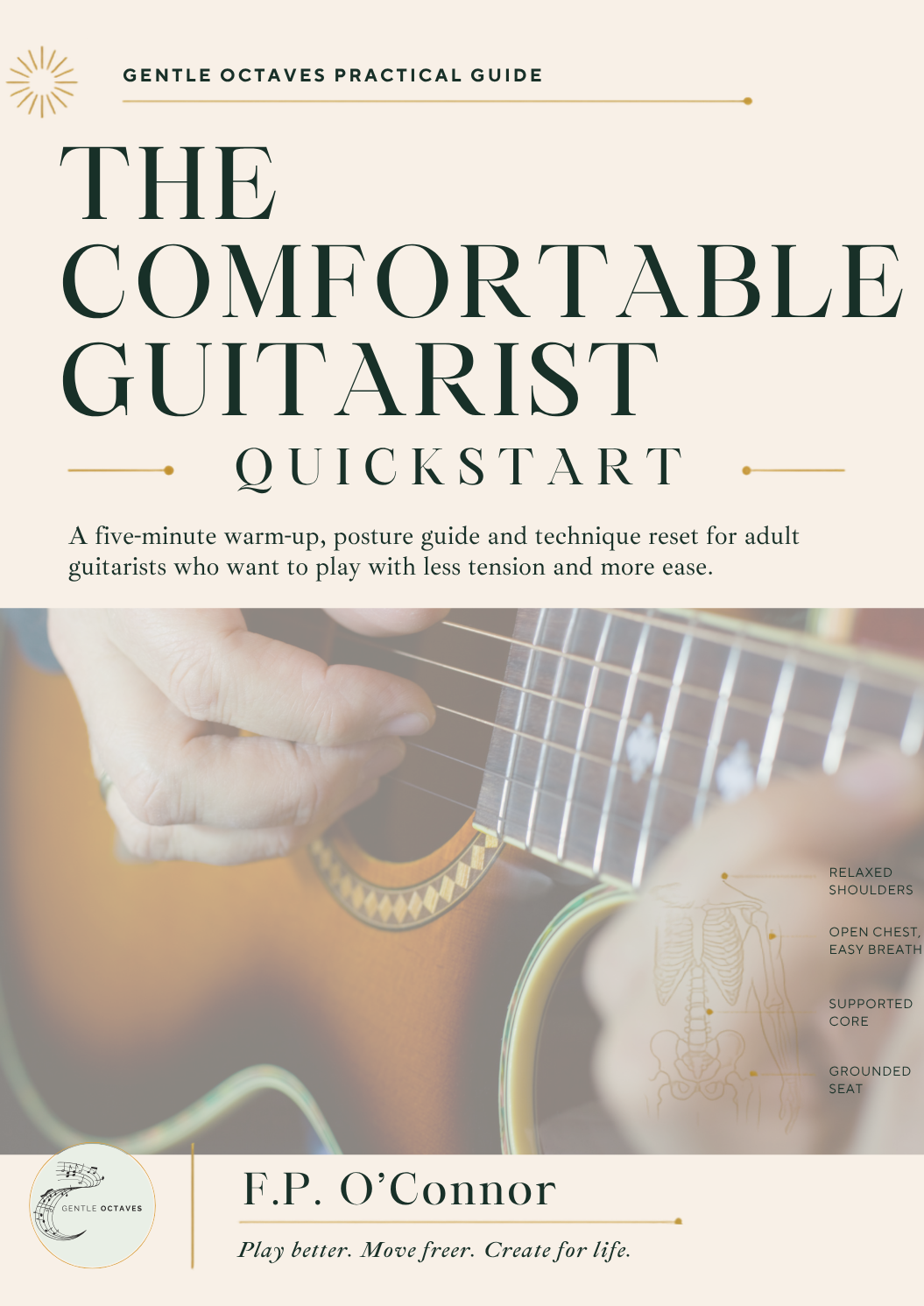
Free 15-page Guitar Comfort Guide
Play with less tension. Keep the music moving.
A short, practical guide to help your body feel more prepared before you pick up the guitar.
- Warm up properly in five minutes
- Find a playing position that feels supported
- Learn the seven pillars of playing posture
No spam. No daily sales sequence. Just practical guidance for keeping music in your life. Unsubscribe at any time.
"Sit down in that chair now and let the cool things to the younger ones, you had your day...."
It's much harder in that way. Maybe there is a truth that we are unlikely to get the record deal, that this music thing isn't full of the same wild adventures that the world may open up when we were younger.
But here's the thing, and this is backed by actual science, not just me being optimistic, you've probably heard the word neuroplasticity.
Your brain's ability to change and grow, even later in life. It's real. It's backed by decades of research.
Your brain still wants to learn. It's wired for it. You just have to give it permission and a bit of space to do its thing.
Even if your fingers don’t move like they used to…
Even if arthritis makes things slower…
Even if you’ve doubted yourself for years…
You can rewire how you play and how you think about playing starting now.
What Shifts When You Stop Comparing
Okay, let's say it plainly: comparing yourself to some conservatory-trained 17-year-old is emotional sabotage in a cap and gown.
They're on a completely different path. They're learning for competition, for grades, for conservatories, for external validation. Fine for them. But it's not your path.
Comparison kills creativity.
Comparison kills creativity. I mean that literally. The fastest way to lose your joy is to stack yourself against some invisible 20-something shredding on YouTube.
That's not your pace. That's not your purpose.The musicians I work with don’t want to shred.
They want to play freely. To create something honest.
To feel at home in their body again.
To sit down on a Tuesday night and play something that moves them, even if no one else ever hears it.
And you know what happens when they let go of the timeline they thought they should be on? They find their rhythm. They trust their bodies and their creativity. They trust their own version of success. Not just in music. In life.
Your First 3 Gentle Steps to a Musical Rebirth
Here's the good news, and I know this sounds almost too simple, but every shaky note you play is a brain cell doing push-ups. Every time you try to play that bloody barre chord without it buzzing for the 17th time your brain is changing.
You're not just learning music. You're strengthening the way you meet life. The way you show up for hard things. The way you stay present even when it's uncomfortable.
So here's where to start:
Pick one small thing to work on. Not five things. One. A chord. A line. A lyric. Something small enough that it doesn't feel overwhelming.
Detach from outcome. I mean this. Your job is showing up, not impressing anyone, including yourself. You're not trying to be great today. You're just trying to be present.
Notice what your body is saying. Not to judge it. Not to bully it into compliance. But to actually listen. Where's the tension? Where's the ease? What's your body trying to tell you?
The secret to starting again ?
Don't over-plan. Don't wait for perfect conditions or the right moment or when you have more time. Just begin small. And begin again tomorrow.
Follow the 20 Min Rule to ensure consistency, read about it here: The 20 -minute rule: How to build a Guitar Practice Habit that actually sticks
Try This: 5-Minute Reset Practice
Alright, here's something you can actually do today. I call it a reset practice because you're not trying to master anything, you're just making peace with where you are right now.
Choose one melody or chord you already know.
Something simple. Something you've played before, even if it was years ago.
Set a 5-minute timer.
That's it. Five minutes.
Play it slowly, with full attention.
Not fast. Not perfect. Just present. And while you're playing, notice:
- Where is your breath? Are you holding it?
- Is your shoulder lifting toward your ear?
- Does the movement feel effortful or easy?
- What's happening in your wrist, your thumb, your lower back?
Afterward, pause. Close your eyes. Take a breath. Say out loud or in your head: "One note at a time."
Jot one sensory note somewhere. A journal, your phone, whatever. Just one observation: "Wrist felt tight today." "Thumb stayed relaxed." "I felt grounded for the first time in months."
That's it. Repeat this daily for 2-4 weeks. You'll start to feel the shift and I mean feel it in your body, in your confidence even before you hear it in your playing.
Optional: Record a 30-second clip of yourself playing once a month. Not for critique. Not to post anywhere. Just to witness your own evolution. You'll be surprised.
When Progress Feels Slow (And What To Do)
Look, progress isn't linear. Especially with adult learning. Some days you'll feel like you're flying. Other days it'll feel like molasses. Like you're moving backwards.
That's not failure. That's re calibration. That's your nervous system integrating new information. That's your body figuring out how to do something it hasn't done in a while or maybe ever.
If your hands hurt, (and they will in the beginning) check out my post below, even if you dont have arthritis it has some nice chord variations that help when your hands are just too sore to keep playing:
Arthritis-Friendly Guitar Chords That Feel Easier on Stiff Hands
When things feel slow, and they will:
Come back to breath. Come back to why you're doing this in the first place. Let patience be your technique for the day.
You’re not behind you’re just building something that lasts. It might take a little longer but it will matter a lot more in the long run.
Music Matters
Sometimes, and be honest with yourself here, the hardest part isn't the chord. It's not the stretch. It's not even the tension.
It's the voice in your head that says: "You're wasting time. You'll never catch up. You should've started sooner. What's the point now?"
Free 15-page Guitar Comfort Guide
Play with less tension. Keep the music moving.
A short, practical guide to help your body feel more prepared before you pick up the guitar.
- Warm up properly in five minutes
- Find a playing position that feels supported
- Learn the seven pillars of playing posture
No spam. No daily sales sequence. Just practical guidance for keeping music in your life. Unsubscribe at any time.
That voice is fear pretending to be logic. And it's loud. And it sounds really convincing.
But here's what's usually much more true: You're right on time. You're exactly where you're supposed to be. You're listening to something deeper than productivity or achievement or catching up to some imaginary standard.
You're listening to the part of yourself that still wants to create. That still wants to play. That still believes even after everything that music matters.
And it does. It genuinely does.
Your Invitation + Tool
If this resonated, I’d love to hear your story.
What’s your biggest barrier right now: pain, fear, schedule?
What’s one doable step you could take this week?
Hit reply and tell me. If your looking to go further on your musical journey check out:
Keep Playing: The Release → Reset → Rebuild™ Method for Lifelong Guitar Playing
You still have more music in you than you think.
F.P
Founder, Gentle Octaves
About the Creator
I’m F.P. O’Connor. a Musician and Movement Specialist with training in Manual Osteopathy, Psychology, Personal Training and Coaching.
I founded Gentle Octaves as a place where science, movement, and musicianship meet helping adults play guitar with less tensions, less pain and more confidence.
This work comes from over 15 years of experience mixed with playing, teaching, treating and plenty of lived trial-and-error.
Explore more at:
Play better. Move freely. Create for life
FAQ
Q: Is it really possible to return to music after a long break?
A: Yes you don’t need to reclaim a “prime‑time” career to enjoy meaningful music. The post shows how small, consistent habits help adult musicians rebuild joy and connection, even after years away or dealing with physical setbacks.
Q: What if I have arthritis or an injury? Do I have to stop playing?
A: If you’re dealing with arthritis, tension, or an injury, it’s important to check in with a qualified healthcare provider about what’s appropriate for your situation. Many adult players find they can continue making music by adjusting their posture, warm-up, and technique, but this varies from person to person.
The goal of Gentle Octaves is to offer educational tools that help you explore your own comfort, awareness, and ease at the instrument not to replace medical guidance.
Q: How much time do I need to invest to make progress?
A: You don’t need hours every day. Even 10–15 minutes of focused, mindful practice + one deliberate body‑oriented habit can move the needle. It’s about smart frequency and consistency rather than marathon sessions.
Q: What if I feel like I’m “too old” or “too rusty” to play again?
A: Age and rust don’t cancel your musician‑identity they reshape it. You’re not starting over, you’re finding a better way to ensure you can continue to play comfortably and respect your age. By working with your body, mind and instrument together, you can play with more freedom and less pressure than you ever did.
Sources & Further Reading
- Bugos, J. A., Perlstein, W. M., McCrae, C. S., Brophy, T. S., & Bedenbaugh, P. H. (2007). Individualized piano instruction enhances executive functioning and working memory in older adults. Aging & Mental Health, 11(4), 464–471. https://doi.org/10.1080/13607860601086504
- Herholz, S. C., & Zatorre, R. J. (2012). Musical training as a framework for brain plasticity: Behavior, function, and structure. Neuron, 76(3), 486–502. https://www.sciencedirect.com/science/article/pii/S0896627312009312
- Wan, C. Y., & Schlaug, G. (2010). Music making as a tool for promoting brain plasticity across the life span. The Neuroscientist, 16(5), 566–577. https://pmc.ncbi.nlm.nih.gov/articles/PMC2996135/