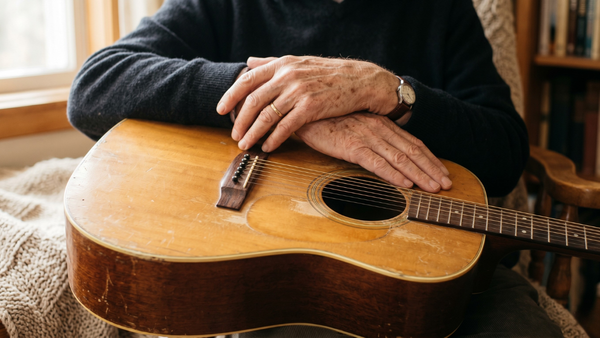
How Much Guitar to Play With Arthritis: Why Good Days Are the Dangerous Ones

The advice that sounds right but isn't
Most guidance for guitarists with arthritis lands in the same place: warm up carefully, rest when it hurts, don't push through pain.
That's not entirely wrong, ignoring sharp or acute pain is of course never wise. But it sets up a particular trap.
If pain is your stop signal then you're only stopping after the harm is already accumulating. And if the absence of pain is your green light, you'll do what almost every arthritic guitarist does naturally: play more on good days to make the most of them.
The problem is that "making the most of a good day" is precisely what produces the next bad one.
Trust me I know, as a Manual Osteopath who is also a very keen guitar player and deals with arthritic fingers and wrists I know better than anyone the importance of managing the demands I put on my hands.
And Ive made the mistakes talking about here many times over the years, which has led to periods of me not being able to play and even worse, being so inflamed that I'm wasn't able to treat clients until th inflammation subsisded.
What actually happens
Here's the pattern. A player has a bad week, plays very little, maybe ten or fifteen minutes on the days they manage anything at all. Then Saturday comes, the joint feels almost normal, the stiffness is low, and they sit down for a proper session. Ninety minutes, maybe its a jam with friends and it turns into two hours. It feels fine while they're doing it.
By Monday, they can barely make a chord shape.
They assume Monday is random. Something they did wrong, weather, sleeping awkwardly. They don't connect it to Saturday.
But in chronic pain rehabilitation, Saturday is the entire explanation. The tissue has a tolerance threshold. Staying under it allows adaptation and recovery.
Going over it, even once, even on a day that feels good, drives an inflammatory response that takes days to resolve. The good day didn't just not help. It set the clock back.
The principle that changes how you think about practice
Pacing in pain rehabilitation is done against time and a pre-set plan, not against symptoms.
This is the part that feels backwards when you first hear it. The clinical model says your practice quota on a good day should be the same as your practice quota on a bad day, because the quota is set at a level the bad day can sustain.
Not the good day. The bad day.
If forty minutes is your sustainable ceiling on a flare day, that's your session length. On the days when you could easily play for two hours, you stop at forty minutes anyway. You bank the capacity. You don't spend it.
The goal isn't to maximise any individual session. The goal is to be able to play consistently for months and years, with a gradually widening tolerance, rather than cycling through flares that each leave you a little worse off than before.
How to set your actual quota
The number you want is the length of session you can complete on a moderate-to-bad day without a significant symptom increase the following morning.
Most people overestimate this when they're first working it out. Start conservatively. If you think you can manage thirty minutes, try twenty.
Hold that for two weeks. If your symptom baseline stays stable or improves, you can add five minutes. If it spikes, you've found your real ceiling and it's lower than you thought.
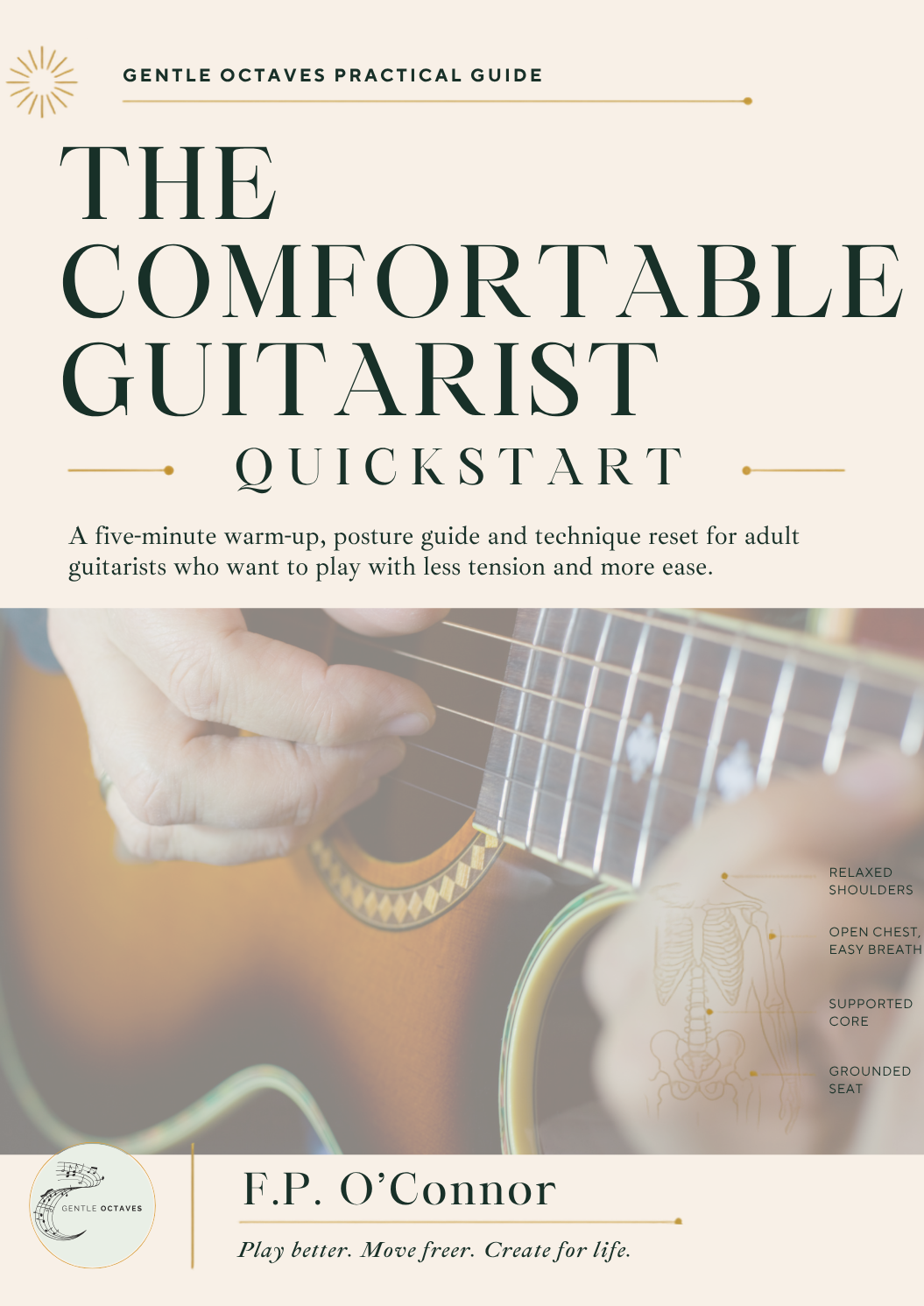
Free 15-page Guitar Comfort Guide
Play with less tension. Keep the music moving.
A short, practical guide to help your body feel more prepared before you pick up the guitar.
- Warm up properly in five minutes
- Find a playing position that feels supported
- Learn the seven pillars of playing posture
No spam. No daily sales sequence. Just practical guidance for keeping music in your life. Unsubscribe at any time.
This is a slow process. It's also the only process that will help to stop the overuse and inflammation that comes from the big sessions.
The rule that makes it easier: the good days are not a resource to spend. They're evidence that your baseline is holding. Keep the session the same length. Do better quality work with the time you have. Save the two-hour session for when two hours is your bad-day ceiling, not your good-day indulgence.
This post covers general information about pacing and activity management. It is not a substitute for advice from a healthcare provider familiar with your specific condition.
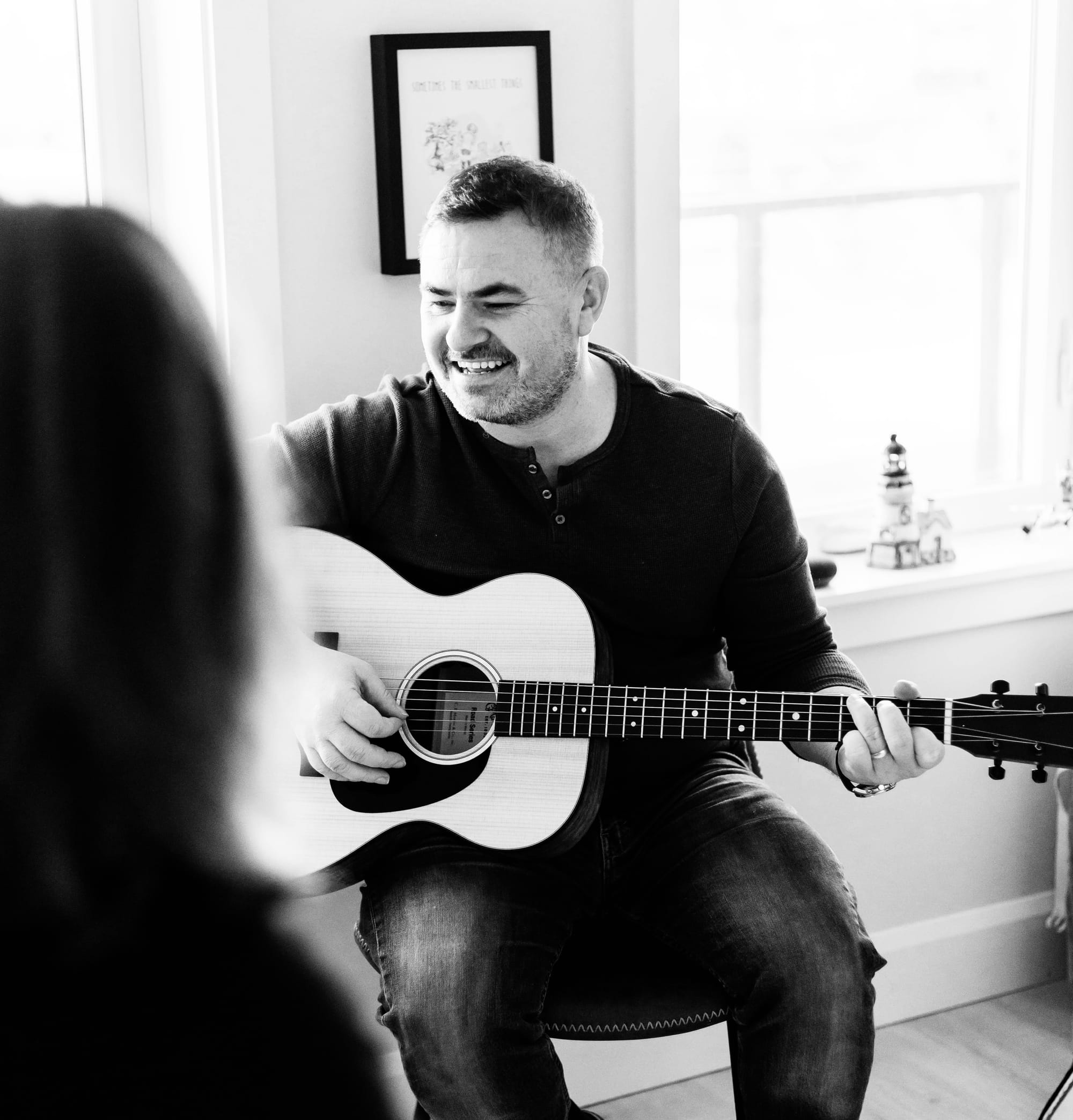
F.P. O'Connor
Manual Osteopath · Guitarist · Movement Nerd
Fergus is a manual osteopath and guitarist who spent nearly two decades watching players quietly give up because nobody gave them a straight answer about why their body was protesting.
→ Download the free Pain-Free Guitar GuideIf pacing is new territory, the Keep Playing guide goes deeper into how to apply this across a full practice week, including how to structure what you do inside a shorter session to get more from it. You can find it at payhip.com/b/ItW5E.
Frequently asked questions
How much guitar should I play with arthritis each day?
There is no universal number, but the right starting point is the session length you can complete on a symptomatic day without a significant increase in pain or stiffness the following morning. For most players this is somewhere between fifteen and forty minutes. The session length should stay consistent regardless of how you feel on a given day.
Why do I feel worse after playing on a good day?
This is the boom-bust pattern. On low-symptom days, it's intuitive to do more. But activity beyond your tissue's tolerance threshold drives inflammation, and the response often peaks twelve to twenty-four hours later. The good-day session and the bad next morning are the same event.
Is it okay to push through arthritis pain while playing guitar?
Persistent or sharp pain during playing is a signal worth taking seriously, not pushing through. Mild stiffness at the beginning of a session often settles with gentle movement. The more important guidance is not to use the absence of pain as permission to extend your session significantly beyond your usual quota.
What should I do on days when my arthritis is bad?
If you can play at all, a shorter and gentler version of your normal session is generally better than complete rest, unless the joint is acutely inflamed. Very light movement within a pain-free range can help maintain circulation and prevent the deconditioning that makes bad days worse over time. If your symptoms are significantly elevated, rest is appropriate, and one missed session does not set you back.
References
Vlaeyen, J.W.S., Crombez, G., & Linton, S.J. "The fear-avoidance model of pain." Pain, 2016. https://doi.org/10.1097/j.pain.0000000000000573
Nielson, W.R., & Jensen, M.P. "Relationship between changes in coping and treatment outcome in patients with Fibromyalgia Syndrome." Pain, 2004. https://doi.org/10.1016/j.pain.2004.08.010
Andrew, R., Derry, S., Taylor, R.S., Straube, S., & Phillips, C.J. "The costs and consequences of adequately managed chronic non-cancer pain and chronic neuropathic pain." Pain Practice, 2014. https://doi.org/10.1111/papr.12050