
Why Guitar Practice Makes Inflammation Worse

The 23 Hours
Three sources of background load contribute more cumulative tissue stress than most practice sessions.
Phone grip.
Sustained pinch grip on a smartphone loads the same intrinsic hand muscles and flexor tendons as fretting. An hour of evening scrolling, where the phone sits between thumb and fingers in sustained compression, loads those structures comparably to a moderate session. A phone stand and stylus costs almost nothing and eliminates the grip loading entirely.
Desk posture.
Static wrist loading at a keyboard or with a mouse keeps the carpal tunnel under low-grade compression for hours. Most players with office work spend six to eight hours in moderate wrist load before they touch the guitar. The session in the evening inherits that full prior loading.
Sleep position.
Sleeping with the wrist flexed, or with the arm tucked under the body, loads the carpal tunnel and flexor tendons passively for six to eight hours. A wrist splint or a simple positional adjustment changes the overnight load almost completely. The playing session the following afternoon begins from a meaningfully lower baseline.
What Changes?
None of these require stopping playing. Modifying the 23 hours before a session is what changes the threshold.
One additional variable worth examining: how you actually hold your guitar. Your setup especially in the fretting hand loads the flexors and shoulder before you play a single note. You can check out The Guitarist Body Blueprint post for more tips on how to setup properly.
These are small interventions. The cumulative effect of removing three sustained loads across a full day is not small.
If you want to go deeper into the upstream habits that protect the entire tissue chain, the full picture is in Anti-Inflammatory Habits That Actually Support Your Guitar Playing.
Keep Playing covers the complete framework for long-term playing resilience, from load management to recovery sequencing across all phases. https://payhip.com/b/ItW5E
If your looking for an immediate solution you can start applying today then check out the protocols designed specifically for guitarists in pain by a Manual Osteopath with over 18 years experience.
As a guitar player you put your body through some very demanding and unique demands, so any treatment should incorporate this and be specific to those demands to actually get results long term.
As a guitar player you put your body through some very demanding and unique demands

Free 15-page Guitar Comfort Guide
Play with less tension. Keep the music moving.
A short, practical guide to help your body feel more prepared before you pick up the guitar.
- Warm up properly in five minutes
- Find a playing position that feels supported
- Learn the seven pillars of playing posture
No spam. No daily sales sequence. Just practical guidance for keeping music in your life. Unsubscribe at any time.
Treatment should be specific to YOUR body and YOUR demands
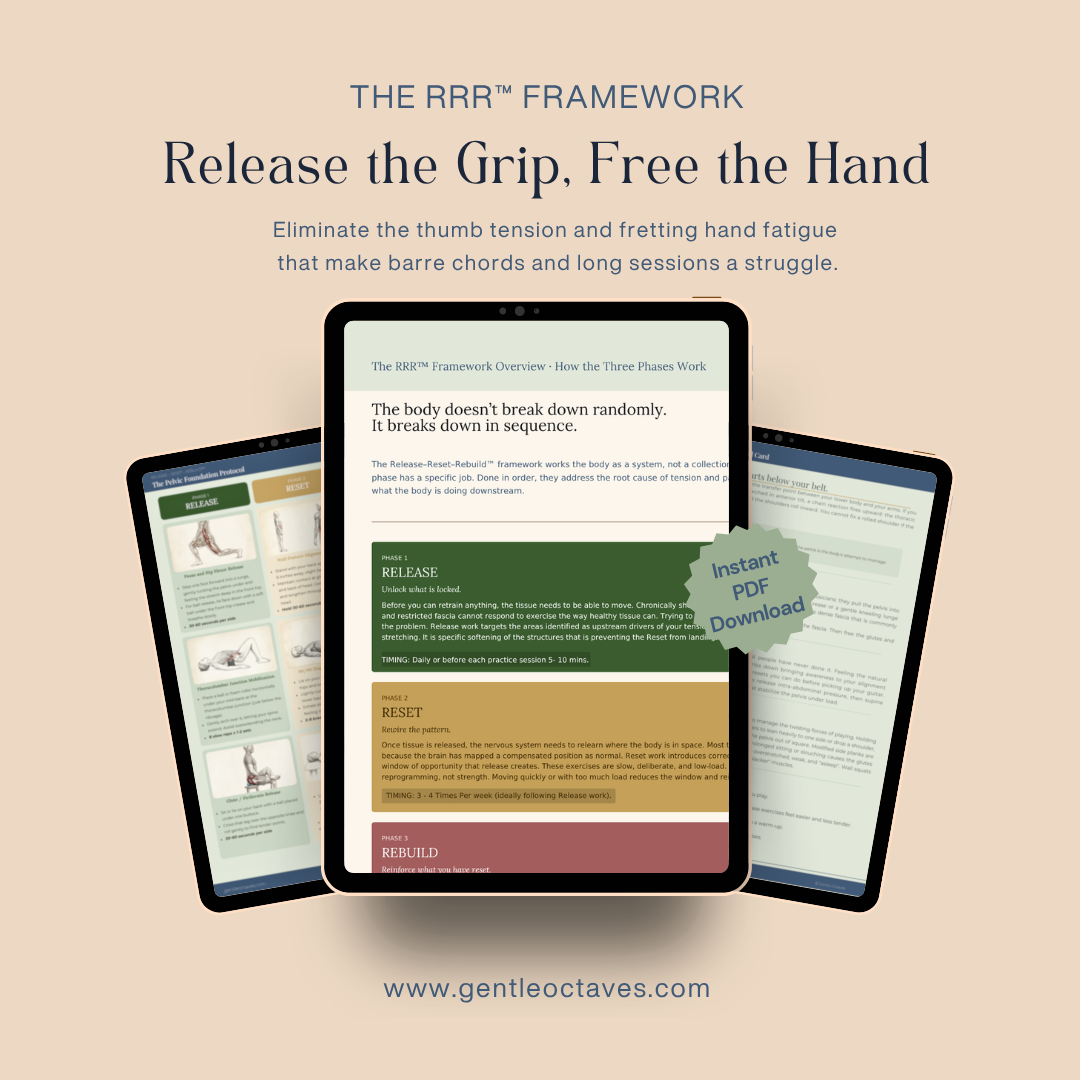
9 exercises to decompress the joint, release the locked forearm driving the pain, and rebuild the stability barre chords demand. 10 minutes. Instant PDF.
"This helped me identify and fix my restrictions which were causing my thumb pain. Easy to follow and the explanations were top class."Thomas, 59 — Manchester
 Get the Protocol →
Want to understand the biomechanics? Keep reading below.

F.P. O'Connor
Manual Osteopath · Guitarist · Movement Nerd
Fergus is a manual osteopath and guitarist who spent nearly two decades watching players quietly give up because nobody gave them a straight answer about why their body was protesting.
→ Download the free Pain-Free Guitar GuideFAQ
Will stopping guitar practice reduce inflammation long-term?
Stopping practice reduces the final input that crosses the pain threshold, but it does not address the background load that was keeping the tissue near-threshold in the first place. Phone grip, desk posture, and sleep position remain unchanged. Most players find that rest provides temporary relief but the inflammation returns quickly when practice resumes, because the underlying load pattern has not changed.
Which daily habits contribute most to guitar-related joint inflammation?
The three highest-impact sources of background load are sustained phone grip in the evening, prolonged keyboard or mouse use at a desk, and compressed or flexed wrist position during sleep. These accumulate across many hours each day. Addressing all three typically has more impact on the tissue's reactivity to playing load than any reduction in practice duration or change in technique.
Is guitar-related joint inflammation the same as arthritis?
They are different conditions, though they can interact. Arthritis involves structural joint changes, while the inflammation described here is a tissue sensitivity state that responds to load management. Players with diagnosed arthritis often find that background load reduction is a meaningful part of managing flare patterns, but the two require separate approaches. If you have a confirmed diagnosis, your treating clinician should be involved in any load management plan.
References
- Zaza, C. Playing-related musculoskeletal disorders in musicians: a systematic review of incidence and prevalence. Canadian Medical Association Journal, 1998. PMC. https://pmc.ncbi.nlm.nih.gov/articles/PMC1229223/
- Rodriguez-Romero, B. et al. Correlations between body postures and musculoskeletal pain in guitar players. Medicina, 2021. PMC. https://pmc.ncbi.nlm.nih.gov/articles/PMC8726467/
- Barr, A.E. et al. Pathophysiological Tissue Changes Associated With Repetitive Movement: A Review of the Evidence. Physical Therapy, 2005. PMC. https://pmc.ncbi.nlm.nih.gov/articles/PMC1550512/
- Aringer, M. et al. Work-related physical strain and development of joint inflammation in the trajectory of emerging inflammatory and rheumatoid arthritis. Rheumatology, 2024. PMC. https://pmc.ncbi.nlm.nih.gov/articles/PMC11015171/