
The Complete Guide to Playing Guitar With Joint Pain

General hand tension and grip fatigue
If your hands tighten up during playing, feel stiff after you put the guitar down, or start to ache partway through a session even without a specific injury, the 5-minute hand reset is a good place to start. It's a warmup protocol designed for blood flow and tissue preparation, not a generic stretch routine.
For something a bit more technical, the Guitarist's Body Blueprint covers how hand mechanics connect to posture, instrument setup, and body mechanics in one place. It's the closest thing on this site to a complete picture of how the playing body works as a system.
Arthritis in the hands
Arthritis doesn't mean you can't play. It means you need smarter load management and a better understanding of what your tissue state is doing on any given day.
The 3 arthritis reset moves are a pre-playing routine specifically for arthritic or reactive hands. Not a generic warmup. A targeted reset that addresses the specific stiffness pattern that tends to build up overnight or after sitting still.
If chord shapes are the main problem, arthritis-friendly guitar chords covers which voicings reduce finger load substantially, and why the standard open-chord shapes that beginners learn are often the hardest on inflamed joints.
Part Two: Shoulder and Neck Pain
Shoulder tension is the most underdiagnosed contributor to hand pain in guitarists. Most players never connect the two.
Why shoulder position matters for hand pain
There's a direct mechanical relationship between how your shoulder sits and how much grip force your hand needs to generate. A restricted shoulder drives compensations through the elbow, forearm, and wrist. By the time the pain shows up in the hand, it's been building from the shoulder for months.
The post on why guitarists develop rounded shoulders covers the postural pattern in detail, including why simply stretching the chest or rolling the shoulders back doesn't fix what's happening at the ribcage level.
For something more targeted, the piece on the left shoulder trap works through the specific tension pattern the fretting arm creates, and the three-minute reset that interrupts it.
Posture and playing position
Posture isn't about sitting straight. It's about loading the playing body in a way that distributes effort across the system rather than concentrating it in the small joints of the hands.
What's the best playing posture for guitarists over 40? covers the body-aware playing position in five practical steps. It's one of the most read posts on this site, and the one I'd send any new adult player to before they picked up a guitar.
If you sit for long sessions, the chair is a bigger variable than most players realise. The best guitar chairs and posture hacks for older players covers seating mechanics, foot position, and the armrest problem in some detail.
Part Three: Gear and Setup
Before technique. Before exercises. Before anything else.
A guitar that is set up badly will fight you. High action forces excess grip. Heavy strings demand more force from already-loaded tendons. The wrong neck profile puts the fretting thumb in a mechanically disadvantaged position from the first chord you play.
These aren't refinements for advanced players. They're the baseline that makes everything else work.
The guitar setup nobody thinks about that reduces tension covers the setup variables that have the most direct impact on playing comfort. It's short and practical.
For players who are already past setup basics and want to look at hardware, 3 gear tweaks that reduce fretting force covers specific equipment changes that reduce the mechanical demand on the fretting hand, including string gauge, action height, and nut slot width. These changes alone have resolved hand pain for players who had been stretching and icing for years with no lasting improvement.
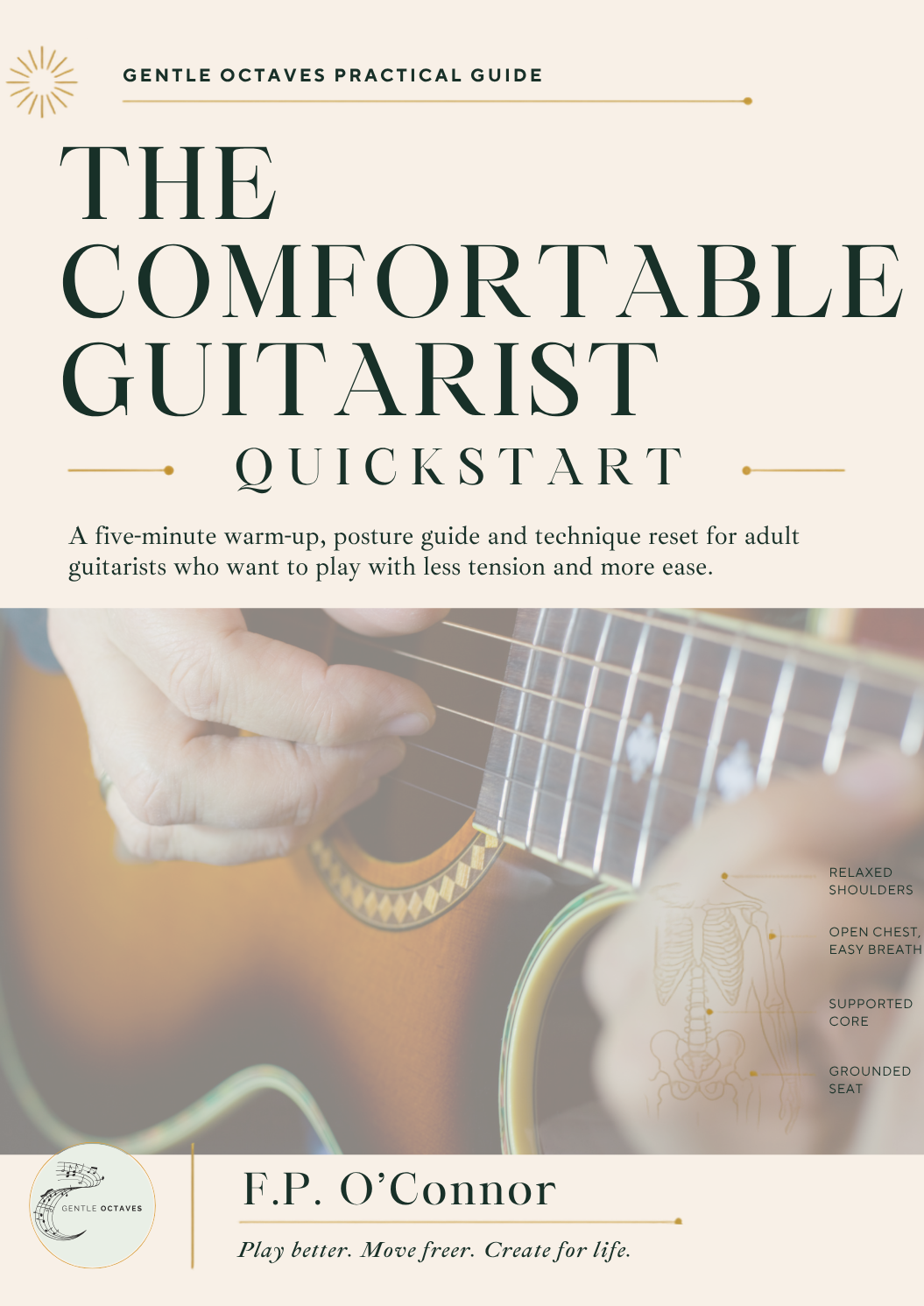
Free 15-page Guitar Comfort Guide
Play with less tension. Keep the music moving.
A short, practical guide to help your body feel more prepared before you pick up the guitar.
- Warm up properly in five minutes
- Find a playing position that feels supported
- Learn the seven pillars of playing posture
No spam. No daily sales sequence. Just practical guidance for keeping music in your life. Unsubscribe at any time.
Part Four: Lifestyle and Inflammation
This is the upstream layer that most guitar-specific content ignores entirely.
The sensitivity of your joints isn't fixed. Systemic inflammation raises the reactivity of your whole tissue chain. The same chord at the same tension can be painless on a well-rested, low-stress day and sharp on a day when your sleep has been poor and you're dehydrated. That's not weakness or age. That's tissue physiology.
Anti-inflammatory habits that actually support your guitar playing covers the lifestyle levers that have the most evidence behind them for reducing joint sensitivity. Sleep is top of that list, ahead of diet and supplements, for a reason that is worth understanding if you're dealing with pain that seems disproportionate to your playing volume.
Part Five: Recovery and Getting Back to Playing
If you're coming back from a period of pain, or from time off the instrument, the rebuild phase matters more than most players give it credit for. Going straight back to your previous repertoire and practice volume is the most reliable way to reload an injury.
Rebuild Stronger: The Guitarist's Recovery System covers the structured return-to-playing process I use, including how to sequence load, what to monitor, and when to stop interpreting discomfort as progress.
If you've been away from the guitar for a long time, A 30-Day Comfort Rebuild is worth reading first. It treats the return as a body mechanics project, not a motivation project.
The Framework Behind All of It
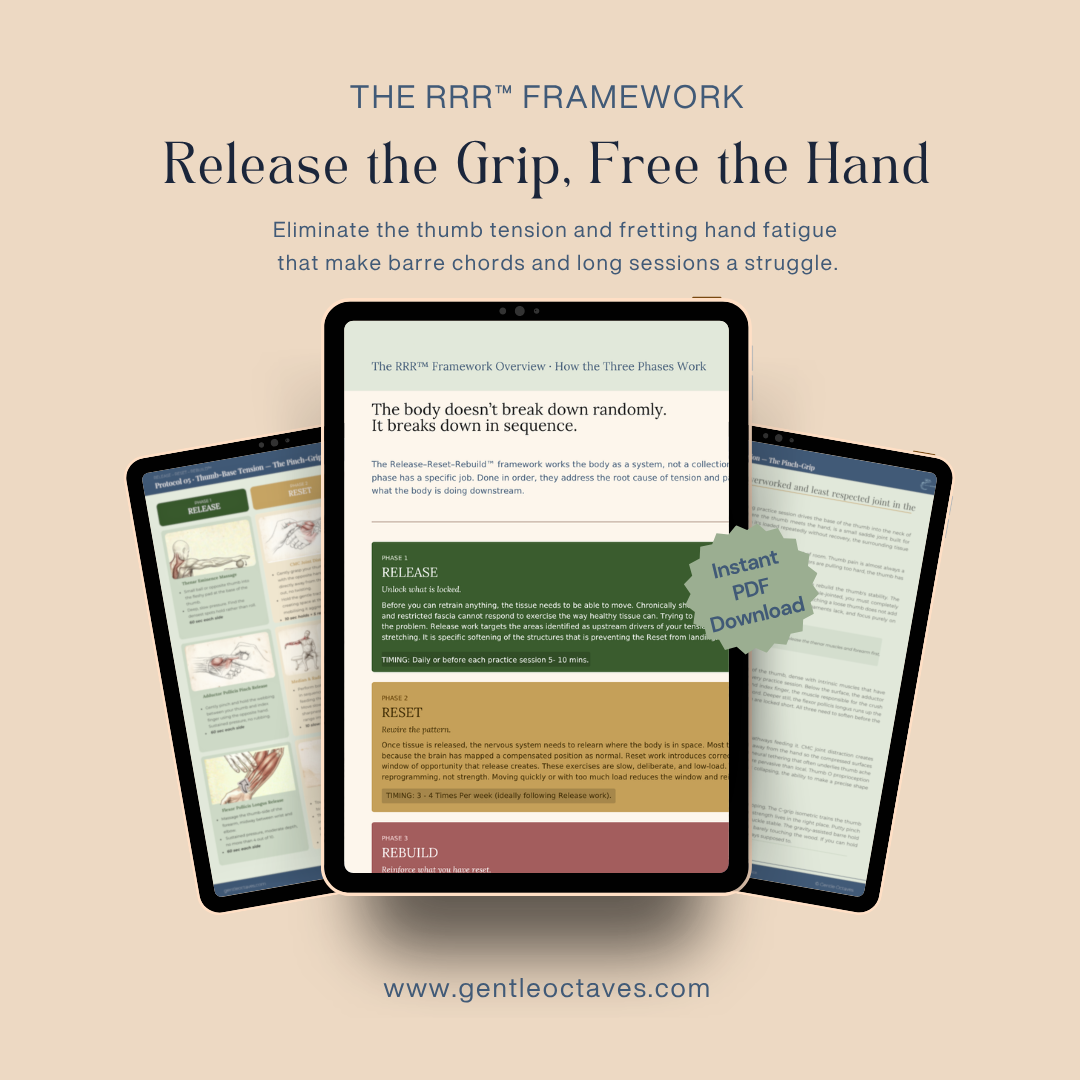
Every post on this site connects back to the same underlying model: Release, Reset, Rebuild.
Release is the first phase. Before you can load tissue effectively, you need to reduce the background tension that's already in the system. That means addressing gripping patterns, postural compression, and anything in your setup that's adding unnecessary force before you even start playing.
Reset is about changing the inputs. Posture, seating, instrument position, equipment. The variables that determine what your tissue is dealing with on every single note.
Rebuild is progressive load. Returning capacity to the joints, tendons, and muscles through graded movement, so that the same playing demands feel progressively easier rather than wearing you down.
The Guitar Comfort System covers the full framework in one post if you want the overview before you go deeper into any one area.
The Thumb Pain Protocol
If you're dealing with thumb or hand pain right now and want something structured to work through, the Thumb Pain Protocol is the place to start. It's a clinical protocol built for the most common presentation of playing-related hand pain in adult guitarists, formatted for home use.

F.P. O’Connor
F.P. O'Connor is a Musician and Movement Specialist whose work is informed by extensive training in Manual Osteopathy, Psychology, and Strength Coaching.
He is the founder of Gentle Octaves, helping adult players develop practical, science-based systems for ease, control, and long-term playing confidence.
Free 15-page Guitar Comfort Guide
Play with less tension. Keep the music moving.
A short, practical guide to help your body feel more prepared before you pick up the guitar.
- Warm up properly in five minutes
- Find a playing position that feels supported
- Learn the seven pillars of playing posture
No spam. No daily sales sequence. Just practical guidance for keeping music in your life. Unsubscribe at any time.
FAQ
Can you still play guitar with arthritis?
Yes, and most players with arthritis can continue playing for years with the right combination of setup modifications, warmup protocols, and load management. The key shift is treating playing as a physical activity that requires preparation rather than an activity you just pick up and do. Instrument setup, specifically action height and string gauge, often makes more difference than any exercise or medication for arthritic hand pain.
What type of guitar is easiest to play with joint pain?
Classical guitars with nylon strings produce the least mechanical demand on the fretting hand. Within steel-string guitars, shorter scale lengths, lower action, and lighter string gauges reduce the force required to fret cleanly. A professional setup on any guitar is the highest-value starting point before switching instruments.
Should I rest when my hands hurt from playing guitar?
Short rest after an acute flare, yes. Prolonged rest alone is rarely the answer. Tendon and joint tissue recovers best through graded movement, not immobilisation. If pain recurs as soon as you return to playing after rest, the underlying load pattern hasn't changed, and rest is masking rather than addressing the problem.
Is guitar playing bad for arthritis?
There's no evidence that gentle, appropriately loaded guitar playing worsens arthritis. The instrument itself is not the problem. Excess grip force, compensatory tension from poor posture or a badly set-up instrument, and rapid increases in practice volume are the variables that tend to aggravate arthritic tissue. Remove those variables and most players find they can continue without meaningful symptom progression.
What's the difference between tendonitis and arthritis pain when playing guitar?
Both can produce aching and stiffness, but they respond differently. Tendon pain tends to be more positional and load-specific, often felt most sharply during particular movements or chord shapes. Joint pain from arthritis is often worse after periods of rest and improves somewhat with gentle movement, then worsens again with sustained load. Both benefit from load management and setup modification. If you're unsure which you're dealing with, a physiotherapist or manual therapist who works with musicians is worth one session.
References
- Zaza, C. (1998). Playing-related musculoskeletal disorders in musicians: a systematic review of incidence and prevalence. Canadian Medical Association Journal, 158(8), 1019–1025. https://www.ncbi.nlm.nih.gov/pmc/articles/PMC1229068/
- Abreu-Ramos, A.M., & Micheo, W.F. (2007). Lifetime prevalence of upper-body musculoskeletal problems in a professional-level symphony orchestra: age, gender, and instrument-specific results. Medical Problems of Performing Artists, 22(3), 97–104. https://pubmed.ncbi.nlm.nih.gov/17987191/
- Brandfonbrener, A.G. (2003). Musculoskeletal problems of instrumental musicians. Hand Clinics, 19(2), 231–239. https://pubmed.ncbi.nlm.nih.gov/12852665/
- Norris, R.N. (1996). Return to play after injury: strategies to support a musician's recovery. Work, 7(2), 89–93. https://pubmed.ncbi.nlm.nih.gov/24441688/