
The 60-Second Thumb Reset You Can Do Without Putting the Guitar Down

There's a pattern worth naming before you try any of the usual fixes.
You notice the tension in your thumb, so you stop playing, shake your hand out, stretch it back a bit, maybe do a few slow wrist circles. It loosens. You pick the guitar back up and within two minutes, sometimes less, the same tightness is back.
The reason this keeps happening isn't that the stretch is wrong. It's that the stretch is aimed at the wrong problem. What you're experiencing is a gripping reflex, not simple muscle fatigue.
The hand has learned that guitar-playing time is effort time, and it responds by bracing. Thumb contact increases, the thenar muscles engage without being asked, and the whole thing runs on neurological autopilot.
Passive stretching doesn't interrupt a reflex. It releases tension in the tissue for a moment, but the reflex reinstates itself the second you start playing again. You'd need to stretch continuously to outrun it, which isn't a strategy.
What does interrupt a gripping reflex is a deliberate, slow counter-movement: something that sends a clear signal to the nervous system that the grip is no longer required. This is a different mechanism from stretching. It's more like pressing a reset button than loosening a tight rubber band.
This is something I see often in players who've been at it for years. The bracing pattern gets so well-established that the thumb grips even during easy material, even during passages that genuinely don't need it. By that stage, shaking out won't touch it. The hand will just pick up where it left off.
The reset below works through the reflex rather than around it. You can do it mid-practice, guitar still in your lap.
Step 1: Let the thumb completely leave the neck.
Not a hover. Full contact broken, thumb hanging free. Rest your forearm on the body of the guitar so the hand stays roughly in position but nothing is gripping. Take three or four slow breaths here, long enough that the hand genuinely has no task to do. If you find you're still holding tension through the fingers, that's useful information: the bracing pattern often goes wider than the thumb.
Step 2: Introduce a slow opposition movement.
Bring the tip of your thumb to meet the pad of your little finger. No pressure, just contact. Then slowly let it drift back to a resting position. Repeat three times, moving at about half the speed you think is necessary.
This isn't a stretch. You're not trying to lengthen anything. You're asking the nervous system to move through a pattern deliberately, under no load, at a pace slow enough that it doesn't trigger the defensive reflex again. The difference in effect between doing this slowly and doing it quickly is significant and worth testing for yourself.
Step 3: Return the thumb to the neck without gripping.
Place it back as though you're resting it there, not anchoring. Let the fretting fingers settle on the strings without any chord shape yet. Sit in that position for a few seconds before you play anything.
Notice: when you do start playing again, is there a moment before the grip reinstates? It might only be a few seconds. That gap is what you're training. Each time you run the reset, you're lengthening it.
The goal isn't a thumb that floats off the neck. Most styles of guitar playing require thumb contact, and some require fairly consistent pressure. The goal is contact that matches what the music actually asks for, and nothing more. The difference between a gripping thumb and a resting thumb is often only a few millimetres and a few grams of pressure, but that distinction, over an hour of practice, is the difference between pain and no pain.
A practical note on timing: the reset works best used early, at the first sign of building tension rather than after it's fully established. Once the reflex is in full pattern it will still respond, but you'll need to run the reset more than once. Catching it early is more efficient.
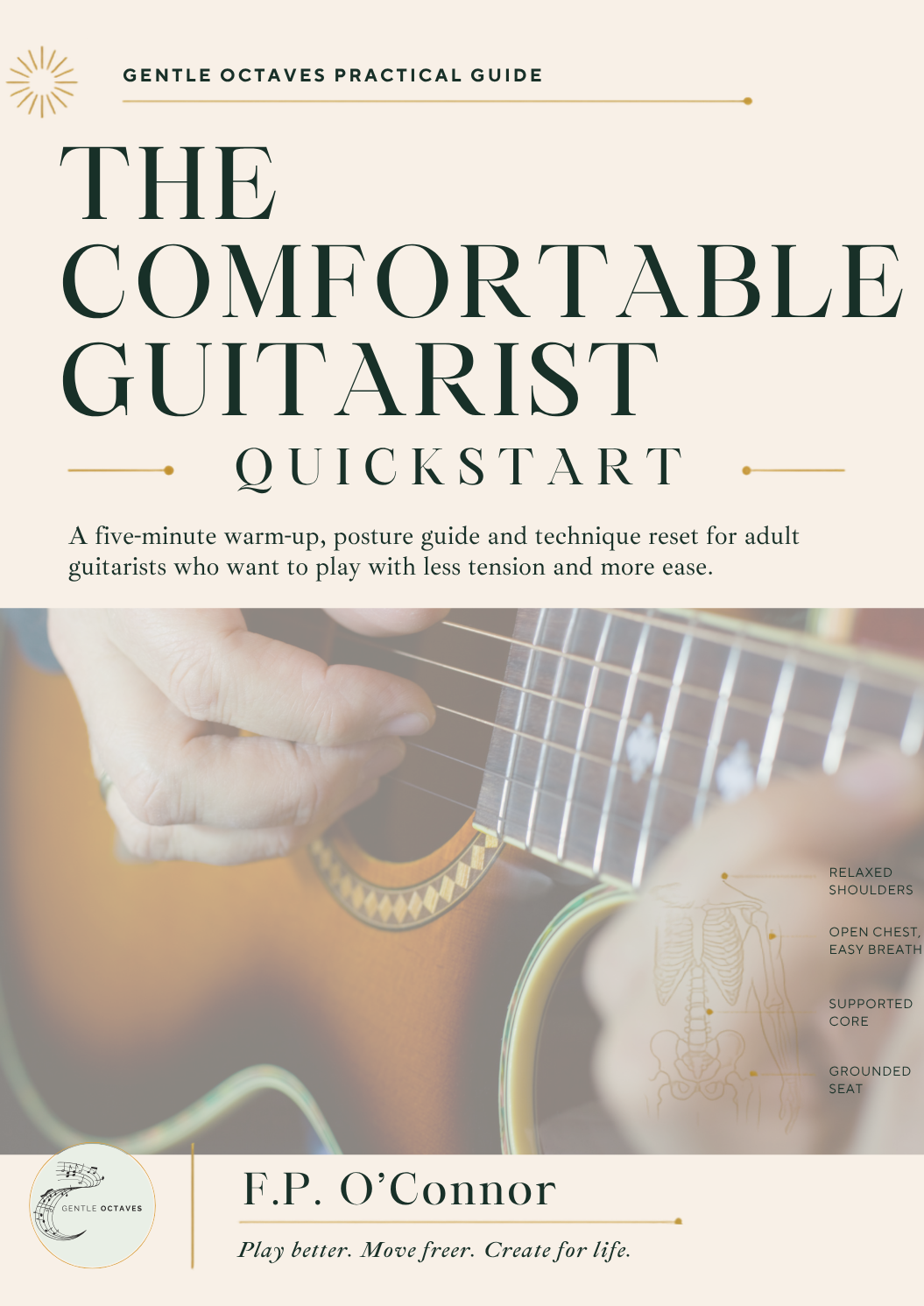
Free 15-page Guitar Comfort Guide
Play with less tension. Keep the music moving.
A short, practical guide to help your body feel more prepared before you pick up the guitar.
- Warm up properly in five minutes
- Find a playing position that feels supported
- Learn the seven pillars of playing posture
No spam. No daily sales sequence. Just practical guidance for keeping music in your life. Unsubscribe at any time.
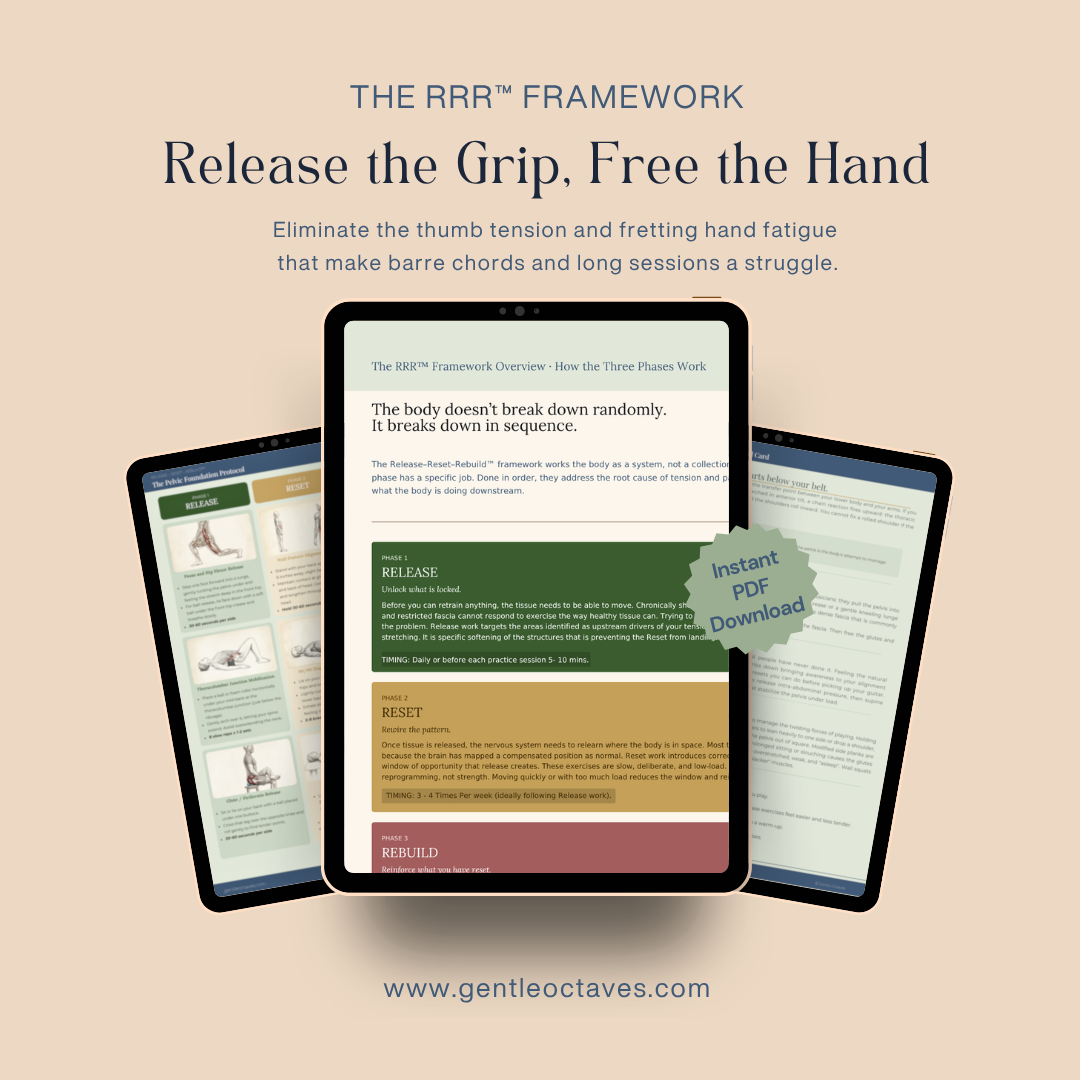
Experiencing thumb pain right now?
Stop the ache at the base of your thumb before your next session.
9 exercises to decompress the joint, release the locked forearm driving the pain, and rebuild the stability barre chords demand. 10 minutes. Instant PDF.
"This helped me identify and fix my restrictions which were causing my thumb pain. Easy to follow and the explanations were top class."Thomas, 59 — Manchester
 Get the Protocol →
Want to understand the biomechanics? Keep reading below.
One more thing worth knowing. If the reset helps but the tension reinstates quickly and consistently regardless of how early you catch it, something upstream is usually contributing. Shoulder restriction, thoracic stiffness, even the angle your guitar sits at can keep the hand in a low-level defensive state that no amount of thumb work will fully address. The kinetic chain piece is worth reading if that sounds familiar: Your Thumb Pain Starts in Your Shoulder.
If the pain is more specific to the base of the thumb joint under load during barre chords, that's a different presentation and worth approaching differently.
The full thumb protocol, including how this reset fits into longer practice sessions and what to do if the pattern is well-established, is in Keep Playing: https://payhip.com/b/ItW5E

F.P. O'Connor
Manual Osteopath · Guitarist · Movement Nerd
Fergus is a manual osteopath and guitarist who spent nearly two decades watching players quietly give up because nobody gave them a straight answer about why their body was protesting.
→ Download the free Pain-Free Guitar Guide