The Minimum Pressure Drill That Doubled My Practice Time

I was strangling the fretboard.
Not metaphorically. Literally gripping it like I was trying to choke the sound out of the strings. A pure white-knuckle situation on every chord change.
And I had no idea I was doing it until someone watched me play and said, "Why are you pressing so hard?"
I wasn't trying to. It just felt... necessary I guess? . Like if I didn't grip hard, the notes wouldn't ring clean.
Turns out I was using about three times more pressure than I actually needed. And that extra force was burning through my hand's capacity in twenty minutes instead of an hour.
This one drill changed that. Not overnight. But within two weeks, I could practice twice as long without my hands giving out.
Minimum Pressure Drill SummaryInteractive artifact
Why Over-Gripping Kills Your Endurance
Here's what nobody mentions about fretting pressure: you only need about 1-2 pounds of force to get a clean note. Most guitarists use 5-8 pounds.
That extra 4-6 pounds per finger doesn't improve your sound. It just burns through your hand's capacity faster.
Think about it mathematically. If you're playing a passage with 100 notes, and each note requires 5 pounds of unnecessary force, that's 500 pounds of wasted work your hand is doing. No wonder it fatigues in twenty minutes.
When you learn to use minimum effective pressure, you're not making your playing weaker. You're making it efficient. And efficient means sustainable.
The Science Bit (But Quick)
Your hand muscles work on a load-to-capacity ratio. They can generate a certain amount of total force before they fatigue and need recovery.
Every bit of excess pressure you use eats into that capacity doing work that doesn't contribute to the music. It's like running with a weighted vest when you're training for distance, not strength.
The goal isn't to build stronger hands (though that can help). The goal is to stop wasting the capacity you already have on unnecessary force.
This drill retrains your nervous system to recognize what "enough" actually feels like. Because right now, your brain thinks heavy pressure = secure notes. We're teaching it that light pressure = secure notes if applied precisely.
How to Actually Do This
Session 1: Finding Your Baseline
Start with one note. I usually use 3rd fret on the G string because it's easy to reach and hear clearly.
Place your finger on the string with zero pressure. Don't press at all. Pluck the string. You'll get a dead, buzzing sound.
Now, press down extremely slowly. Gradually increase pressure until the note just barely rings clear. No buzz, no dead sound, just a clean note.
That moment: when it transitions from buzz to clear, that's your minimum effective pressure. Remember what that feels like.
Now lift your finger completely. Press again, trying to hit that same pressure point immediately. You probably won't. That's fine you're just calibrating at this stage.
Do this 10 times on the same note. Lift, press to minimum, check. Lift, press to minimum, check.
Session 2-7: Scales at Minimum Pressure
Once you can consistently find minimum pressure on a single note, apply it to a scale. Start simple maybe a C major, one octave, whatever you know well.
Play it slowly. I mean really slowly. One note every 2-3 seconds. Focus entirely on using the lightest pressure that produces a clean sound.
If a note buzzes, you went too light. Add a tiny bit more pressure. If your hand feels tense, you're gripping too hard. Back off.
Trust me, this will feel weird. It might feel insecure, like the notes aren't "locked in." That's your nervous system resisting the change because light pressure feels unfamiliar.
Keep going. Five minutes per session, twice a day. Morning and evening if possible.
Session 8-14: Chords
Now apply it to chords. Pick an open chord: G major, C major, whatever you play regularly.
Press each finger down to minimum effective pressure, one at a time. First finger, find the lightest pressure that works. Second finger, same thing. Third finger, same.
Now strum the chord. Any buzzing? Adjust that finger slightly. The goal is all fingers using minimum pressure simultaneously.
This is harder than single notes because you're coordinating multiple points of pressure at once. But it's where the real endurance gains happen.
Do this with 3-4 chords per session. Slow, deliberate, focused entirely on light pressure.
What Changes (And When)
Week 1: You'll probably feel frustrated. Light pressure feels weird and insecure. Your notes might buzz more than usual. That's normal. You're unlearning years of over-gripping.
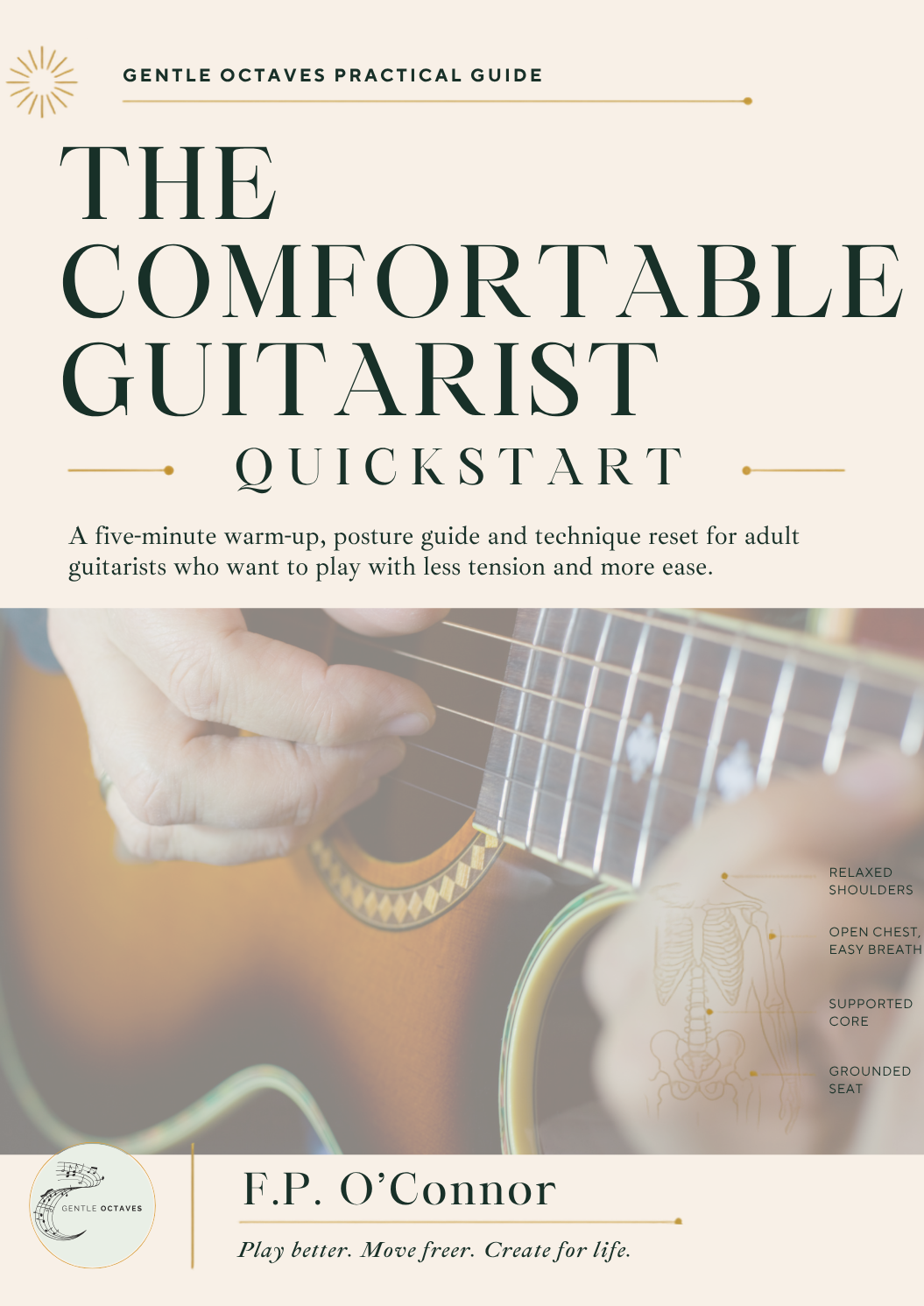
Free 15-page Guitar Comfort Guide
Play with less tension. Keep the music moving.
A short, practical guide to help your body feel more prepared before you pick up the guitar.
- Warm up properly in five minutes
- Find a playing position that feels supported
- Learn the seven pillars of playing posture
No spam. No daily sales sequence. Just practical guidance for keeping music in your life. Unsubscribe at any time.
Week 2: You start to find the pressure point more consistently. The notes ring clean with less force more often. Your hand might feel less tired after practice, but you're not sure if it's the drill or placebo.
Week 3-4: This is where it clicks. You notice you can play for longer before fatigue sets in. Not dramatically longer, but measurably. Maybe you go from 20 minutes to 35 minutes before your hand starts complaining.
Week 6-8: Minimum pressure becomes your default. You don't think about it as much. Your hand just uses less force automatically. And your practice sessions? 60+ minutes without the fatigue that used to show up at 20.
That's the trajectory for most people who stick with it.
Common Mistakes (And How to Avoid Them)
Mistake 1: Going too fast
If you're playing at normal tempo, you can't focus on pressure control. Slow down. Way down. This drill only works if you're moving slowly enough to actually feel what you're doing.
Mistake 2: Doing it once and expecting change
One session won't reprogram years of over-gripping. You need consistent repetition. Twice daily for at least two weeks. That's the minimum for nervous system retraining.
Mistake 3: Only practicing the drill, never applying it
The drill teaches the skill. But you have to apply the skill to actual playing. After your drill session, play something you know and consciously try to use lighter pressure. That's where it integrates.
Mistake 4: Expecting it to feel "right" immediately
It won't. Light pressure feels insecure and weird for the first week or two. Your nervous system is used to heavy pressure = safe. You're teaching it light pressure = precise. That takes time.
The Integration Phase
After two weeks of dedicated drill work, start integrating minimum pressure into your regular practice.
Pick one song or exercise per session and play it with deliberate focus on light pressure. Not the whole session just one piece. The rest of your practice can be normal.
Each week, add one more piece to your "minimum pressure" rotation.
Within a month, light pressure should start feeling normal instead of effortful. And your endurance? You'll notice you're not thinking about hand fatigue as much because it's not showing up as early.
When This Doesn't Work
Right, so this drill assumes your action (string height) is set properly. If your action is too high, you genuinely need more pressure to fret cleanly, and light pressure will just create buzz.
Get your guitar set up properly first. Action as low as possible without fret buzz. Then this drill becomes effective.
Also, if you've got arthritis or joint issues that limit finger strength, minimum pressure might still be more than your hands can sustain.
In that case, the solution is lighter strings, lower action, and possibly a different guitar altogether. The drill helps with technique, but it can't override physical limitations.
Try It Today
You don't need to commit to the whole two-week protocol right now. Just try Session 1.
Pick a note. Find the minimum pressure that makes it ring clean. Lift and repeat 10 times.
That's it. Five minutes max.
If you notice that you're using way more pressure than you thought, you've just identified why your hands fatigue so quickly.
And now you know how to fix it.
Put your guitar down. Open and close your fretting hand slowly 5 times. Notice any tightness? That's residual grip tension. Shake it out. Your hand just told you it's been working harder than it needs to.

F.P. O'Connor
Manual Osteopath · Guitarist · Movement Nerd
Fergus is a manual osteopath and guitarist who spent nearly two decades watching players quietly give up because nobody gave them a straight answer about why their body was protesting.
→ Download the free Pain-Free Guitar GuideF.A.Q.
How light is too light?
If the note buzzes consistently, you're too light. Minimum pressure means the lightest force that produces a clean sound every time.
Should this feel easy?
No. It should feel awkward and insecure for the first week or two. That's your nervous system adjusting to a new baseline. If it feels comfortable immediately, you're probably not using light enough pressure.
Can I do this on electric and acoustic?
Yes, but electric guitars typically require less pressure due to lower action. You might find different minimum pressures for different guitars. That's normal—adapt to each instrument.
What if my thumb starts hurting?
You're probably compensating for lighter finger pressure by gripping harder with your thumb. Relax your thumb too. It should provide gentle counter-pressure, not a vice grip.
Does this work for barre chords?
Yes, but barre chords are advanced. Master it on single notes and open chords first, then apply it to barres. The principle is the same—use the minimum pressure that makes all notes ring cleanly.