
Why Your Thumb Hurts at the Base When You Play Guitar (And What to Do Without Stopping)

The short version
Why Your Thumb Hurts at the Base When You Play Guitar (And What to Do Without Stopping)
Pain at the base of the thumb is one of the most common complaints in guitarists over 40, and most players manage it at the wrong level. The thumb is usually where the problem shows up, not where it starts.
What this covers
- What the CMC joint is and why guitarists load it differently than most people
- How barre chord technique and arm position directly affect thumb compression
- The difference between inflammatory pain and load-pattern pain
- Three adjustments that reduce CMC joint load without changing your sound
- When a thumb splint helps and when it doesn't
The core truth
If your thumb only hurts during certain chord shapes or positions, that's information. It means there's a load problem to solve, not just inflammation to suppress.
If your thumb pain is specific to barre chords, the problem almost certainly isn't the thumb.
Experiencing thumb pain right now?
Stop the ache at the base of your thumb before your next session.
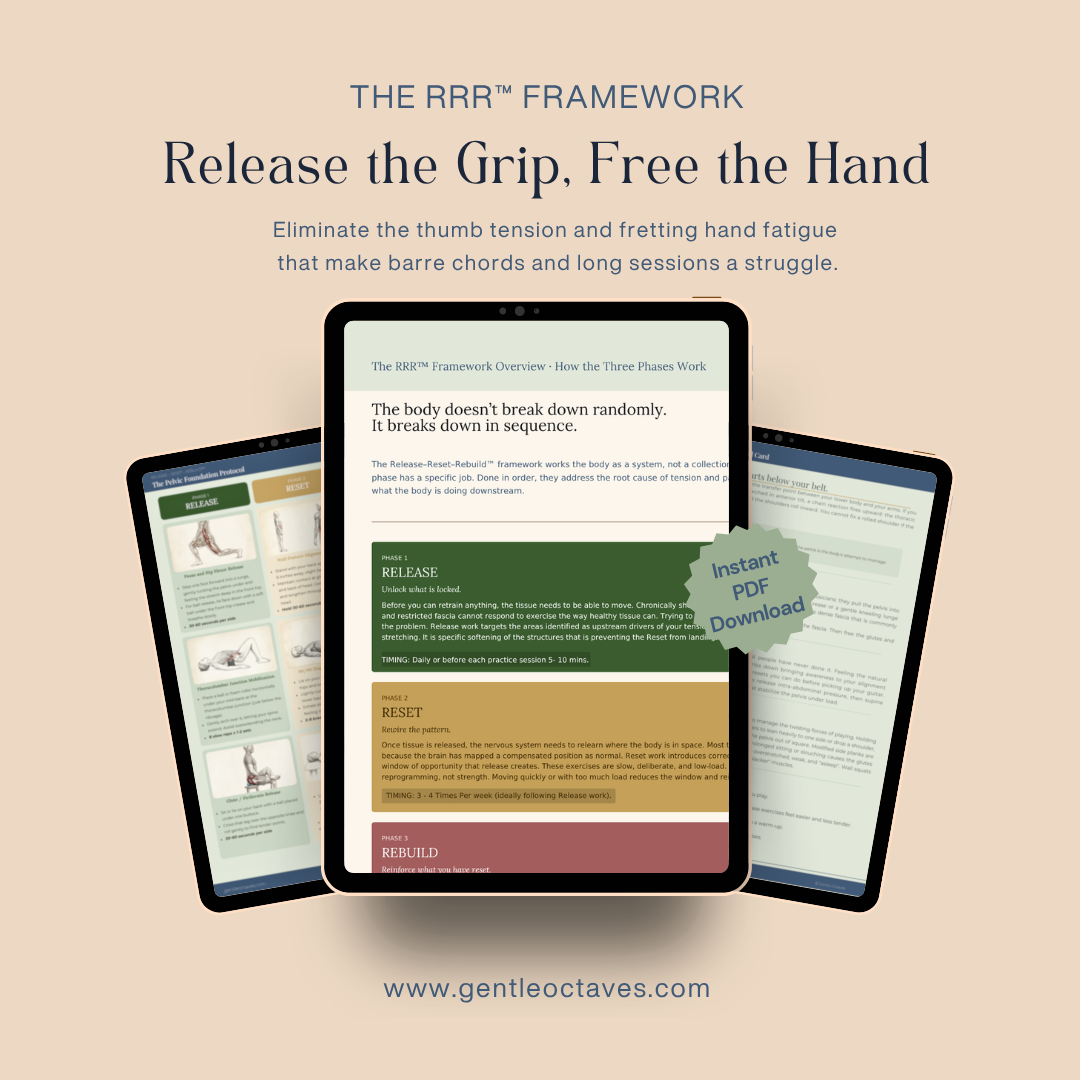
9 exercises to decompress the joint, release the locked forearm driving the pain, and rebuild the stability barre chords demand. 10 minutes. Instant PDF.
"This helped me identify and fix my restrictions which were causing my thumb pain. Easy to follow and the explanations were top class."Thomas, 59 — Manchester
 Get the Protocol →
Want to understand the biomechanics? Keep reading below.
The thumb is where you feel it. But the load that drives CMC joint compression in guitarists typically comes from further up the chain: from arm position, elbow height, the way the shoulder girdle is or isn't doing its share of the work. Before you reach for a splint or a tube of diclofenac gel, it's worth asking what's actually driving the compression in the first place.
What is thumb arthritis in guitarists? Thumb base pain in guitarists typically involves the carpometacarpal (CMC) joint, where the thumb bone meets the wrist. In players over 40, osteoarthritis or early cartilage wear can make pinching and gripping painful. Playing technique, arm position, and shoulder support all affect how much load the CMC joint absorbs, often more than the arthritis itself.
That distinction matters. A lot of the advice floating around guitar forums treats thumb arthritis as something you manage in isolation: rest, ice, maybe a brace, lower your action, switch to lighter strings. None of that is wrong, exactly. But it frames the problem as a local tissue issue, and for the majority of guitarists I've seen with CMC pain, it isn't only that.
What the CMC Joint Actually Is
The carpometacarpal joint sits at the base of your thumb, where the first metacarpal bone meets the trapezium bone in the wrist. It's a saddle joint, which means it's built for range of motion: you can move the thumb across, away, in a circle, in opposition to your fingers. It's what makes the thumb uniquely human.
The trade-off for all that mobility is stability. A saddle joint tolerates compression poorly when it's loaded off-axis. When everything is aligned and the load is distributed properly, it holds up well. When the thumb is bracing, stabilising, compensating for something the arm or shoulder should be doing, the joint surface takes compressive force it wasn't designed to absorb repeatedly.
Over years of playing, that adds up. In some players it progresses to osteoarthritis: cartilage wears, the joint space narrows, pinching becomes painful, and in later stages, a small bony prominence can develop at the base of the thumb.
Free 15-page Guitar Comfort Guide
Play with less tension. Keep the music moving.
A short, practical guide to help your body feel more prepared before you pick up the guitar.
- Warm up properly in five minutes
- Find a playing position that feels supported
- Learn the seven pillars of playing posture
No spam. No daily sales sequence. Just practical guidance for keeping music in your life. Unsubscribe at any time.
What the medical descriptions of CMC arthritis don't cover is this: the degree of load placed through that joint during guitar playing is directly influenced by technique and body mechanics. Two guitarists with identical X-rays can have very different experiences, because one is compressing the joint with nearly every chord they play and the other isn't.
Why Barre Chords in Particular
Open chords don't usually aggravate CMC arthritis much. The thumb in an open chord position is relatively relaxed, often resting lightly against the back of the neck, not gripping.
Barre chords change that equation significantly.
When you form a barre chord, the index finger has to apply sustained pressure across multiple strings while the thumb provides a counter-force from behind the neck. In good barre chord mechanics, that counter-force is modest, almost incidental. The arm, elbow, and shoulder position mean the finger can press efficiently without the thumb needing to brace hard against the neck.
In the pattern I see most often, the elbow has dropped, the forearm is over-pronated, and the wrist has come up and around in an effort to get the finger across the frets. In that position, the index finger is approaching the strings at an inefficient angle and needs more pressure to sound the chord cleanly. The thumb compensates by gripping harder. The CMC joint absorbs that grip load every time you move through a chord progression.
It's not a technique problem in the sense of the player doing something obviously wrong. It's a mechanics pattern that's very common, especially when people are playing acoustic guitars with higher action, or when they haven't yet found the arm and shoulder position that makes barre chords feel easier.
The tension patterns in guitarists over 40 that show up with barre work almost always have an elbow and shoulder component that's being ignored.
The Upstream Connection Most Players Miss
Here's the part that doesn't appear in guitar forums or on the CMC arthritis pages at medical websites.
The shoulder girdle and thoracic spine have a direct relationship with how much load the thumb absorbs.
When there's restriction through the mid-back and reduced mobility in the shoulder complex, the arm can't position itself efficiently to support barre chord technique.
The body finds a workaround: the elbow drops further, the wrist compensates, and eventually the thumb becomes the primary load-bearing structure in the grip.
This is a proximal-to-distal pattern. The restriction isn't at the thumb. It's upstream. But the thumb is the joint that fails.
A player who comes in with classic CMC arthritis pain, nearly always has some degree of thoracic stiffness and reduced shoulder mobility on the affected side. Addressing only the thumb is like managing a sore knee without ever looking at hip mobility. You can reduce symptoms temporarily, but the loading pattern doesn't change.
This is why two moves that don't involve your hand at all, shoulder mobilisation and thoracic extension, can produce an immediate and measurable reduction in the grip force required to play barre chords.
Two Different Problems That Feel the Same
Not all thumb base pain in guitarists is the same, and the distinction matters for how you approach it.
Inflammatory pain is the pain of an irritated joint. It tends to be present at rest, worse in the morning, accompanied by some swelling or warmth at the base of the thumb. This kind of pain needs tissue rest first. Playing through it in this state loads an already reactive joint. This is when bracing, anti-inflammatories, and time off make sense.
Load-pattern pain shows up only when you play, only with certain chord shapes, and tends to ease off within minutes of stopping. The joint isn't inflamed. It's being mechanically overloaded during a specific movement pattern. This kind of pain does not primarily need rest. It needs a mechanics change.
Treating load-pattern pain with rest alone is frustrating because you come back to the guitar and the pattern is still there. Treating inflammatory pain with a technique adjustment alone is also frustrating, for the obvious reason that the tissue isn't ready.
Most guitarists have a bit of both, and the proportions shift over time. The skill is in reading which mode you're currently in.
Three Adjustments That Reduce CMC Load
These aren't stretches or strengthening exercises. They're position changes to test while playing. Each one removes load from the thumb by redistributing it elsewhere.
1. Raise the elbow slightly on barre chord positions.
Let the elbow drift out from the body by a few centimetres. This changes the approach angle of the index finger, reducing the diagonal contact that requires compensatory thumb pressure. A lot of players find the barre sounds cleaner immediately, before the thumb has any time to adjust.
2. Check the shoulder on the fretting side.
Is it dropped, or is it pulled down and back so it's doing nothing? A shoulder with mild active engagement distributes some of the arm's weight through the torso rather than letting it hang and drag the elbow down. This is subtle. You're not bracing the shoulder up. You're keeping it from entirely collapsing under the weight of the arm.
3. Reduce thumb contact area during barre chords.
Many players brace the thumb flat against the neck, which feels more stable but actually increases the compression force at the CMC joint. Bringing the thumb slightly more upright so only the pad makes contact rather than the full lateral surface can reduce joint load noticeably. This takes some time to feel natural, but it's worth the adjustment period.
None of these changes will override advanced arthritis. But for load-pattern pain in early to moderate presentations, they change where the force is going.
On Thumb Braces
A rigid CMC brace immobilises the joint. It's appropriate for an inflammatory flare: it gives the joint rest when playing through that period would worsen things. Most players with CMC arthritis will benefit from having one available for acute episodes.
The limitation is that a rigid brace can't stay on while you play, and a soft support brace while playing is a temporary crutch rather than a solution if the underlying load pattern hasn't changed.
There's also a subtler issue: prolonged bracing can reduce proprioception at the joint, which means the thumb becomes less accurate at gauging how much force it's applying. This can paradoxically lead to more loading when the brace comes off, not less. A brace is a tool for a specific phase. It's not a long-term management strategy.
The arthritis-friendly chord adaptations covered here are more durable than bracing for ongoing playing, because they change the mechanical demand rather than just protecting the joint from it.
And if you're managing the pre-play window, the arthritis reset routine is worth doing before you make any technique changes, because it reduces baseline stiffness and gives you more accurate feedback on how the joint is responding.
When to See Someone
CMC arthritis is progressive and irreversible in the sense that cartilage doesn't regenerate. But the rate of progression is highly variable, and symptoms don't track linearly with X-ray findings.
Some players with significant radiographic changes have manageable pain. Others with relatively early changes have significant functional limitation.
See a hand therapist or your GP if:
- Pain is present at rest or consistently waking you at night
- The base of the thumb is visibly swollen or warm to the touch
- Grip strength has reduced noticeably over a short period
- You're relying on anti-inflammatories regularly to get through a practice session
- You've noticed a small bony bump developing at the base of the thumb
Free 15-page Guitar Comfort Guide
Play with less tension. Keep the music moving.
A short, practical guide to help your body feel more prepared before you pick up the guitar.
- Warm up properly in five minutes
- Find a playing position that feels supported
- Learn the seven pillars of playing posture
No spam. No daily sales sequence. Just practical guidance for keeping music in your life. Unsubscribe at any time.
A certified hand therapist, specifically, is worth finding if this is limiting your playing. They can assess the joint stage, fit a proper brace if needed, and give you exercises appropriate to where you actually are, which is more useful than anything generic.

F.P. O'Connor
Manual Osteopath · Guitarist · Movement Nerd
Fergus is a manual osteopath and guitarist who spent nearly two decades watching players quietly give up because nobody gave them a straight answer about why their body was protesting.
→ Download the free Pain-Free Guitar GuideIf thumb pain is one of the reasons you're playing less than you want to, the Keep Playing guide covers hand and wrist management within the full Release-Reset-Rebuild approach. It was written for players in exactly this situation: https://payhip.com/b/ItW5E
Frequently Asked Questions
Why does my thumb hurt at the base when I play barre chords but not open chords?
Open chords place relatively light demand on the CMC joint. Barre chords require a sustained counter-force from the thumb while the index finger presses across multiple strings. If your arm and elbow position mean the index finger is approaching at an inefficient angle, the thumb compensates by gripping harder, and the CMC joint absorbs that load. The pain being specific to barre chords is useful information: it points to a load pattern, not just a tissue problem.
Can I keep playing guitar if I have thumb arthritis?
In most cases, yes, with some adjustments. The key distinction is whether you're in an inflammatory flare (rest is appropriate) or dealing with a load-pattern issue (mechanics change is appropriate). Many players continue playing for years with CMC arthritis by managing action, string gauge, chord voicing, and arm mechanics. Complete rest is rarely the right long-term answer.
Does a thumb brace help with guitar playing?
A rigid brace helps during an inflammatory flare by resting the joint. It's not practical while playing. A soft support brace can be worn during playing, but it doesn't change the mechanics driving the problem. Bracing alone, without addressing upstream load patterns and technique, typically manages symptoms short-term without resolving the underlying issue.
What's the difference between thumb arthritis and thumb tendinitis in guitarists?
CMC arthritis involves the joint itself: cartilage wear and, over time, joint space narrowing. The pain is typically at the very base of the thumb, often described as deep. De Quervain's tendinopathy is a tendon issue affecting the extensor pollicis brevis and abductor pollicis longus, producing pain more along the side of the thumb extending toward the wrist. The two can coexist. A grind test (passive rotation of the thumb under compression) positive for pain or crepitus suggests CMC joint involvement. Pain with resisted extension and on Finkelstein's test suggests tendon involvement.
Should I stop playing guitar if my thumb joint hurts?
A short break is appropriate if the joint is acutely inflamed. But extended rest isn't recommended as a primary strategy for CMC arthritis: the joint benefits from controlled, low-load movement, and complete rest can allow surrounding musculature to weaken, which reduces the joint's mechanical support. The goal is to identify the specific load pattern that's driving the pain and modify it, not to stop playing.
References
- Sodha S, Ring D, Zurakowski D, Jupiter JB. Prevalence of degenerative trapeziometacarpal arthritis in patients with symptomatic carpal tunnel syndrome. J Bone Joint Surg Am. 2005;87(8):1765-1769. https://pubmed.ncbi.nlm.nih.gov/16085614/
- Portnoy S, Cohen S, Ratzon NZ. Correlations between body postures and musculoskeletal pain in guitar players. PLoS One. 2022;17(1):e0262207. https://pmc.ncbi.nlm.nih.gov/articles/PMC8726467/
- Diagnosis and Treatment of De Quervain Tenosynovitis. StatPearls. NCBI Bookshelf. https://www.ncbi.nlm.nih.gov/books/NBK526096/
- Glickel SZ, Gupta S. Ligament reconstruction. Hand Clin. 2006;22(2):143-151. PubMed PMID: 16600184. https://pubmed.ncbi.nlm.nih.gov/16600184/